
Tension rises between Iraq and Kurdish autonomy, Turkey concerned
By Sara Rajabova
In further escalation of tension, Iraq and its semi-autonomous Kurdish region have reinforced military presence along their separation line, Iranian Press TV channel reported on Friday.
Officials from both sides convened on Thursday to break the impasse, but little progress was made, Reuters reported.
The clashes between Iraqi government forces and armed groups of the Kurdish autonomy on Monday left 12 Iraqi army soldiers and one civilian dead.
The clashes reportedly took place near the Tigrit town, which is under the control of the central government, over the Kurdish administration head Massoud Barzani's order not to allow the central government's troops into the autonomy's territory.
The Iraqi Kurdistan's president met with the Iraqi parliament speaker, Usama al-Nujayfi, and promised to "open the door" to talks.
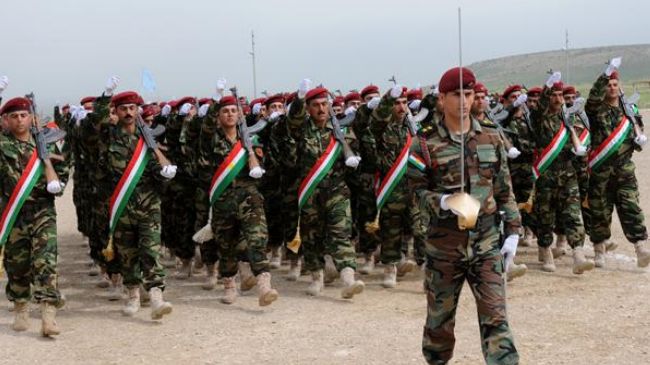
Recently, thousands of Peshmarga troops, the Kurdistan Regional Government's (KRG) security force, were dispatched to Kirkuk, one of the provinces claimed by both the KRG and the central government, following the deployment there of the Dijla Operations Command, which was formed by Iraqi Prime Minister Nouri al-Maliki in June. On Friday, a shootout between Iraqi police and Kurdish guards in a disputed northern city left a civilian dead and four policemen wounded.
Maliki has told Kurdish troops to stay away from the government forces, deployed in the flashpoint town of Tuz Khurmatu, located 88 kilometers (close to 55 miles) south of the provincial capital Kirkuk, where Peshmerga (armed Kurdish fighters) deployment also took place.
The Dijla aimed to eliminate terrorists in Kirkuk as well as in Diyala and Salahaddin, two other disputed provinces.
According to the Iraqi constitution, the federal government has the authority to establish and manage armed forces to guarantee the security of Iraq. But the constitution also requires the Iraqi parliament's consent before military commands are formed. Maliki had not sought this consent.
On the other hand, Turkish Prime Minister Recep Tayyip Erdogan said on Wednesday his government feared the Iraqi central government was dragging the country toward internal conflict, Turkish newspaper Todays Zaman reported.
"Now, our fears are slowly coming true," Erdogan said. "The regime is trying to take things toward a civil war."
Erdogan also expressed concern that the conflicts inside Iraq could escalate into an ethnic war.
"We always had concerns that, God forbid, this [conflict] may turn into a sectarian clash. Now our fears are slowly becoming real. This gives us reason to be concerned," Erdogan said.
Turkey's relations with the central Iraqi government have soured significantly in the recent past due to oil agreements it signed with the KRG without the consent of the Iraqi government. Turkey separately imports oil from Iraq through a twin pipeline running from Kirkuk to the Mediterranean oil terminal of Ceyhan. Baghdad has warned Turkey that its separate deal in the region could damage trade relations between Iraq and Turkey.
"At the same time, this conflict might be a war for oil. Why? Because the central government wants to show its displeasure with the KRG exporting oil without the knowledge of the Iraqi government," Erdogan said.
But Turkey has not openly taken sides in the conflict in Iraq. Yunus Demirer, the Turkish ambassador to Iraq, has visited both Iraqi President Jalal Talabani and Kurdish region leader Massoud Barzani.
Besides, any deterioration into actual fighting in the broad swath of northern Iraq could spread into Turkey, which has a large Kurdish minority.
Thus, the frequent clashes have been taking place between Turkey and the Kurdistan Workers Party (PKK), which is recognized as a terrorist organization by the UN and the EU.
However, Turkish PM Erdogan said on Friday that the militants of the terrorist PKK who voluntarily lay down their arms will be able to leave Turkey and go to another country, the Sabah newspaper reported.
He said that if the PKK announces a temporary cease-fire, it will not be enough, militants must lay down their arms once and for all.
The conflict between Turkey and the PKK has lasted for 25 years.
Here we are to serve you with news right now. It does not cost much, but worth your attention.
Choose to support open, independent, quality journalism and subscribe on a monthly basis.
By subscribing to our online newspaper, you can have full digital access to all news, analysis, and much more.
You can also follow AzerNEWS on Twitter @AzerNewsAz or Facebook @AzerNewsNewspaper
Thank you!