
Azerbaijan choosing trade over war in South Caucasus, Hajiyev tells Jeffrey Sachs [VIDEO]
Akbar Novruz
Read moreAzerbaijan is seeking to transform the South Caucasus from a region of geopolitical confrontation into a platform for economic cooperation, regional connectivity and lasting peace, Hikmet Hajiyev, Assistant to the President of Azerbaijan and Head of the Foreign Policy Affairs Department of the Presidential Administration, has said. You can watch the full video down below.
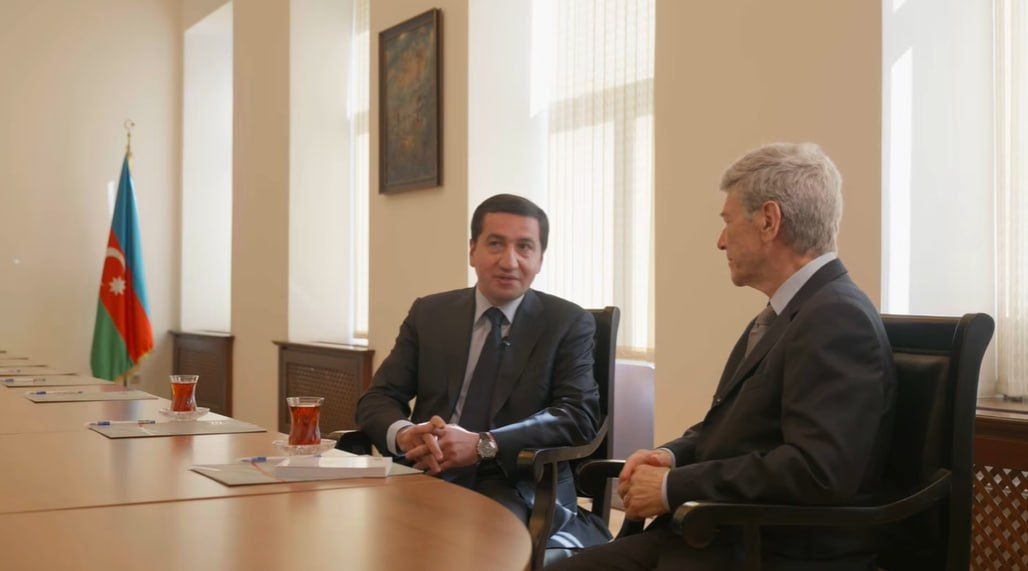
Hajiyev made the remarks during a conversation in Baku with American economist and professor Jeffrey Sachs, footage of which he shared on his official X account.
Azerbaijan has transformed South Caucasus from “The Battle Space” of big powers to “A Marketplace” or “Cooperation Space”of every party.
“In Baku, Professor Jeffrey Sachs sit down with Hikmat Hajiyev, Assistant to the President of the Republic of Azerbaijan, Head of the Department of Foreign Policy Affairs of the Presidential Administration of the Republic of Azerbaijan. From a country that spent 34 of its 35 years of independence at war, to one now quietly building a green corridor from the Caspian Sea to Europe, Azerbaijan is rewriting its own story.
Hajiyev reflects on the peace with Armenia, the 800 gigawatts of wind potential sleeping beneath the Caspian, COP29, and a surname that carries within it both an Arabic pilgrimage and a Russian suffix, a dialogue of civilisation in a single word. Professor Sachs delivers the Pope’s encyclical on peace and AI. And somewhere between the caviar and the wind farms, a new picture of the world begins to take shape,” the post stated.
In his interview, he stated. "We want to transform the region from a 'battlefield for great powers' into a 'marketplace for great powers.' We have shown our partners that trade is far better than war."
He explained that Azerbaijan's approach draws on its experience of attracting international investment into the energy sector, particularly through the 1994 Contract of the Century.
"A prime example is the 1994 'Contract of the Century' for the development of Azerbaijan's hydrocarbon resources, for which we invited companies from the United States, Europe, Türkiye, the Arab world, and even Iran," he noted.
Green energy corridors and European cooperation
Hajiyev also highlighted Azerbaijan's expanding energy partnership with the European Union, noting that cooperation is increasingly extending beyond traditional oil and gas supplies.
Referring to a recent visit by European Commission President Ursula von der Leyen, he said discussions had focused not only on hydrocarbons but also on developing a green energy corridor connecting the Caspian region with Europe's electricity network.
"Naturally, in previous visits, hydrocarbons and the European market were the dominant factors on our agenda—and they remain so today; that is an unavoidable reality. At the same time, however, a significant portion of our discussions focused on a 'green corridor' stretching from the shores of the Caspian Sea to Europe's energy grid."
According to Hajiyev, Azerbaijan expects a substantial increase in renewable electricity generation capacity in the coming years, creating additional opportunities for energy exports.
"Azerbaijan possesses immense potential: within just a few years, we will have an additional 2 GW of renewable energy capacity, followed by another 8 GW a couple of years later—all available for export."
He linked these ambitions directly to the ongoing peace process with Armenia, arguing that energy connectivity could help demonstrate the economic advantages of regional cooperation.
"We are no longer constructing dividing lines or walls; instead, we are building peace and overcoming the fragmentation of our region. We aim to demonstrate the economic benefits of a peace-oriented vision—the 'dividends of peace.' I hope that green energy will become an integral part of this strategy."
Azerbaijan chooses lasting peace with Armenia
Addressing the history of the Azerbaijan-Armenia conflict, Hajiyev stressed that Baku had chosen reconciliation and economic integration over continued confrontation.
He described the peace initiative as a significant political decision following decades of conflict and occupation.
"The President and the leadership of Azerbaijan have demonstrated immense political and diplomatic courage, and we have extended a hand of peace to our neighbor, Armenia. We faced two paths: perpetual war or perpetual peace. We chose the path of perpetual peace."
Hajiyev emphasised that the objective was not simply to establish a formal diplomatic agreement, but to create practical conditions in which citizens and businesses could experience the benefits of peaceful relations.
"This is not merely a declarative peace on paper. We are building a functional, tangible peace—one that people can truly experience, allowing them to appreciate the value of a peaceful life after 35 years of independence, most of which were defined by war."
He added that Azerbaijan intended to consolidate these gains through a regional security framework capable of withstanding future challenges.
"Now that we are living in peace, we are discovering its true worth; we will cherish it, strengthen it, and use it as a foundation to construct a unique security architecture, one capable of withstanding any negative challenges and ensuring a long-lasting impact for future generations."
Here we are to serve you with news right now. It does not cost much, but worth your attention.
Choose to support open, independent, quality journalism and subscribe on a monthly basis.
By subscribing to our online newspaper, you can have full digital access to all news, analysis, and much more.
You can also follow AzerNEWS on Twitter @AzerNewsAz or Facebook @AzerNewsNewspaper
Thank you!