
Azerbaijan turns Caspian into gateway to Central Asia
Akbar Novruz
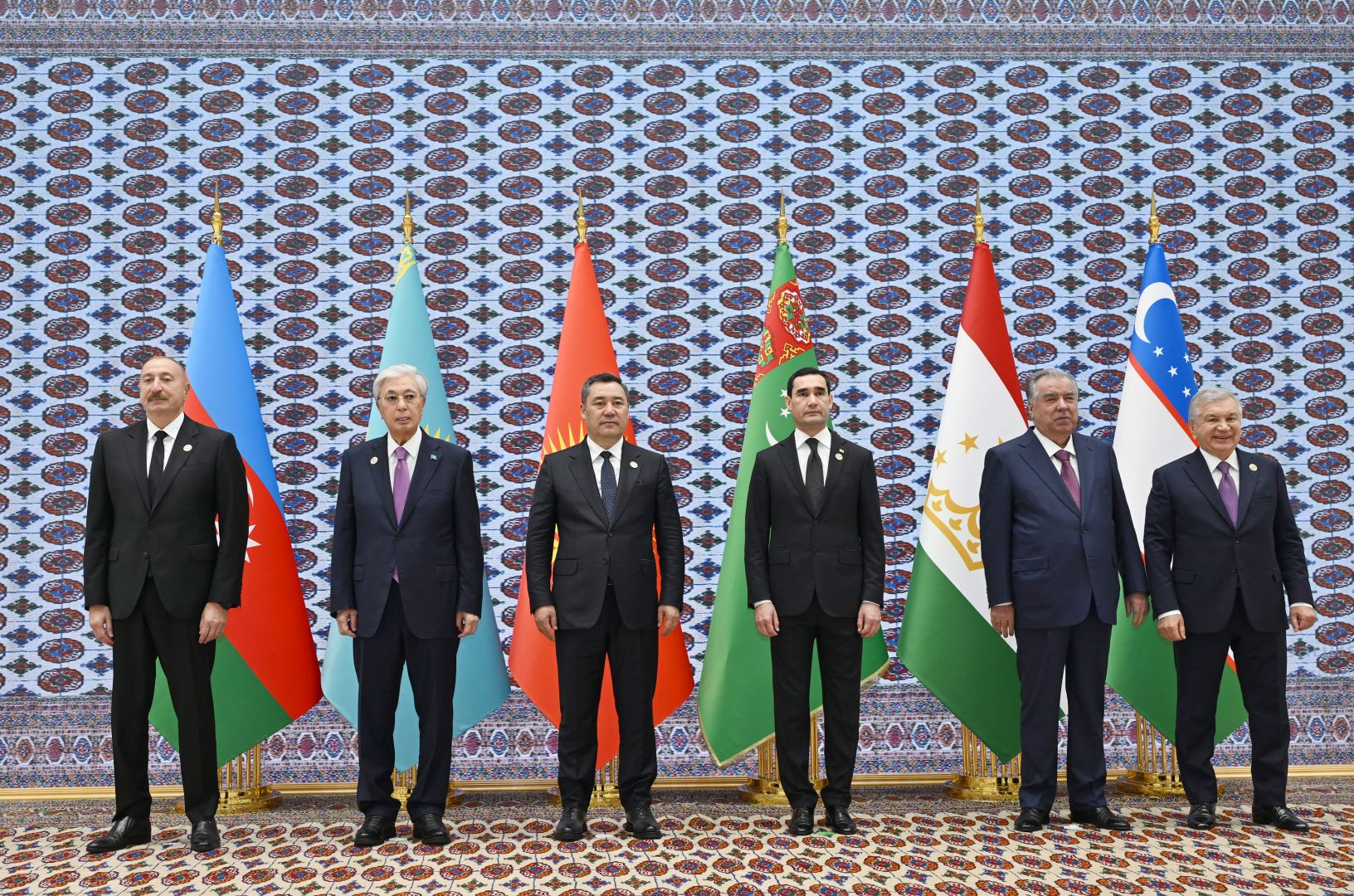
Read moreAt the Awaza Complex on the Caspian coast of Turkmenistan, the dance steps were known: arrival of presidents, shaking hands, family picture. However, behind all the rituals of the eighth Consultative Meeting of the Heads of State of Azerbaijan and Central Asia, there is a more serious reconfiguration process going on. It takes place not through changes in borders but also through changes in the route through which they are crossed.
President Ilham Aliyev of Azerbaijan has come to Turkmenbashi today to participate in the talks with the presidents of the five Central Asian republics. His appearance is noteworthy for the following reason: for the first time ever, one of the countries from the South Caucasus became a participant in the format which was initially created specifically for Central Asia. Practical considerations justified the decision to include Azerbaijan.
As the next year's host country, Azerbaijan aims to become a must-have western connection for the landlocked economies of Central Asia through everything from energy shipments to investments and fibre-optic cable installations.
Azerbaijan is becoming more and more defined as a middle power; that is, one which is not large enough to dominate its neighbours in the region, but whose economic and geographical importance is such that it will be able to influence decisions of far more powerful players. It has resources to shape the domestic policies of its neighbours, and from time to time we have witnessed it speaking as an equal to Moscow and Türkiye - which are considered the regional powers.
Yet the ability to offer alternative trade, energy and transport routes gives Baku bargaining power that a conventional measure of national size would miss.
“Azerbaijan's interaction with the countries of Central Asia has expanded significantly in recent years,” Aliyev told the meeting. According to the president, Azerbaijan’s trade turnover with Central Asian states rose by more than 50% last year, while more than 400 companies backed by Central Asian capital are operating in Azerbaijan.
Joint investment funds established with Kazakhstan, Uzbekistan and Kyrgyzstan offer another instrument of cooperation. But the President signalled that investment must become more than an item in summit communiqués. “We must not only increase mutual trade; it is important to jointly invest, produce, and enter external markets,” he said.
Connectivity at the focal point
The Middle Corridor, linking Asia and Europe via Central Asia, the Caspian, Azerbaijan, Georgia and onward routes, is the clearest expression of the region’s shifting priorities. This has been stated in several articles for a decent amount of time. Russia’s war in Ukraine and wider supply-chain disruptions have increased the appeal of alternatives to traditional northern routes. European governments and businesses have an obvious interest in access to Central Asian markets and resources that does not depend on a single transit system.
In the case of the European Union, Azerbaijan has been more than just a country that supplies its energy requirements to it. It has been instrumental in providing the means through which economic connections with Central Asia can become a reality. However, the viability of any corridor lies not only in the extent of the railway network constructed but also in its dependability. And Brussels, which is willing to provide up to €12bn towards the Middle Corridor and is hoping that Azerbaijani gas will reach 20bn cubic metres annually by 2027, needs both. For Europe, practically speaking, the way to Central Asia goes through Baku.
According to a World Bank publication issued in September, investments in the Trans-Caspian transport corridor would lead to a tripling of trade flows and cutting travel times in half by 2040; additional reforms could result in even bigger returns, such as GDP growth of around 2-3% and new job opportunities of around 250.
“The Caspian Sea plays an increasingly vital role today in the transport interaction of our countries. The transport infrastructure on both shores of the Caspian is of key importance for connecting Central Asia with Azerbaijan and further onward to international markets,” President Ilham Aliyev said at the Awaza Summit.
Kazakhstan said on 6 October that a new Trans-Caspian fibre-optic connection linking Aktau with Sumgayit in Azerbaijan was expected to become operational this month. It reported that 390km of cable had been deployed, while the CaspiLink firm, which oversees the development of the project, mentions a submarine cable of around 380km having a designed capacity greater than 400 terabits per second.
Kazakhstan currently sends a very large share of its international data traffic through Russian connections, according to the figures cited in the project discussion. A direct westward link would diversify that dependence and strengthen the basis for data centres, cloud infrastructure and digital services across the region.
As such, the Middle Corridor is developing from a transportation concept to an infrastructure network. Trains and ferries may transport cargo in the region; fiber may transport data in the region. The Caspian Sea is becoming less of a divide between economic regions and more of a connector between them.
Turkmenistan connection
The host country has an interesting case as well, subjectively. For much of its post-Soviet history, the country has pursued one of the most inward-looking political and economic models in Central Asia. Its doctrine of permanent neutrality has provided the foundation for a foreign policy built on avoiding military alliances and limiting exposure to external political entanglements.
Yet geography has a way of challenging even the most carefully maintained isolation. Turkmenistan possesses substantial natural gas reserves and occupies a strategically important stretch of the Caspian's eastern coastline. The more Central Asian nations look for new ways of reaching Europe and the rest of the world, the more important Ashgabat becomes to them.
This is where Baku enters the equation. Azerbaijan offers Turkmenistan something that its geography alone cannot provide. The relationship between Baku and Ashgabat is a good example of both possibilities and reality. The two nations signed a declaration of strategic partnership in 2017. Also, as per the Azerbaijani government's briefs, the two have signed 108 agreements for cooperation. Bilateral trade between the two reached a level of $208.39m in 2025 – a relatively small amount in comparison to the bigger picture. The freight transportation between the two has increased significantly in comparison with the previous year: 2.344m tonnes in 2025 (up by 15%) and 2.029m tonnes in eight months of 2026 (up by 38%).
This is an apparent contradiction in Baku’s strategy. The city derives its power from its position as an important node in the network but relies on the freedom of choice among alternatives on the part of its neighbours for its success. This is exactly what makes diversification such an attractive concept for Central Asian countries. It does not involve replacing one patron with another; rather, it involves increasing the number of patrons with whom they can deal.
The Awaza summit is exactly this acknowledgement. While geographically no closer to Central Asia than before, Azerbaijan and Central Asia have become much closer strategically. In the years to come, it will be less the expression of solidarity that will determine their relationship, but rather the efficiency of their ports, pipelines, joint investments, and communications infrastructure. The Caspian Sea, which was once viewed mainly as an impediment to overland connectivity, has now become its organizing center.
Here we are to serve you with news right now. It does not cost much, but worth your attention.
Choose to support open, independent, quality journalism and subscribe on a monthly basis.
By subscribing to our online newspaper, you can have full digital access to all news, analysis, and much more.
You can also follow AzerNEWS on Twitter @AzerNewsAz or Facebook @AzerNewsNewspaper
Thank you!