
Can taking Kharg Island really break Iran’s resistance?

Akbar Novruz
Read moreFrom the very beginning of the US–Israel–Iran war, the central question has been deceptively simple: who will win, and how will it end? Yet with each passing day, the answers seem to grow more uncertain.
Only a week ago, speaking from the White House, US President Donald Trump projected confidence. In his first televised national address since launching the operation in late February, he assured Americans that the war was moving swiftly toward its objectives.
“Over the next two to three weeks, we're going to bring them back to the Stone Ages, where they belong,” he said, emphasizing that the conflict remained far shorter than wars such as the Second World War or Vietnam.
But developments on the ground tell a more complicated story. Reports of downed US aircraft over Iran’s Isfahan province during a rescue operation have underscored the risks of escalation. What was initially framed as a controlled military campaign increasingly resembles a conflict with no clear off-ramp.
Seems like Washington found itself in a quicksand-type situation. The more they do something, the deeper they go down.
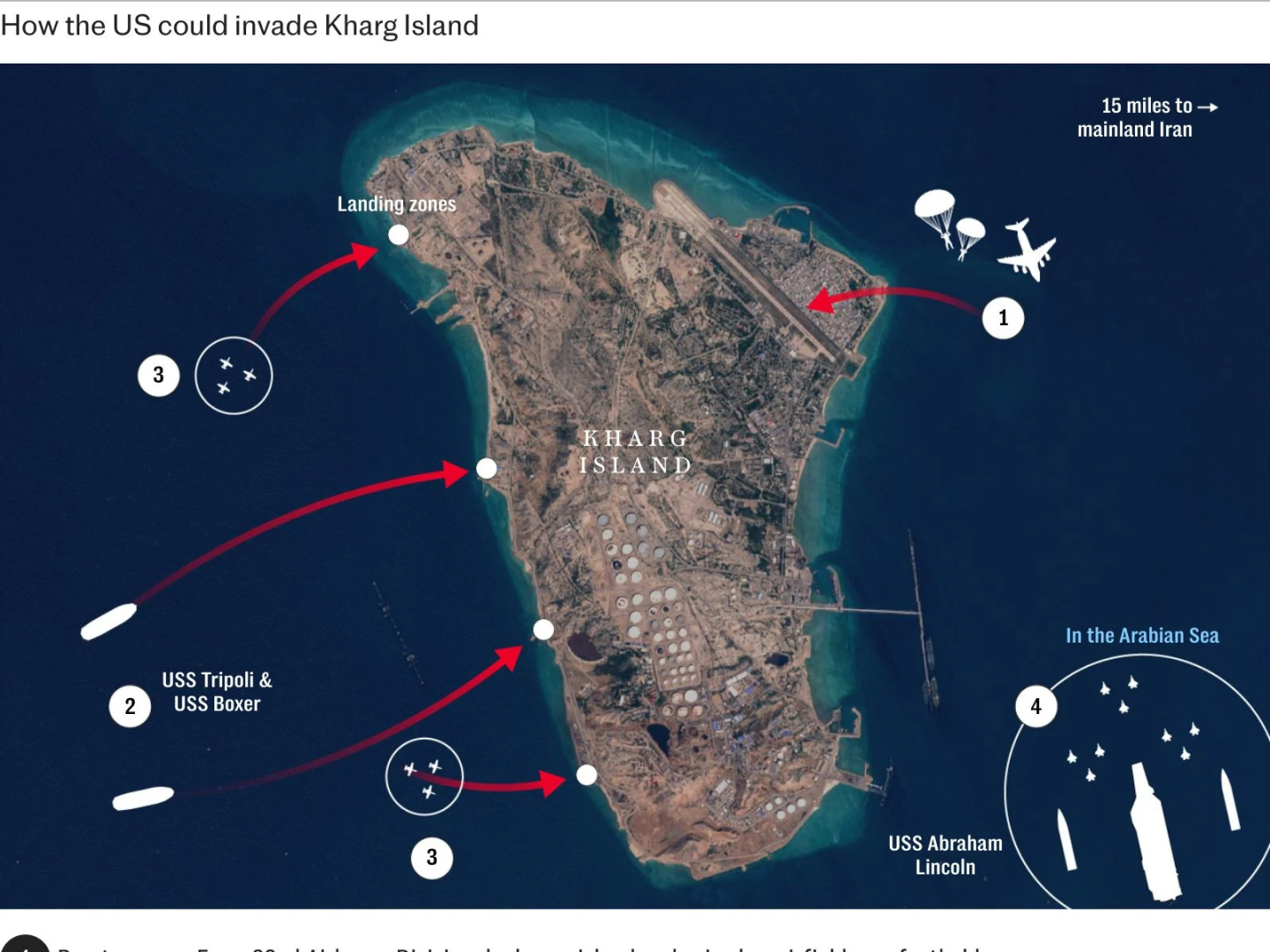
Now there is indeed a key component here, that Trump's indication that he may send troops to seize control of Iran's key oil export terminal at Kharg Island in the northern Gulf. Perhaps, the Pentagon knows well that 90% of Iran's oil exports are pass through that island, and seizing its control might give US and Israel the upper hand in this war's resolution.
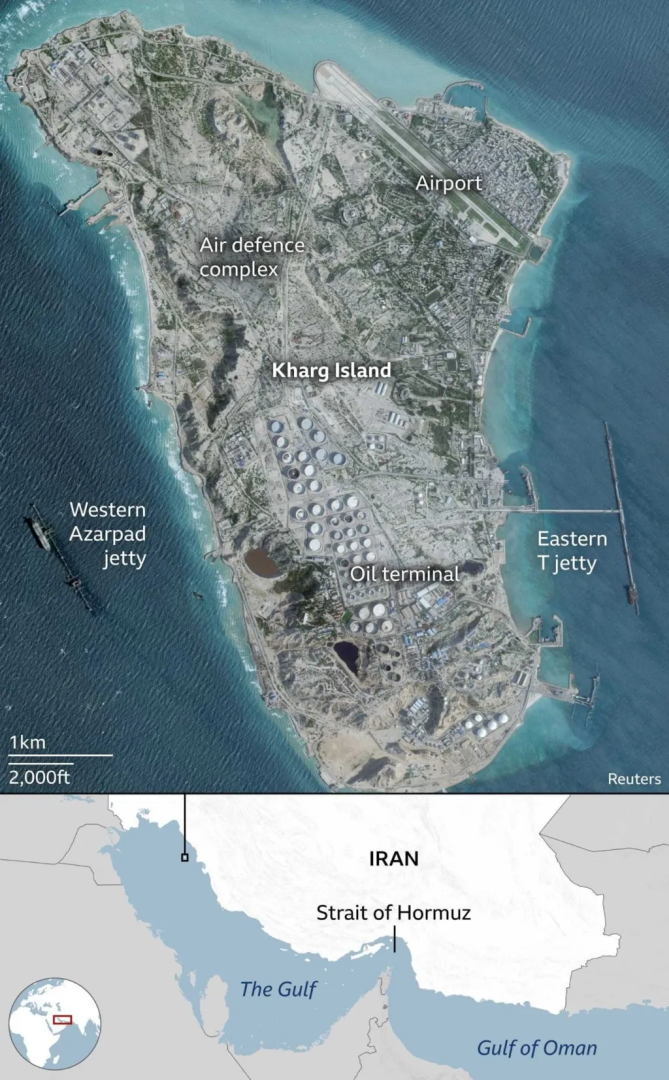
If the US does decide to invade Kharg Island then it would most likely be a temporary measure intended to put pressure on Iran by cutting off its fuel exports until it relinquished its chokehold on the Strait of Hormuz - one of the world's busiest oil shipping lanes - and conceded to Washington's demands.
What is behind this situation, how does it work, and what are the risks? Lastly, how could this war potentially end?
Irish historian and analyst Ronan Vaelrick, in his commentary to AzerNEWS, notes that while capturing the island might be feasible, holding it presents a far more difficult challenge:
“In theory, the paratroopers could make an airborne assault, probably at night, to seize key positions on this small island, which measures just 20 sq km (7.7 sq miles). The US Marines would deploy from ships equipped with Osprey tilt-rotor aircraft and Landing Craft Air Cushioned (LCAC) for making amphibious landings. But first those ships would have to run the gauntlet of getting through the Iranian-controlled Strait of Hormuz and then sailing all the way up the Gulf past any number of hidden Iranian drone and missile launch sites. Any landing, by air or sea, would expect to be met with anti-personnel mines and swarms of drones. Such is the awesome fighting power of these Marine Expeditionary Units (MEUs) that the US force would almost certainly prevail, but it could come at the expense of a severe number of casualties. Finally, it is worth noting that there has been so much noise made about a possible US ground assault on Kharg that it could be part of some deception plan."
Regarding the end of this war, the historian thinks that, as long as Iran plays the long game, the war is perhaps won by them:
“Over the past three days, we have been getting information such as US planes being shot down, and some of the pilots are still yet to be found and rescued. US have and perhaps in near future could easily make Iran's airspace a nightmare. They are incapable of going head-to-head with each other. For example Thunderbolt A-10 was captured a day ago, which surely gives us short example on how Iran's incapable of holding down a lower-end, short-capable plane.”
Yet, he cautions, battlefield dominance does not necessarily translate into strategic victory:
"Nevertheless, having military superiority alone is not likely to determine the outcome of this war. Iran isn’t a target that can simply be subdued through aerial bombardment. The underlying dynamics of the conflict are rooted in geography. Iran’s current approach, which focuses on resilience and imposing costs on its opponents over time, reflects the realities of its landscape. Unlike many smaller regional nations with limited territory, Iran possesses vast internal space and significant natural defenses.
In contrast, the smaller states in the Gulf area, whose economic infrastructure is situated along the coastline, are much more vulnerable to swift military action. If these patterns continue to benefit Tehran, the conflict could end with Iran battered but still standing, while the U.S.-Gulf alliance fractures, which could diminish the United States’ influence in the region for years. Iran may emerge with a weakened conventional military capacity, but it will still retain essential resilience in what has always mattered most to Tehran: the proven capability to defend its sovereignty against the world’s most formidable military powers. Although the United States and Israel might be achieving tactical victories due to their overwhelming firepower, Iran, having spent 35 years strategizing for endurance rather than sheer strength, could ultimately be prevailing in this war."
Here we are to serve you with news right now. It does not cost much, but worth your attention.
Choose to support open, independent, quality journalism and subscribe on a monthly basis.
By subscribing to our online newspaper, you can have full digital access to all news, analysis, and much more.
You can also follow AzerNEWS on Twitter @AzerNewsAz or Facebook @AzerNewsNewspaper
Thank you!