
Trump, Tehran and truth gap: US-Iran talk bluff or breakdown
Akbar Novruz
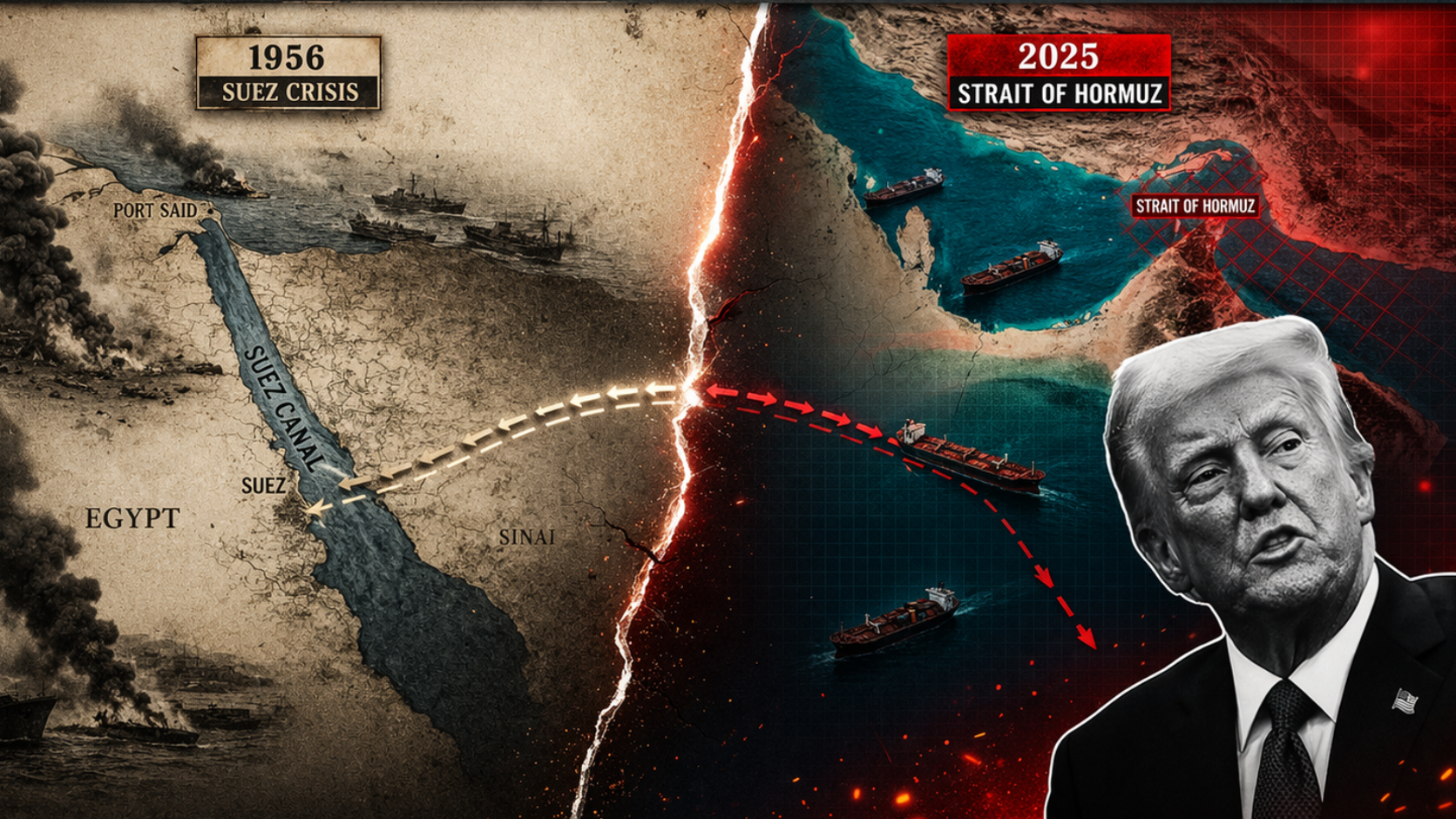
Read moreIn the autumn of 1956, Britain and France launched a military operation to seize the Suez Canal from Egypt's Gamal Abdel Nasser. The operation was swift, decisive, and, within weeks, a geopolitical catastrophe. Washington refused to support it. The pound collapsed. The troops withdrew. While it wouldn't be appropriate to downplay the event with a mere sentence, it revealed a harsh truth: the era of European imperial power projection had come to an end. Many historians state this crisis as the start of the collapse of the British and French Empires.
The United States has spent the decades since as the inheritor of that mantle. In the Middle East, that posture has rarely been questioned. But it is being questioned now, and the interrogation is arriving from an unexpected direction. The US, Israel-Iran war is now entering its fourth week, a Strait of Hormuz blockade that has sent oil markets into their worst crisis since the 1970s, and a Truth Social post that may, in retrospect, come to mark an inflection point as consequential as the moment British troops boarded their ships home from Port Said.
As the Iran war entered its fourth week, President Donald Trump announced on Monday that the United States had engaged in diplomatic talks with Iran and was taking a five-day pause on strikes against Iranian power plants and energy infrastructure. The announcement came via Truth Social, in characteristically capitalised prose: the U.S. and Iran had, Trump wrote, held "very good and productive conversations regarding a complete and total resolution of our hostilities in the Middle East."
Trump had issued a 48-hour ultimatum over the weekend, threatening to "obliterate" Iran's power plants if Tehran did not fully reopen the Strait of Hormuz. That deadline was due to expire Monday evening. It did not. Instead came the pause, five days, contingent on progress, the Department of War instructed to stand down on energy infrastructure strikes.
Trump said special envoys Steve Witkoff and Jared Kushner had held discussions into Sunday evening with a "top person" on the Iranian side, claiming both parties were keen to "make a deal" and would speak again by phone on Monday. Iran's response was to flatly deny that any such talks had taken place. Iranian state media, citing an unnamed senior security official, said: "There has been no negotiation and there is no negotiation, and with this kind of psychological warfare, neither the Strait of Hormuz will return to its pre-war conditions nor will there be peace in the energy markets."
Two parties. One alleged deal. Zero confirmed participants. This is the international environment in which the United States is presently operating, and it looks an awful lot like the confused final stages of the Suez operation, in which the British Anthony Eden was assuring the world that the operation was a success even while the Americans were pulling the financial rug from under his feet.
To understand how the United States arrived at this moment, one needs to look back over several years of unsuccessful nuclear negotiations. Since the US pulled out of the 2015 nuclear agreement, Iran has been consistently ratcheting up its enrichment program. Inspectors from the IAEA verified enrichment at levels close to 60% purity, which is just a small technological leap from the 90% mark, which would be classified as weapons-grade. This was noted by the non-proliferation community with great alarm. This was the centerpiece of all US demands in any subsequent negotiations.
Yet the U.S. intelligence community's own assessments complicated the narrative throughout. Its threat assessments consistently stated that Iran had not reauthorised the nuclear weapons programme suspended in 2003, while noting that pressure on Supreme Leader Khamenei to do so had been building. The implication was never fully absorbed by Washington's negotiating teams. The policy designed to prevent Iranian weaponisation may have been generating the precise conditions most likely to produce it.
This miscalculation, however, did not occur without warning. For example, in previous rounds, verifiable factual errors were made by American envoys, such as mistakes regarding the status of Iran's nuclear facilities, including claims regarding enrichment at facilities where there was no such activity. Iranian offers to cap enrichment, dilute existing stockpiles, and place them under international supervision were not seriously engaged with, and the maximalist position of zero enrichment, zero dismantlement, was maintained even as it was becoming increasingly clear that no Iranian government, regardless of its political colours, would be able to accept it and survive at home.
Ultimatum and its aftermath
Almost a month has passed since the missile strikes began, and now the International Energy Agency has warned that the global economy faces a "major, major threat" from the conflict's disruption to oil and gas flows, with the IEA chief stating: "No country will be immune to the effects of this crisis if it continues." The IEA has released 400 million barrels of crude oil, the largest release in its history, in an attempt to stabilise global prices. It has not been enough. At least 40 energy facilities across nine countries have been severely damaged in the conflict.
Iran's Islamic Revolutionary Guard Corps responded to Trump's ultimatum by threatening to strike electrical plants and desalination facilities across the Middle East, including in countries hosting U.S. military bases. Iran's Defence Council warned simultaneously that any attack on its coasts or islands would trigger the laying of sea mines that could sever Gulf shipping routes entirely, blocking maritime traffic beyond the Strait of Hormuz.
Iranian ballistic missiles struck Dimona, home to Israel's main nuclear facility, injuring nearly 200 people, after Israeli air defences failed to intercept at least two projectiles. Iran also launched long-range ballistic missiles at the joint U.S.-British military base on Diego Garcia in the Indian Ocean, the first time such missiles had been used in the conflict - perhaps the one thing that made a lot of noise in the West, given the fact that it can travel around 4500 km.
The USS Gerald R. Ford, the world's largest aircraft carrier, has returned to a naval base in Crete. Whether that represents strategic repositioning or the beginning of a drawdown is, for now, unclear. What is clear is that Washington's operational tempo has shifted, and Tehran, whatever its public denials about negotiations, has noticed.
Suez lesson Washington is not learning
What made Suez a turning point was that Britain's power to impose its preferred outcomes had quietly expired, even as its rhetoric had not. The gap between self-image and capability, when exposed, proved fatal to the entire edifice of postwar British foreign policy.
The United States is not Britain in 1956. Its military capacity is not in question. But there is a pattern here that should give pause to any serious analyst of American power. Trump said on Monday that the war against Iran would make Earth "a more secure planet", and that not having to "annihilate" Iran would be "a good thing, not a bad thing."
Britain's Eden, in November 1956, was also reassuring himself. The reassurances did not survive contact with the bond markets.
The parallel is not that the United States will lose this conflict militarily. It is that military superiority and strategic success are not the same thing, and that Washington appears to be discovering, in real time, that a war begun with apparent confidence in swift resolution has produced instead a four-week attrition, a global energy crisis, a diplomatic fog in which both sides dispute whether they are even talking to each other, and a five-day pause announced via social media at the expiry of a 48-hour ultimatum.
Even during the Eid holiday, multiple countries at different levels have been holding conversations with embassies and directly with the White House, urging that the process of escalation does not bode well for either side.
So, what might a deal actually look like?
If talks do produce an agreement, or maybe it did as Trump claims, and that remains a meaningful if, the contours of a workable framework have been visible for some time. Iranian proposals have historically included suspending enrichment for a defined period, diluting existing stockpiles, accepting international supervision, and offering American companies access to Iranian energy markets. In exchange, Tehran has sought sanctions relief and political recognition.
These are not the demands of a state racing toward a weapon. They are the demands of a state seeking to trade nuclear restraint for economic survival and diplomatic standing. It is, notably, exactly what the 2015 JCPOA achieved, before Washington walked away from it unilaterally in 2018 and set in motion the chain of escalation that has now produced an active war.
Direct talks between the United States and Iran could be held in Islamabad as early as this week, according to Reuters. Whether those talks materialise, and whether they produce anything durable, depends on whether both sides can move beyond the positions they have staked out in public, positions calibrated for domestic audiences rather than diplomatic outcomes.
Five days is long enough, however, for the gap between Trump's account of productive conversations and Tehran's denial of any conversations at all to become either a foundation for a deal or a pretext for resumed strikes. The outcome will tell us something important about the durability of American power in a region that has been the theatre of its most consequential overreaches.
Britain's Suez moment came when the Americans said no. Washington's equivalent may come not from external veto but from internal exhaustion, the accumulating weight of a war that has damaged 40 energy facilities across nine countries, mined the geopolitical imagination of every Gulf state, and produced as its most recent diplomatic output a Truth Social post that Iran says does not reflect reality.
Sometimes, history does repeat, but in some sort of different conditions. Perhaps, great powers, as a rule, make that recognition too late. They call the resulting wisdom policy. The world calls it a turning point and marks it on a map.
Here we are to serve you with news right now. It does not cost much, but worth your attention.
Choose to support open, independent, quality journalism and subscribe on a monthly basis.
By subscribing to our online newspaper, you can have full digital access to all news, analysis, and much more.
You can also follow AzerNEWS on Twitter @AzerNewsAz or Facebook @AzerNewsNewspaper
Thank you!