
Sanctions crack: US waiver frees Russian oil amid supply shock [ANALYSIS]
![Sanctions crack: US waiver frees Russian oil amid supply shock [ANALYSIS]](https://www.azernews.az/media/2026/03/20/635726572356.jpg)

Akbar Novruz
Read moreAs the Gulf War persists, the extent of its ripple effect is expanding to a point that feels beyond control. Trump, who has made it his objective since his second term to "defeat" oil prices, might be questioning his involvement in a conflict without a clear 'strategic plan'.
The great example?
The United States has issued a temporary waiver of its sanctions on the purchase of Russian oil currently stranded at sea, a 30-day measure intended to cushion global energy markets amid the severe supply disruptions sparked by the ongoing war in Iran involving U.S. and Israeli forces.
It eases some of the severe strain currently being felt in the world’s oil supplies, and it highlights an uncomfortable reality that Western leaders have long tried to downplay: Russian oil is indispensable to the functioning of the world’s economies. Why, given this reality, were these sanctions ever considered viable in the first place?
Well, perhaps Donald Trump himself reiterated that this waiver won't last more than 30 days. However, to understand the present, it is necessary to wind the clock back more than four years. When the US decided to impose sanctions on Russian oil exports in response to the invasion of Ukraine. The conflict itself is believed to have been engineered to deal a strategic blow to one of its main geopolitical rivals. The imposition of sanctions on Russian oil is believed to have been the economic counterpart of this strategy.
That calculation proved wrong, for reasons that extend well beyond the scope of this analysis. What matters here is what followed: the sanctions remained nominally in place, even as the assumptions underpinning them crumbled.
Faced with the impossibility of truly severing Russian oil from global markets, Western policymakers devised a workaround, the G7 price cap regime, established in late 2022, which permitted the continued shipment of Russian seaborne crude provided it was sold at or below roughly $60 per barrel. G7-based insurers and maritime service providers were barred from facilitating transactions above that threshold.
In practice, however, compliance was uneven at best. Countries were permitted to continue purchasing Russian oil provided they at least pledged adherence to the cap, an arrangement that, in effect, meant Washington was selectively tolerating violations of its own sanctions architecture. The price cap functioned less as a hard constraint than as a diplomatic fig leaf, allowing major importers to keep Russian crude flowing while the West maintained the appearance of economic pressure on Moscow.
The data bear this out. Indian imports of Russian crude surged by more than 130 per cent in the year following sanctions implementation; Chinese imports rose by around 27 per cent. By mid-2024, Russia was earning approximately $17 billion per month from oil exports, roughly 22 per cent more than in the same period a year prior, as higher global prices and a diversified buyer base more than compensated for the loss of Western customers.
The current waiver arrives against a backdrop of acute global disruption. The outbreak of hostilities involving the United States and Israel against Iran, which some are already calling the Third Gulf War, has sent shockwaves through energy markets. The Strait of Hormuz, through which approximately 20 per cent of the world's oil and gas normally transit, has been subject to severe disruption, driving Brent crude sharply higher and injecting deep uncertainty into forward markets.
In this context, the stranded Russian barrels suddenly look less like a sanctions target and more like a lifeline. The waiver has allowed countries such as India to move quickly to secure an estimated 30 million barrels of Russian crude, while Chinese state-owned oil majors have signalled renewed interest in Russian seaborne supply after a recent pause. Moscow, despite years of Western pressure, remains central to Asia's energy calculus.
Ukraine seems to be the biggest loser here. Ukrainian President Volodymyr Zelenskyy has condemned the waiver, warning it could direct as much as $10 billion into Russian coffers, potentially sustaining the very war effort that sanctions were meant to curtail. European capitals have echoed that criticism, arguing that any relaxation of energy pressure on Moscow undermines the collective leverage the West has spent years assembling. EU officials have called on the U.S. and G7 partners to return to strict enforcement of the original price cap framework.
Those objections carry moral and strategic weight. But they also collide with an energy market reality that is increasingly difficult to manage through diplomatic instruments alone.
The deeper stakes of this debate extend far beyond the principal protagonists. If India and China were suddenly compelled to stop purchasing Russian oil, the consequences would not be confined to their own economies. Alternative suppliers would be overwhelmed; prices would spike to levels that smaller, poorer importers simply could not absorb.
For economies across the Global South, already operating on narrow fiscal margins, an oil shock of that magnitude could prove destabilising in the most literal sense. Energy shortages have a well-documented tendency to cascade: contracting economic output, eroding living standards, fuelling social unrest, and in extreme cases delivering the conditions for political violence, coups, or broader governance collapse.
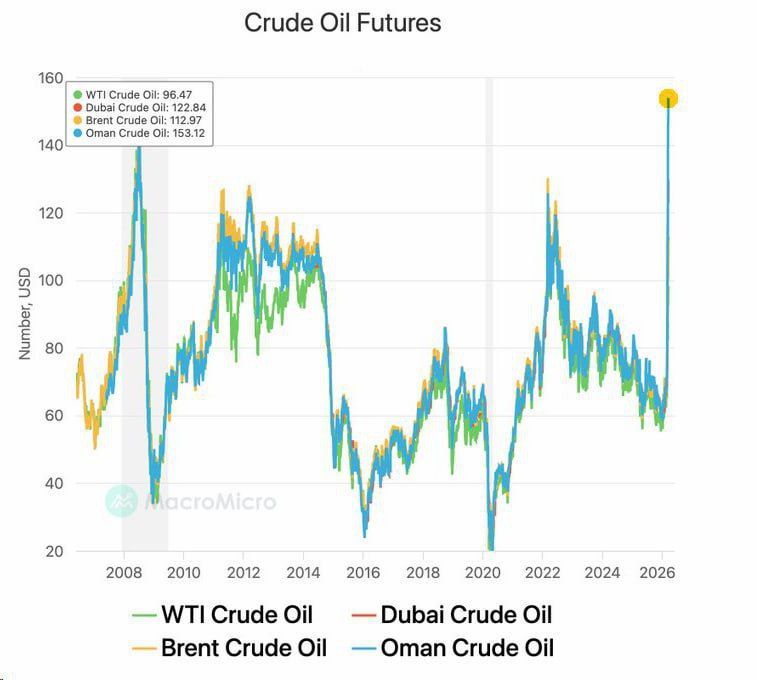
Even as much as the U.S. claims or tries to establish any sort of avertness, the market reaction has been unambiguous. One chart captures the stakes clearly. Crude oil futures, after years of relative range-trading, have broken violently upward, Oman crude above $153, Brent above $112, Dubai above $122. History suggests these spikes do not resolve themselves quickly. The last two comparable surges, in 2008 and 2022, required years of market adjustment and left lasting economic scars. If the current trajectory holds, the debate over Russian oil sanctions will not remain an abstract geopolitical question for long. It will become a cost-of-living crisis, a debt crisis, and for the world's poorest economies, something far worse.
The temporary waiver is, by design, a limited instrument. It covers only Russian oil already at sea and does not unwind the broader sanctions regime. But it may nonetheless mark an inflection point, a moment at which the cumulative weight of evidence forces a reassessment of a policy that has, by most measures, failed to achieve its primary objective while generating significant collateral costs.
The most obvious route towards true market stability, a number of analysts now argue, lies with the permanent removal of American sanctions from the Russian oil industry. Whether or not such a move is politically feasible in the United States, at least from the perspective of the optics of rewarding Russia after a period of confrontation, remains highly uncertain. What remains certain, however, is the reality of the economics at play.
Here we are to serve you with news right now. It does not cost much, but worth your attention.
Choose to support open, independent, quality journalism and subscribe on a monthly basis.
By subscribing to our online newspaper, you can have full digital access to all news, analysis, and much more.
You can also follow AzerNEWS on Twitter @AzerNewsAz or Facebook @AzerNewsNewspaper
Thank you!