
President Aliyev lights Novruz bonfire as life returns to Garabagh
Elnur Enveroglu
Read moreIn the rolling landscapes of Garabagh and East Zangazur, reconstruction is no longer an abstract promise. Now, we can proudly say that it is a lived reality. Across once-devastated districts, from Aghdam to Fuzuli, from Zangilan to Khojavend, new roads cut through valleys that were, until recently, scarred by war. Thanks to almighty Allah and the bravery of the martyred soldiers, and due to the visionary leadership of President Ilham Aliyev, rows of newly built houses now stand where ruins once defined the horizon. Electricity, gas, and fibre-optic networks have been restored or laid anew, while schools, medical points, and public facilities are gradually returning to service.
This is the architecture of Azerbaijan’s “Great Return”, which is a state-led project that blends infrastructure, demography, and political messaging into a single national narrative. The numbers alone are striking: tens of thousands have already resettled, with entire communities re-emerging after decades of displacement. However, beyond the statistics, what is unfolding is something more symbolic: the deliberate reconstruction of belonging.
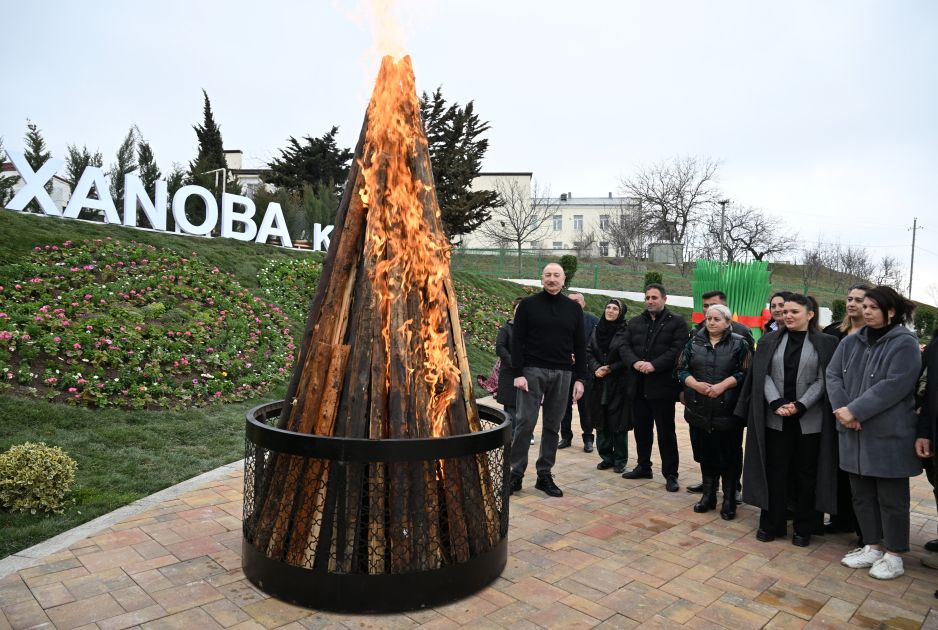
Nowhere is this more visible than in Khanoba village in the Khojavend district. Once reduced to a fragment of its former self, the village is now undergoing a careful, phased revival. Of its 153 homes, dozens have already been restored, with more nearing completion. The return of the first 25 families that are expected soon to be followed by over a hundred more signals not merely habitation but continuity.
Infrastructure has been prioritised with a precision that reflects both urgency and intent. Transformer substations have been restored, electricity and gas lines reconnected, and new fibre-optic systems installed, ensuring that returning residents are not stepping back into the past but into a modernised rural environment. Water systems, too, have been rehabilitated, underscoring the emphasis on sustainability and habitability.
It was against this backdrop that President Ilham Aliyev and First Lady Mehriban Aliyeva visited Khanoba on March 18. Their presence was not merely ceremonial. In post-conflict regions, leadership visibility serves as both reassurance and assertion. To be more precise, reassurance to returning citizens and assertion of sovereignty to a broader audience.
Their meeting with residents coincided with the approach of Novruz, the ancient festival marking renewal and rebirth. The symbolism was unmistakable. Standing alongside villagers, the President lit the traditional Novruz bonfire, which was a gesture that fused cultural ritual with political meaning. “All conditions have been created in the village—for living and working. Most importantly, you have returned to your native Garabagh land,” he told the gathered residents.
Such moments are carefully choreographed but not devoid of genuine resonance. For families returning after years, often decades, of displacement, the act of celebrating Novruz at home carries emotional weight that transcends politics. As President Aliyev put it, “After a long break, you will now celebrate these holidays in your homeland.”
Yet the President’s remarks also reveal the broader narrative framing the reconstruction effort. “We have restored our national pride, ensured justice and territorial integrity, and driven the enemy out of our lands,” he declared, linking physical reconstruction with political vindication. The ruins left behind - “entire villages, settlements, and cities were destroyed” - are invoked not only as evidence of past devastation but as justification for the scale and speed of current rebuilding.
There is, undeniably, a duality at play. On the one hand, the reconstruction of Garabagh is a humanitarian and developmental necessity. On the other hand, it is a powerful instrument of statecraft. By rapidly rebuilding infrastructure and facilitating returns, Azerbaijan is consolidating control, reshaping demographics, and reinforcing its post-2020 and 2023 victories in tangible terms.
The Azerbaijani President himself underscored the pace and ambition of the effort: “In just five to six years, more than 80,000 people are already living, working, and studying in Garabagh and East Zangezur.” The message is clear. This is not a tentative recovery but a determined transformation.
Still, questions linger beneath the surface of progress. Can such rapid reconstruction sustain long-term economic viability? Will these newly revived settlements evolve into self-sufficient communities, or remain dependent on state support? And how will this ambitious project be perceived beyond Azerbaijan’s borders, where narratives of the conflict remain deeply contested?
For now, however, the emphasis is firmly on momentum. “The time has come to build and create,” the President told residents, framing the present as a turning point from conflict to construction. His closing words - “Now we will live forever on this native Garabagh land. We had to return - and we have returned as a victorious people” - encapsulate both the triumphal tone and the enduring political significance of the project.
In Khanoba, as in much of Garabagh, the bonfire lit for Novruz burns with layered meaning. It is a symbol of renewal, certainly and also of resolve. Whether this reconstruction becomes a lasting model of post-conflict recovery or remains a deeply national project shaped by geopolitics will depend on what follows the flames: sustained development, inclusive growth, and, perhaps one day, a broader regional reconciliation.
For now, the message from Garabagh is unmistakable: the return has begun, and it is being built brick by brick, road by road, and story by story.
Here we are to serve you with news right now. It does not cost much, but worth your attention.
Choose to support open, independent, quality journalism and subscribe on a monthly basis.
By subscribing to our online newspaper, you can have full digital access to all news, analysis, and much more.
You can also follow AzerNEWS on Twitter @AzerNewsAz or Facebook @AzerNewsNewspaper
Thank you!