
Azerbaijani diplomat: Neighboring countries should exert pressure on Armenia
By Sara Rajabova
Turkish Foreign Minister Ahmet Davutolu's upcoming visit to Armenia has fueled discussions about the normalization of Ankara-Yerevan relations and the possibility of reopening the Armenian-Turkish border.
Davutoglu is scheduled to visit Yerevan to attend the Foreign Ministers Council of the Organization of Black Sea Economic Cooperation (BSEC) on December 12.
Turkish media reported earlier that the Armenian-Turkish border may be reopened in exchange for liberation of two occupied Azerbaijani regions.
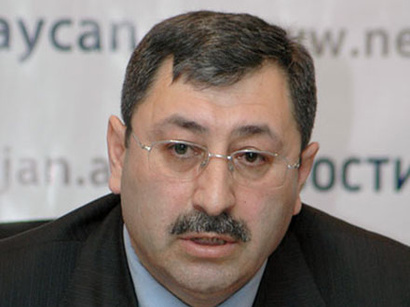
Commenting on the issue, Azerbaijani Deputy Foreign Minister Khalaf Khalafov said on December 11 that Turkey closed its border with Armenia for two reasons.
He said the first reason was Armenia's territorial claims against Turkey, and the second was the occupation of Azerbaijani lands by Armenia.
"If we consider this issue today, we will see that nothing has changed. Armenia still has a hostile attitude toward Turkey. Yerevan has given up neither its open territorial claims toward Turkey, nor its claims for 'recognition' of the 'Armenian genocide' in the global scale," Khalafov said.
He went on to note that the Azerbaijani lands are still occupied and the negotiations, held in this regard, have not brought any results.
Khalafov said the problem has not been resolved because of Armenia's lack of constructive position on the issue.
"Armenia is not ready for a settlement. The reason for lack of progress in the peace process is the lack of will from Armenian side, in particular lack of political will," the diplomat said.
Regarding the media reports about Turkey's request from Armenia to return two occupied regions to Azerbaijan, Khalafov said that Baku's position in the negotiations is clear.
Khalafov said that the OSCE Minsk Group and other international organizations must support this settlement.
"The co-chairmen must try to finish their mission," the official explained.
"This means that they must force Armenia to the peace table, refrain from its aggressive policy and return Azerbaijan's occupied lands. Afterwards, we can talk about the peace process and its progress," Khalafov said.
He noted that Azerbaijan believes that Armenian-Turkish relations are Ankara's internal affair.
"We do not interfere in this issue. Turkey makes its own decisions on how to establish relations with Armenia. We are fully confident that as a country located in our region, Armenia's adoption of an aggressive policy would bear an international responsibility for the state," Khalafov said.
He went on to say that other neighboring countries must not remain indifferent and should express their attitude to the aggressive policy of Armenia.
"We believe that Iran and Russia must also exert pressure on Armenia because the main cause of violating peace and stability in the region today is Armenia's policy," Khalafov said.
He also said a new approach must be demonstrated on the international plan, especially by France, Russia and the U.S, which have taken an intermediary mission in the OSCE.
Khalafov added that the actions must be taken to promote this process.
Turkey and Armenia have no diplomatic relations and the border between them has been closed since 1993. The reason was Armenia's claims for international recognition of the so-called 'genocide' and occupation of Azerbaijani territories by Armenian armed forces.
The Nagorno-Karabakh conflict emerged in 1988 when Armenia made territorial claims against Azerbaijan. Since a lengthy war in the early 1990s that displaced over one million Azerbaijanis, Armenian armed forces have occupied over 20 percent of Azerbaijan's internationally recognized territory, including Nagorno-Karabakh and seven adjacent regions.
The UN Security Council's four resolutions on Armenian withdrawal have not been enforced to this day.
Peace talks are underway on the basis of a peace outline proposed by the Minsk Group co-chairs, dubbed the Madrid Principles. The negotiations have been largely fruitless so far.
Here we are to serve you with news right now. It does not cost much, but worth your attention.
Choose to support open, independent, quality journalism and subscribe on a monthly basis.
By subscribing to our online newspaper, you can have full digital access to all news, analysis, and much more.
You can also follow AzerNEWS on Twitter @AzerNewsAz or Facebook @AzerNewsNewspaper
Thank you!