
China-Central Asia trade routes get boost as Middle Corridor expands

Akbar Novruz
Read moreThe Asian Infrastructure Investment Bank and the International Road Transport Union, through its Global Innovation and Knowledge Center for Sustainable Transport (GSTIKC), have held a joint seminar focused on strengthening logistics connectivity between China and Central Asia, with particular attention to the development of the Middle Corridor, AzerNEWS reports.
According to IRU, the event brought together representatives from governments, international organizations, financial institutions, and key stakeholders to exchange views on transport infrastructure, cross-border cooperation, and regional investment priorities.
Speaking at the seminar, IRU’s Chief Representative for East and Southeast Asia, Ran Wan, highlighted recent progress in implementing the TIR system along China–Central Asia routes. He noted that the system plays a crucial role in helping landlocked countries transform into integrated trade hubs by improving the efficiency and reliability of cross-border transportation.
Ran Wan emphasized the importance of combining infrastructure investments with facilitation tools such as the TIR system, as well as digital innovations.
“Through digital solutions such as eTIR and the development of ‘green corridors’ at key border crossings, we are making transport faster, more predictable and more sustainable,” he said.
He also pointed to the growing role of TIR in supporting new trade routes, including the Middle Corridor, which is gaining importance as an alternative to traditional northern and southern transit routes.
As an example, IRU highlighted the successful implementation of the first intermodal TIR pilot project along the China–Uzbekistan route. Cargo was transported by rail from Xi’an in central China to Kashgar in the Xinjiang Uyghur Autonomous Region, before continuing by road under the TIR system through the Irkeshtam border crossing to Jizak in Uzbekistan.
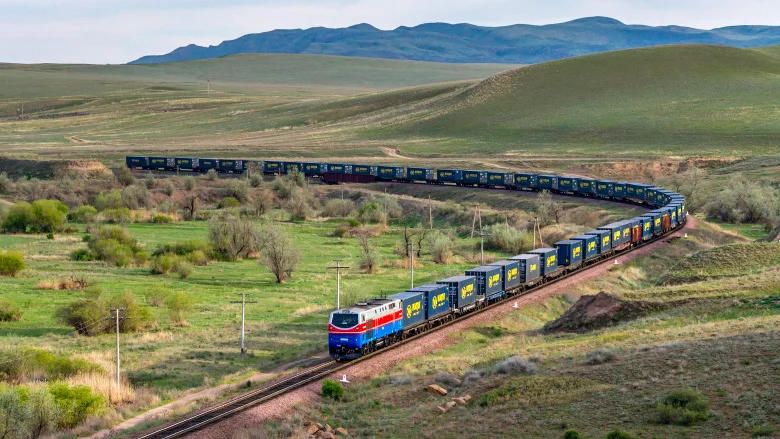
The Middle Corridor connects Asia and Europe via Central Asia, the Caspian Sea, and the South Caucasus, passing through countries such as Kazakhstan, Uzbekistan, Turkmenistan, Azerbaijan, Georgia, and Türkiye. The route is increasingly seen as a strategic alternative that can shorten transit times and diversify global supply chains by reducing reliance on longer maritime routes.
Here we are to serve you with news right now. It does not cost much, but worth your attention.
Choose to support open, independent, quality journalism and subscribe on a monthly basis.
By subscribing to our online newspaper, you can have full digital access to all news, analysis, and much more.
You can also follow AzerNEWS on Twitter @AzerNewsAz or Facebook @AzerNewsNewspaper
Thank you!