
From minefields to new homes, Azerbaijan's deminers help bring life back to Karabakh

Akbar Novruz
Read moreAzerbaijan's extensive demining operations in Karabakh and its surrounding districts are helping pave the way for the return of former internally displaced persons, as specialist teams and mine-detection dogs continue to clear territories contaminated by decades of conflict.
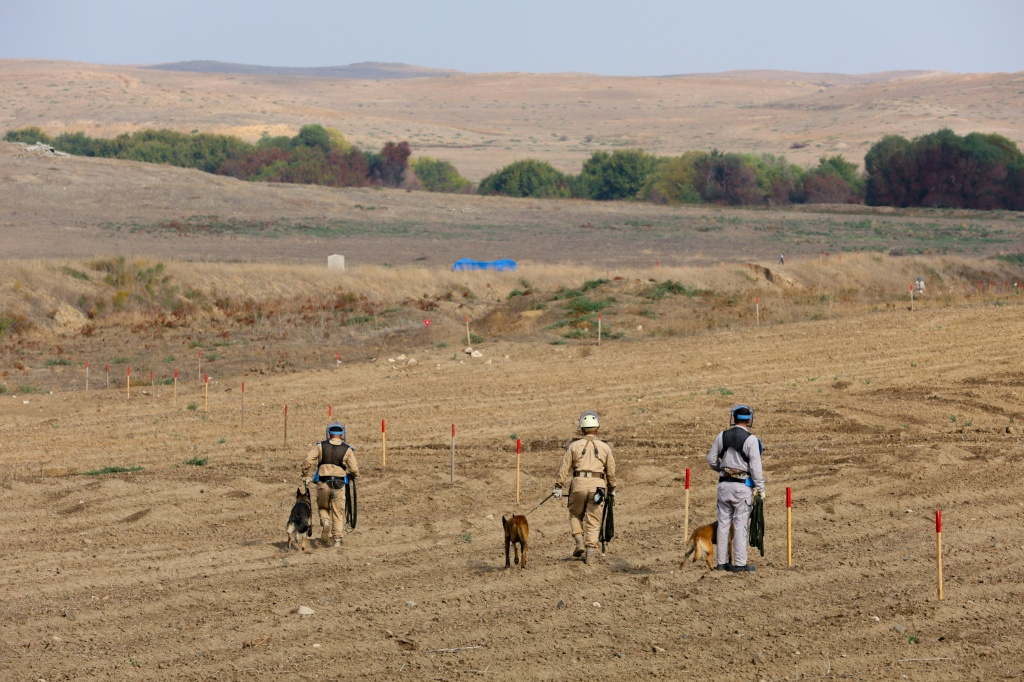
In a report from the village of Ashaghi Abdurrahmanli in Fuzuli district, Agence France-Presse (AFP) highlighted the work of Azerbaijani deminers, focusing on the role of trained dogs in detecting landmines and unexploded ordnance along the former front line.
Among those featured is Afsana Bayramova, one of the relatively few women working in Azerbaijan's mine clearance sector. Alongside her Belgian Malinois, Rocky, brought from Croatia, she searches potentially dangerous areas for explosive devices.
Their work is essential to making previously contaminated land safe for reconstruction, agriculture and the return of displaced communities.
According to Bayramova, the dogs are trained to identify the presence of explosives and alert their handlers whenever they detect a suspicious location.
“We treat every signal as the discovery of a mine,” she explained.
Bayramova said she entered the profession because she wanted to contribute directly to Azerbaijan's reconstruction efforts rather than remain on the sidelines. Her family originates from Zangilan district, which Azerbaijan regained control of during the 44-day war in 2020.
Nearly 69,000 mines neutralised since 2020
The scale of Azerbaijan's demining challenge remains considerable.
According to Jabir Samadov, head of the operations department at the Azerbaijan National Agency for Mine Action (ANAMA), more than 309,000 hectares of land have been cleared since 2020.
During these operations, nearly 69,000 landmines and approximately 200,000 pieces of unexploded ordnance have been neutralised.
The figures illustrate the extensive contamination left across territories that remained under Armenian occupation for decades, where explosive hazards continue to complicate reconstruction and resettlement.
AFP also described the rigorous procedures followed by mine-detection dog teams.
Before entering operational areas, the animals undergo tests at specially prepared training grounds to demonstrate their ability to detect explosive substances.
During field operations, handlers guide the dogs using long leashes, allowing them to examine designated areas while maintaining a safe distance.
When a dog signals a potential explosive device, a second dog is brought in to verify the location. Only after this confirmation does a deminer begin inspecting the suspected site.
Environmental conditions add another layer of difficulty. Summer temperatures in Azerbaijan's lowland districts can exceed 40 degrees Celsius, limiting the time dogs can safely work.
Illness and paw injuries can also temporarily prevent animals from participating in clearance operations.
Once they retire, many of the dogs are adopted by their handlers, reflecting the close relationships developed during years of working together.
Demining clears the way for reconstruction
For Bayramova, the results of these operations are increasingly visible in communities where reconstruction is underway.
She noted that new residential buildings are already being constructed in three villages in Aghdam district where she previously participated in mine clearance operations.
“We see how settlements are being restored, people are returning, and agriculture is being revived. This fills us with a sense of pride,” she said.
Beyond the technical challenge of removing explosives, demining is also closely linked to the human consequences of the conflict.
AFP highlighted the experience of Asif Ahmadov, who struck a landmine in 2020.
The explosion killed his brother and caused Ahmadov to lose his left leg, while his right leg sustained severe injuries.
After spending three months in hospital, Ahmadov became a volunteer with ANAMA, dedicating himself to educating local communities about the continuing dangers posed by mines.
He now visits villages and schools to warn residents, particularly children, against entering potentially contaminated areas.
His experience underscores the long-term risks that unexploded devices continue to pose even after active hostilities have ended.
As Azerbaijan advances reconstruction and resettlement across Karabakh and the surrounding districts, mine clearance remains a prerequisite for restoring normal life.
Here we are to serve you with news right now. It does not cost much, but worth your attention.
Choose to support open, independent, quality journalism and subscribe on a monthly basis.
By subscribing to our online newspaper, you can have full digital access to all news, analysis, and much more.
You can also follow AzerNEWS on Twitter @AzerNewsAz or Facebook @AzerNewsNewspaper
Thank you!