
Erdogan highlights expansion of Turkish higher education, AI and university innovation

AzerNEWS Staff
Read moreBy News Center
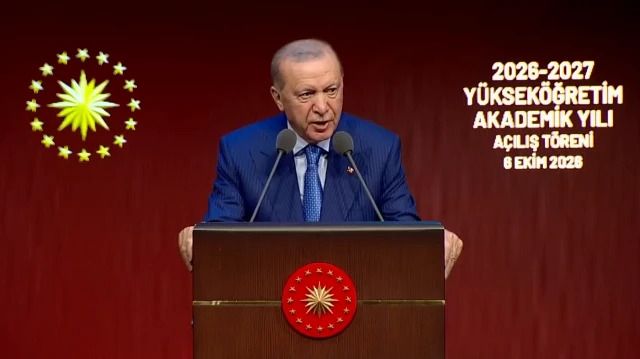
Turkish President Recep Tayyip Erdogan addressed the opening ceremony of the 2026-2027 academic year at the Beştepe Millet Congress and Culture Center in Ankara.
In his speech, Erdogan discussed the development of Türkiye’s higher education system, the growing role of artificial intelligence in education, and the responsibilities of universities in science, research and innovation.
According to the president, Türkiye has significantly expanded access to higher education in recent years. The number of universities in the country has increased from 76 to 208, while the number of students has reached approximately 6.3 million. Turkish universities currently employ around 190,000 academics and researchers.
Erdogan said Türkiye is also strengthening its position in the global academic system.
The country ranks 15th among 213 countries in terms of the number of scientific articles and review publications. The president also said that in 2026, two Turkish universities were ranked among the world’s top 300 universities, while six Turkish universities entered the top 500.
“In the medium term, our goal is to place at least two of our universities among the world’s top 100 universities,” Erdogan said.
At the same time, he stressed that international rankings should not become the sole criterion for evaluating universities.
According to Erdogan, Turkish universities should do more than achieve high positions in international rankings. They should also generate new scientific knowledge, develop original theories, models and systems, and produce technological solutions.
The Turkish president devoted particular attention to the rapid spread of artificial intelligence in education.
Erdogan said the accuracy of information provided by artificial intelligence systems and the reliability of the sources they use can often raise questions. For this reason, he argued, the relationship between students and teachers should not be reduced solely to the transfer of information.
“The teacher shares their experience with the student, instills scientific culture, evaluates what the student has learned and how well they have learned it, identifies areas where the student has difficulties and, when necessary, directs them toward new sources and research,” the Turkish leader said.
Erdogan emphasized that people must remain at the center of the educational process.
“If the human being is not the main actor here, then the information being conveyed will neither be complete nor sustainable,” he said.
The president also said knowledge acquired without independent research and personal effort is quickly forgotten.
Erdogan called on universities to pay greater attention to what is known as their “third mission” — the economic and social contribution of higher education institutions beyond education and scientific research.
According to Erdogan, universities should cooperate more closely with the real sector of the economy and take labor market needs into account.
As an example, the president cited a project involving vocational schools established within organized industrial zones. He said that under the program, launched in 2018, the employment rate among graduates has reached 90% in some cases.
The new vocational education model will be expanded in Istanbul, Ankara, Izmir, Bursa, Kocaeli, Konya and Gaziantep.
In the first stage, approximately 120,000 students enrolled in 185 two-year vocational education programs will participate in the model.
Speaking about the development of higher education over the past 24 years, Erdogan said the number of student dormitories had increased from 190 to 877, while their total capacity had risen from 182,000 to approximately 1 million places.
The president also recalled the abolition of tuition fees at public universities and increases in scholarships for undergraduate, master’s and doctoral students.
Erdogan separately addressed access to higher education, saying that the expansion of the university network has helped provide equal opportunities for young people from different social backgrounds.
Another indicator of changes in Türkiye’s higher education system, Erdogan said, is the growing representation of women in academia.
According to the president, women now account for 47.17% of academic and research staff at Turkish universities.
Erdogan also said Türkiye would continue accepting international students and expanding international cooperation in higher education.
He noted that leading countries around the world view international students not only as a source of revenue but also as a means of strengthening scientific, cultural and economic ties.
Here we are to serve you with news right now. It does not cost much, but worth your attention.
Choose to support open, independent, quality journalism and subscribe on a monthly basis.
By subscribing to our online newspaper, you can have full digital access to all news, analysis, and much more.
You can also follow AzerNEWS on Twitter @AzerNewsAz or Facebook @AzerNewsNewspaper
Thank you!