
France’s student protests expose an uncomfortable question for Amnesty and RSF
Elnur Enveroglu
Read moreFrance’s student protests expose a question that human rights organisations should not be allowed to dodge: do universal principles remain universal when the police force belongs to a powerful Western state?
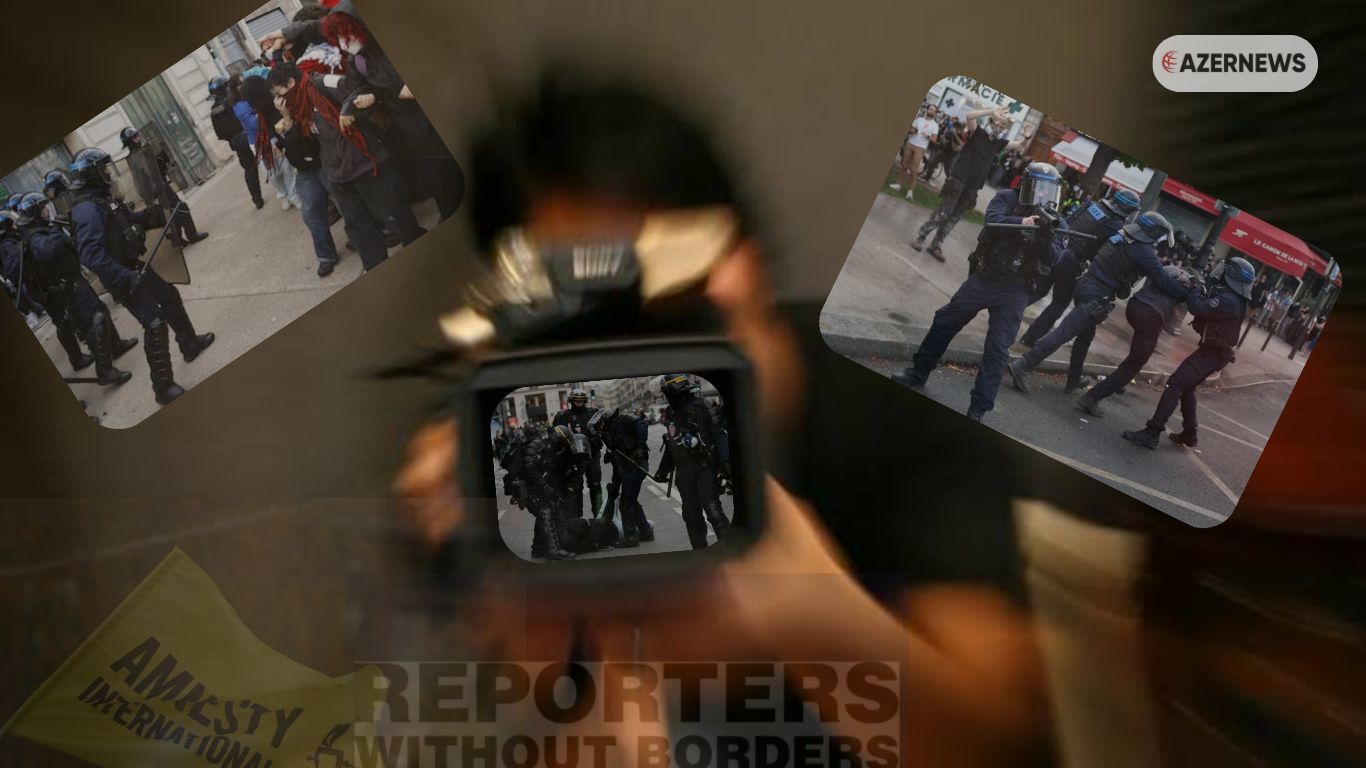
To be honest, the answer matters because the French protests are not some marginal disturbance. On Tuesday, 6 October, 266,000 people marched across France, according to Interior Ministry figures, after 86,000 had already been counted outside Paris. The movement began in late September with lycée pupils demanding more teachers, smaller classes, shorter and more manageable school days, decent buildings and modern equipment. Their anxiety is also about what comes next: university access, Parcoursup and the fear that an underfunded education system is closing doors before adulthood.
Much of that is an ordinary democratic demand like young people asking whether their country is giving them a fair chance.
However, the streets have also exposed something darker, where the protests have repeatedly descended into clashes. Police have used tear gas, batons and crowd-control weapons, and the situation looks worse than it sounds. In Tours, a 16-year-old lost the use of his right eye after a head injury that prosecutors said was compatible with a blast-ball projectile. In Lens, a 15-year-old lost his hand after picking up a police grenade during a confrontation. The Interior Ministry says hundreds of officers and students have been injured, while thousands have been arrested, the overwhelming majority minors.
There are allegations beyond the streets in which lawyers representing detained teenagers have told French media of physical violence, insults and attempts at humiliation during police custody. And those claims should be investigated rather than automatically labelled “torture” before the facts are established, shouldn't they?. Looking at the case, they are serious allegations involving children, and that should be enough to demand scrutiny. Eleven investigations into alleged police violence had been opened, according to reporting on Wednesday.
So where are Amnesty International and Reporters Without Borders?
That makes the question more interesting, not less. Because when similar allegations arise in Azerbaijan, the language can become dramatically more categorical and politically charged. Unlike the current event in France, Amnesty’s July 2026 report accused Azerbaijani authorities of an “escalating campaign of repression” against critics at home and abroad. RSF’s Azerbaijan page describes a “merciless war” against critics and currently places the country 171st of 180 in its 2026 Press Freedom Index.
RSF has, to be fair, criticised police violence in France before, including attacks on journalists covering demonstrations. However, its current intervention around the student movement is far less prominent than its sustained, highly accusatory campaign over Azerbaijan. Unfortunately, no specific RSF statement focusing on the mass detention of student protesters or alleged mistreatment of minors in custody during this latest wave was found. RSF’s recent France interventions have concentrated particularly on violence against journalists, and that imbalance is the real issue.
Human rights cannot be a geopolitical instrument. Police brutality does not become less disturbing because it happens under the tricolour instead of another national flag. A frightened 16-year-old in France has the same claim to dignity as a detained journalist in Baku, depending on the case. The nationality of the police officer should not determine the volume of international outrage.
Azerbaijan has faced years of criticism from Western institutions, and some of that criticism raises legitimate questions that deserve answers. But legitimacy is lost when watchdogs appear to apply different rhetorical temperatures to comparable abuses. When France is described in the language of de-escalation and internal investigations, while Azerbaijan can be portrayed in sweeping terms as an authoritarian system crushing pluralism, readers are entitled to ask whether the same yardstick is being used.
For countries such as Azerbaijan, which often finds itself under intense scrutiny in Western institutions, that consistency is not a cosmetic matter. It is the difference between principled advocacy and political selectivity. Therefore, there is an uncomfortable lesson here for Amnesty and RSF. Their credibility depends not simply on finding wrongdoing, but on showing that they will confront it wherever it occurs.
Thus, given the current events in France, it is not beyond scrutiny because it is democratic. If Azerbaijan is subjected to criticism or accusations regarding certain internal matters or minor, insignificant incidents, then this principle must be applied universally, impartially, and without bias. The law demands equality, and the human factor, along with the violation of human rights, can under no circumstances be considered insignificant. In short, if a French police officer raises a hand against a minor student or manhandles them, the incident should not simply be treated as an internal matter and glossed over with a routine press release. After all, isn't it a service to both law and justice to bring the issue to wider public attention and expose the perpetrators? Ultimately, the approach taken must be, again and again, universal and equitable, because that principle is strongest when it is applied without fear, favour or geopolitical preference.
Here we are to serve you with news right now. It does not cost much, but worth your attention.
Choose to support open, independent, quality journalism and subscribe on a monthly basis.
By subscribing to our online newspaper, you can have full digital access to all news, analysis, and much more.
You can also follow AzerNEWS on Twitter @AzerNewsAz or Facebook @AzerNewsNewspaper
Thank you!