
Dublin puts Azerbaijan at the centre of a changing European equation
Akbar Novruz
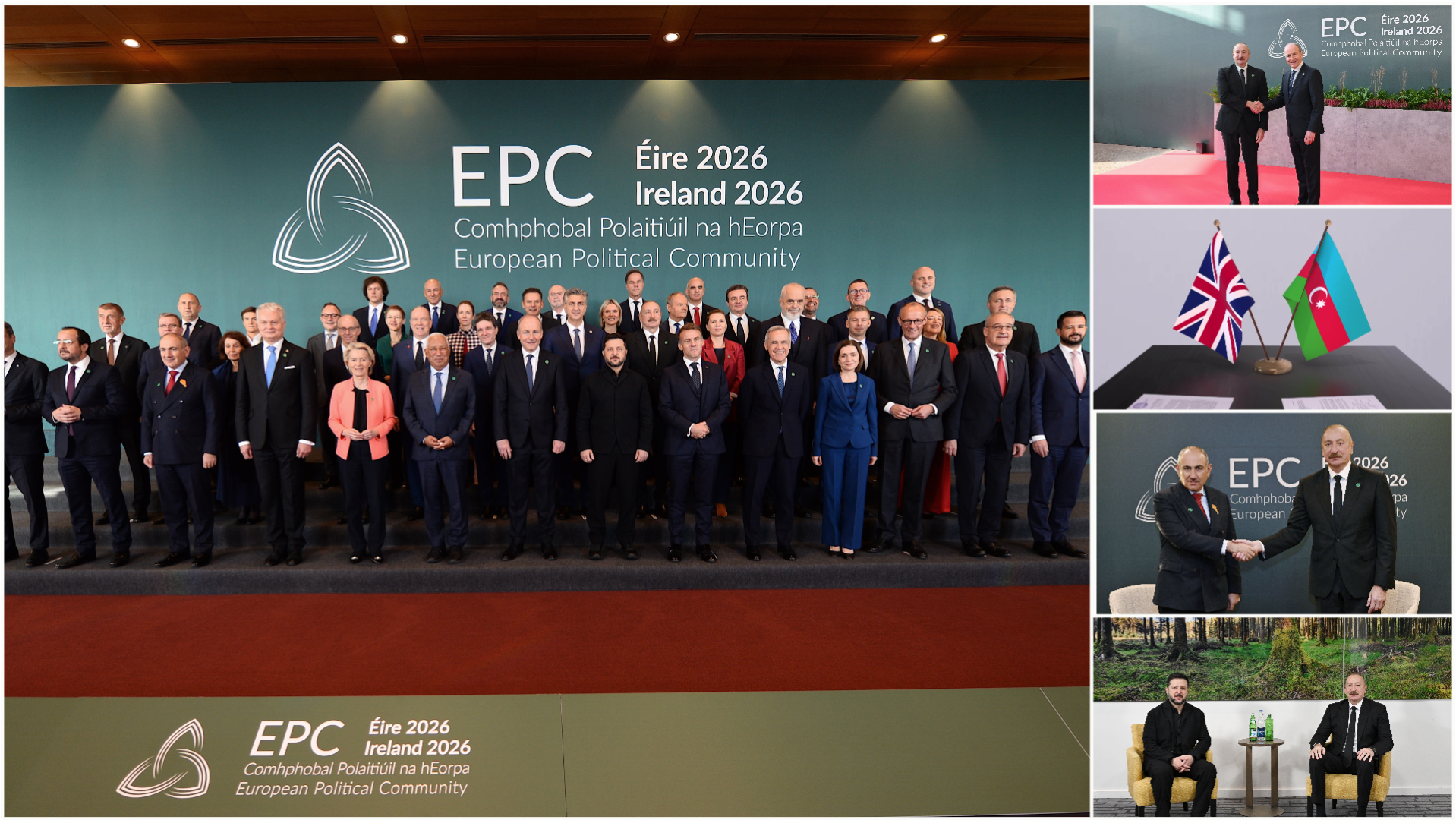
Read moreThe European Political Community was formed with the purpose of bringing a divided continent into one room. At its ninth summit in Dublin, on Thursday, Azerbaijan showed why the room is expanding further outside the boundaries of the European Union. During just one day, President Ilham Aliyev secured for his country a new partnership with the UK, conducted a series of meetings regarding energy security in Europe, and held another round of talks with the Prime Minister of Armenia on how to make peace work.
Participants [heads of state] from the Summit emphasized that Europe requires energy sources beyond those provided by Russia, markets in Central Asia, and stability in the South Caucasus region. Azerbaijan is strategically located at the crossroads of these priorities. The key question is whether this advantageous position can be leveraged to establish lasting agreements.
Reaching peace, steadily
One and almost a half years after the infamous Washington Summit in August 2025, the peace between Azerbaijan and Armenia has been quite the 'rollercoaster' as some would say. As months passed, the normalization between both states at times showed great improvement - in such a way that it seemed like they had been waiting for this. But even with that, at certain times it also showed a slowdown in the progress - it felt like a match burning at its strongest in its first spark, but that spark slowly faded. However, as of now, the Armenia–Azerbaijan normalization process can not be characterized with specific terminology; the reality is that the peace is moving steadily and dynamically. We saw that happening again tonight.
It is noteworthy that the talks between Aliyev and Pashinyan on the sidelines of the EPC transcended symbolic commitments to reconciliation. Among the topics that were touched upon were the rail and road components of the US-sponsored Trump Route for International Peace and Prosperity, as well as possibilities of connecting electricity grids, delimiting the border and negotiating about watercourses. While the draft peace agreement signed in Washington in August 2025 should be completed, and the technical details regarding the routes should still be worked out, the current flow of cargo through Azerbaijan may serve as an indicator of mutual efforts that cannot be undone easily.
Another figure emerged from negotiations between Aliyev and Armenian Prime Minister Nikol Pashinyan, who cited 105,000 tonnes of cargo delivered to Armenia via Azerbaijan since November 2025. This amount seems small on a global scale of logistics but very significant in the context of two neighbouring countries that have experienced conflict for decades, both at border crossings and through transportation links. The Dublin Day is a continuation of a story Baku has been writing since the EPC began. At the first summit in Prague in 2022, President Aliyev and PM Pashinyan reaffirmed the 1991 Alma-Ata Declaration, which Baku reads as mutual recognition of territorial integrity. At Granada in 2023, Ilham Aliyev stayed away amid disagreement over Europe's approach, showing he would use absence as a signal. By Oxford in 2024, he was pitching Azerbaijan as an energy partner able to double gas supplies by 2027. Last May he addressed the Yerevan summit by video link, his first participation in an event hosted by Armenia, and invited the EPC to Baku in May 2028, a trade that Yerevan backed.
The pace of development could slow down and be less steady in the first year. However, normalization cannot continue to be based solely on the successes of one summit alone. The diplomacy is real.
Baku and London elevate relations
But what became a landmark event on this day was concluded not with any of the EU members, but rather with Britain. The joint declaration by Aliyev and Prime Minister Andy Burnham marked the elevation of their partnership to that of a strategic partnership – the new political dimension of a bilateral relationship, which has traditionally been based on oil and gas.
However, it is impressive how strong such a base really is. The Azerbaijani energy ministry claims that the British have invested more than $39bn in Azerbaijan – making the United Kingdom the biggest investor in the country. The activities of bp in developing Caspian hydrocarbons have defined the post-independence development path of the country. However, the Dublin declaration outlines a more complex future with regard to defense training and interoperability, law enforcement cooperation, green finance, and artificial intelligence.
There is a noteworthy paradox in this case – the EPC has no ability to pass binding legislation, yet it served as the platform where two states that are outside the EU made a new partnership agreement for Europe. This agreement helps to expand a continental partnership for Britain after its Brexit and allows Azerbaijan to have a European presence without any thoughts of joining the EU - for now, at least.
The agreement is not just a new name for something else; it is not a mutual defense agreement or financial assistance for construction. It involves an annual strategic partnership meeting and the use of the already existing intergovernmental commission for investments and development of the Middle Corridor. Everything depends on the availability of funds and legislation in the country.
Indeed, the relationship between Baku and London has always been a decent example in the making. Historically, some do indeed have a promising launch pad. A meeting between Britain and Azerbaijan in October saw discussions about a 240 MW solar plant that would be built to help decarbonize the Sangachal energy terminal. Along with planned electricity links from the Caspian Sea to the Black Sea. The process of moving from the pumping of hydrocarbons to helping fund clean industrial infrastructure is a gradual one, but gives London an opportunity to play a part in the next phase of Azerbaijan’s development.
Europe needs options, not slogans
European leaders, as is tradition, have called for deeper energy cooperation with Azerbaijan, with several expressing interest in increased gas supplies as Europe seeks to reduce its dependence on Russian energy, ever since the war.
According to the European Commission, the volume of natural gas imports from Russia declined from 45% in 2021 to 12% in 2025. In 2025, Azerbaijan provided 11.3bn cubic meters to the EU – that constitutes approximately 3.9% of all gas imports by the Union. It does not suffice to replace Russia, but it makes a difference to the states interested in diversification.
At the conference in Dublin, the President of Moldova, Maia Sandu, thanked Baku for its efforts towards energy security; Bulgaria mentioned the possibility of increasing gas exports and even electricity supply; Greece addressed the question of financial and regulatory aspects of further export capacity expansion. The Czech Prime Minister Andrej Babiš considered investments and trade relations, while the oil supplies from Azerbaijan to Prague were also relevant.
Nevertheless, there are differences between the political demand and the bankable supply. Additional volumes of Azerbaijani gas mean production at the source, pipelines, and long-term contracts to buy. Climate regulations and investments in new infrastructure make the decision complex. The matter is not only in selling but also in underwriting expansion. It means that there is an opportunity for some sort of bargain. Azerbaijani can provide gas now, green energy in the future and link of the connection between Europe and Caspian and Central Asia. Europe can provide capital, knowledge, and the demand for it. It is in the interest of both to cooperate; otherwise, it will be impossible to implement the strategy just by declarations.
A summit as a working instrument
Dublin is also another good example of the unusual usefulness of the European Political Community. This is an informal body that is not a treaty organization, and summits are not automatically a decision-making process. But the structure makes it possible to arrange talks between the British Prime Minister, EU officials, and the presidents of Armenia and Azerbaijan, which would otherwise require separate diplomatic journeys. Azerbaijan has been able to gain a good ground in return. Even Ukraine's president, Volodymyr Zelenskyy, who thanked Mr Aliyev for electrical equipment, said Kyiv is watching Azerbaijan's reconstruction of Garabagh and East Zangezur closely and sees its experience as possibly useful. Few countries at the summit table can claim to be sought by so many different partners at once.
Baku has already been able to make use of this opportunity. In 2022, at the first summit in Prague, the format provided a basis for mutual recognition of the sovereignty of Armenia and Azerbaijan. Four years later, the agenda revolves more around cargo transportation, electricity supply, investments, and the implementation of the established peace. In 2028, the summit will be hosted by Azerbaijan, another opportunity to move from attendance to agenda-setting. What once made Azerbaijan important for the West was not so much the wealth hidden below the Caspian, but rather what could travel through it.
Here we are to serve you with news right now. It does not cost much, but worth your attention.
Choose to support open, independent, quality journalism and subscribe on a monthly basis.
By subscribing to our online newspaper, you can have full digital access to all news, analysis, and much more.
You can also follow AzerNEWS on Twitter @AzerNewsAz or Facebook @AzerNewsNewspaper
Thank you!