
Azerbaijan's East–West rail freight rises 21% as Baku Port handles 100,000 TEU


Akbar Novruz
Read moreAzerbaijan recorded significant growth in railway freight transportation and Caspian Sea container traffic during the first nine months of 2026, reinforcing its position as a major transit hub connecting Central Asia with European markets.
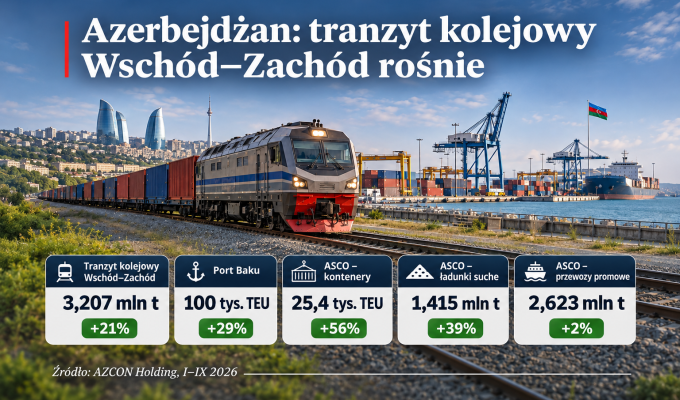
According to figures published by AZCON Holding on November 6 and highlighted by Polish railway publication Kurier Kolejowy, East–West railway freight transportation increased by 21% year on year, reaching 3.207 million tonnes between January and September.
At the same time, container handling at Baku International Sea Trade Port rose by 29% to 100,000 twenty-foot equivalent units (TEU), while the Azerbaijan Caspian Shipping Company (ASCO) reported a 56% increase in container transportation.
The simultaneous expansion of railway, port and maritime operations reflects growing demand for the Trans-Caspian International Transport Route, commonly known as the Middle Corridor.
Baku Port reaches 100,000 TEU milestone
Baku Port, located in Alat, handled 100,000 TEU during the first three quarters of 2026, compared with approximately 77,300 TEU during the corresponding period of 2025.
The result is particularly significant given the port's original annual container handling capacity of 100,000 TEU, which was subsequently increased to 160,000 TEU through operational improvements.
The port therefore handled the equivalent of its originally designed annual container capacity in just nine months, although its current expanded capacity has not been fully utilised.
The increase in container traffic highlights the importance of coordinating port operations with railway schedules and Caspian shipping services to maintain efficient cargo movements.
ASCO records 56% growth in container transportation
Maritime transportation across the Caspian Sea also expanded during the reporting period.
ASCO transported 25,400 TEU of containerised cargo between January and September, representing annual growth of 56%.
The company's dry cargo transportation increased by 39% to 1.415 million tonnes, while ferry cargo volumes rose by a more modest 2% to 2.623 million tonnes.
The figures demonstrate differing growth rates across maritime transportation segments, with container shipping expanding considerably faster than ferry operations.
Nevertheless, ferry services remain essential to the Middle Corridor, particularly for moving railway wagons and road freight between Central Asia and the South Caucasus.
It is important to distinguish ASCO's maritime transportation figures from Baku Port's container handling statistics, as the same cargo may be recorded by both operators at different stages of its journey.
Middle Corridor traffic outpaces overall transit growth
According to an earlier AZCON Holding report published on October 23, Azerbaijan handled more than 12 million tonnes of transit cargo during the first nine months of 2026, an increase of 14.5% compared with the previous year.
Within that total, cargo transportation through the Middle Corridor reached 4.1 million tonnes, representing growth of 20%.
The figure was the highest recorded for the January–September period over the past five years.
By comparison, East–West railway freight reached 3.207 million tonnes, increasing by 21%.
These indicators cover different categories of cargo transportation and should not be added together.
The figures nevertheless show that Middle Corridor traffic is expanding faster than Azerbaijan's overall transit volumes, suggesting the route is becoming increasingly important within the country's transport network.
Infrastructure expansion aims to support future growth
Further increases in cargo volumes will require additional investment in railway infrastructure, port facilities and Caspian shipping capacity.
One of the central projects is the second phase of Baku Port's expansion, which is intended to raise annual cargo handling capacity to 25 million tonnes and container capacity to 500,000 TEU.
Railway modernisation is also planned along the Baku–Alat–Boyuk Kasik line, a strategic connection linking Azerbaijan's railway network with Georgia.
The proposed improvements include upgrading traction power supply systems and railway traffic management equipment to increase reliability and accommodate higher freight volumes.
Meanwhile, Baku Shipyard is constructing four vessels ordered by international partners to expand maritime transportation capacity across the Caspian Sea.
Two container ships, each with a capacity of 780 TEU, are being built for AD Ports Group under a contract signed in September 2025. Their completion is scheduled for 2028.
Another two vessels, ordered by KTZ Express Shipping in May 2026, are being adapted to transport dry cargo, including containers.
According to AZCON Holding, each vessel will have a container carrying capacity equivalent to 537 TEU and a deadweight of approximately 9,900 tonnes.
The expansion of maritime capacity is particularly important because Caspian Sea crossings remain a critical component of the Middle Corridor's overall efficiency.
Growing volumes bring new logistical challenges
The latest figures indicate that Azerbaijan is strengthening its position as a transit link between Central Asia and Europe, supported by rising railway freight volumes, expanding port operations and increased maritime container transportation.
However, the different rates of growth across railway, container and ferry operations also underline the need for coordinated infrastructure development.
As highlighted by Kurier Kolejowy, the competitiveness of the Middle Corridor depends not only on the capacity of individual transport facilities but also on transit times, predictable delivery schedules, competitive tariffs and efficient cargo transfers between railways and ships.
For Azerbaijan, maintaining the current growth trajectory will therefore require continued investment alongside closer operational cooperation with regional transport partners.
Here we are to serve you with news right now. It does not cost much, but worth your attention.
Choose to support open, independent, quality journalism and subscribe on a monthly basis.
By subscribing to our online newspaper, you can have full digital access to all news, analysis, and much more.
You can also follow AzerNEWS on Twitter @AzerNewsAz or Facebook @AzerNewsNewspaper
Thank you!