
How Azerbaijan turns its Caspian geography into geoeconomic power

Qabil Ashirov
Read moreFor decades, Azerbaijan’s strategic value has been measured through energy exports and pipelines carrying Caspian resources westward. A broader transformation is now taking shape. Through closer cooperation with Kazakhstan, Baku is positioning the Caspian basin as a platform for trade, transport, digital connectivity and regional integration. The partnership points towards a new source of influence: the ability to connect markets and economic systems across Eurasia.
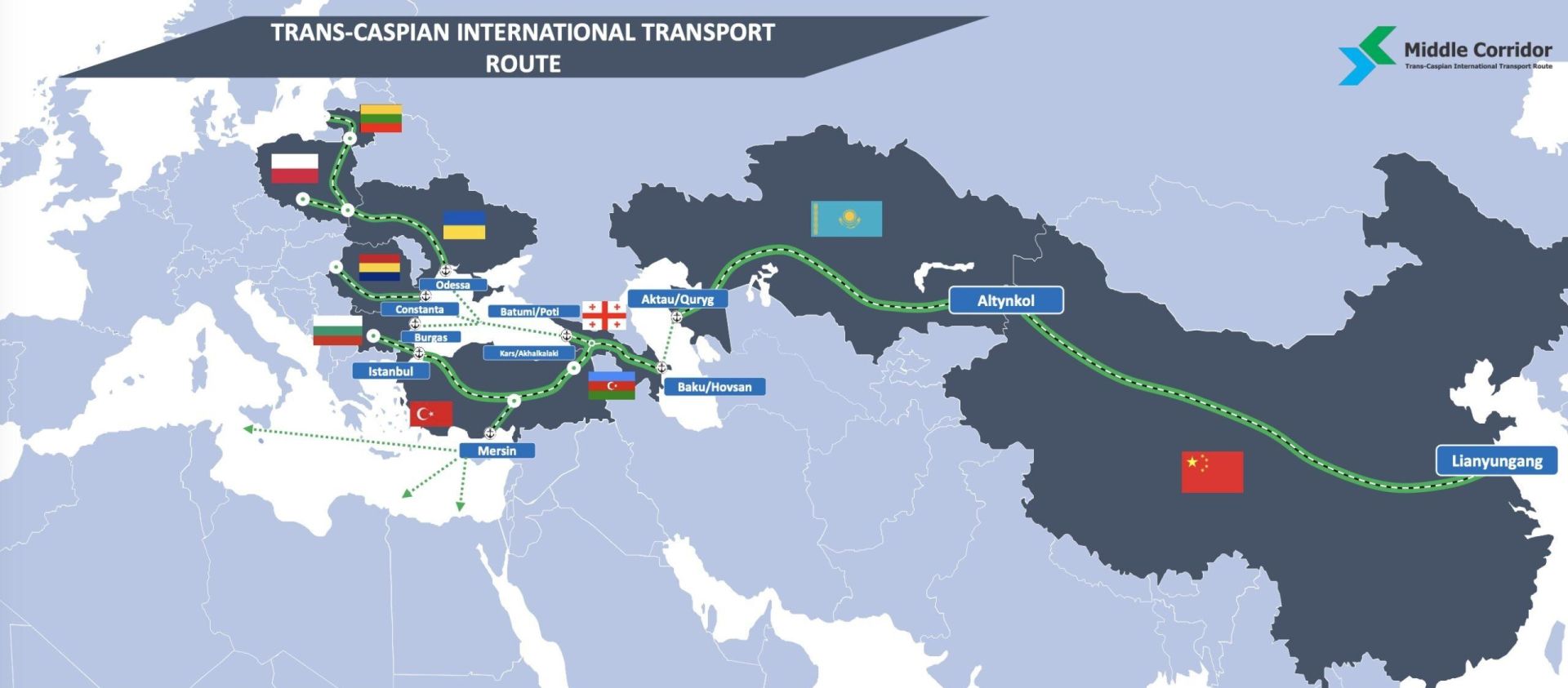
The agreement on cooperation in developing the Trans-Caspian International Transport Route, exchanged by Azerbaijan and Kazakhstan in Baku on October 15, gives this ambition an institutional dimension. Its significance extends beyond another bilateral document. A corridor becomes commercially powerful when its participating states coordinate customs procedures, transport rules, investment priorities, port operations and digital systems. A shared framework can help turn separate national infrastructure assets into a more predictable international logistics chain. The expectation that other countries may join the agreement therefore carries strategic weight: wider participation could strengthen the route’s reach, continuity and commercial credibility.
The Middle Corridor links China and Central Asia with the South Caucasus, Türkiye and European markets, giving businesses an additional route across a region whose trade geography is being reshaped by geopolitical change and supply-chain diversification. Kazakhstan brings vast territory, resource wealth, industrial capacity and access to Chinese production networks. Azerbaijan provides the Caspian’s western gateway, established links to Georgia and Türkiye, and connections to wider European transport systems. Their assets are complementary. The value of the partnership lies in combining them into a functioning economic network.
Azerbaijan’s recent transit performance offers evidence of the opportunity. Transit freight exceeded 12 million tonnes in the first nine months of 2026, rising 14.5 percent year on year. East–West transit increased by 20.2 percent, while container throughput at the country’s ports reached 100,000 twenty-foot equivalent units, up 29 percent. These figures signal rising demand and sharpen the challenge of sustaining capacity, reliability, competitive pricing and coordination across the route.
This is where infrastructure investment becomes a measure of strategic ambition. The Port of Baku currently handles up to 15 million tonnes of cargo annually, with expansion planned to raise capacity to 25 million tonnes. Its container capacity is expected to increase from 160,000 to 500,000 TEU. Expansion can stimulate warehousing, freight forwarding, ship services, insurance, customs brokerage and industrial logistics, generating jobs, private investment and services that diversify Azerbaijan’s non-oil economy.
The Caspian partnership is also acquiring a digital dimension. The 380-kilometre subsea fibre-optic cable between Sumgait and Aktau, inaugurated by the two presidents in October, has a design capacity exceeding 400 terabits per second. This gives the Middle Corridor a digital counterpart, supporting data flows between Asia and Europe, cloud services, data centres and artificial-intelligence infrastructure. Digital transit can become as strategically valuable as physical freight, attracting technology investment and higher-value services.
The two countries are building links across transport, telecommunications, energy and industrial development. Their stated ambition to raise bilateral trade turnover to $1 billion provides a commercial benchmark for this relationship. Cooperation on Kazakh energy exports through Azerbaijan, including the use of the Baku–Tbilisi–Ceyhan pipeline, adds another layer to the partnership. Meanwhile, proposals for regional green-energy connections point towards a future in which electricity networks could complement oil, gas, freight and data routes.
Stronger links between Central Asia and the South Caucasus give landlocked economies more options for reaching international markets and give Azerbaijan a greater role in connecting regions. The Middle Corridor’s development also reflects a wider preference among governments and businesses for diversified routes, resilient supply chains and predictable transit arrangements. Azerbaijan’s diplomatic engagement, including its role in CICA and its close coordination with Kazakhstan, can help translate this demand into practical regional cooperation.
Yet the corridor’s long-term influence will be determined by execution. More ships, efficient ports, modern railways, interoperable customs systems, transparent tariffs and coordinated schedules will shape its competitiveness. Cable capacity must be matched by secure networks, commercial demand, data-centre investment and skilled professionals. Institutional agreements create the framework; operational performance creates the reputation.
Azerbaijan and Kazakhstan are therefore pursuing an opportunity larger than a transport route. They are helping shape a Caspian-centred economic bridge linking production, energy, logistics and information flows across Eurasia. For Azerbaijan, this offers a pathway from hydrocarbon-based connectivity towards a broader role as a regional services and infrastructure hub. For Kazakhstan, it strengthens access to western markets and digital networks. Their partnership illustrates a central reality of the emerging global economy: strategic influence increasingly belongs to countries that make connections work.
Here we are to serve you with news right now. It does not cost much, but worth your attention.
Choose to support open, independent, quality journalism and subscribe on a monthly basis.
By subscribing to our online newspaper, you can have full digital access to all news, analysis, and much more.
You can also follow AzerNEWS on Twitter @AzerNewsAz or Facebook @AzerNewsNewspaper
Thank you!