
Azerbaijan's transport boom opens new revenue stream beyond oil and gas

Qabil Ashirov
Read moreAzerbaijan’s expanding railway and port operations are beginning to demonstrate the economic value of a strategic geographic position. Record cargo volumes at the country’s key transport hubs, rising shipments from China and accelerating transit activity across the Caspian Sea point to an emerging source of economic growth that extends beyond the traditional oil and gas sector. For Baku, the opportunity lies in turning international trade flows into foreign-currency earnings, fiscal revenues and a broader domestic services industry.
The latest figures from Azerbaijan Railways (ADY) illustrate the scale of this transformation. During January–October 2026, the state-owned railway operator transported 15.691 million tonnes of cargo, representing a 13% increase year on year. Transit shipments reached 6.582 million tonnes, up 20%, while container transportation climbed 18% to 132,500 twenty-foot equivalent units (TEU). The particularly strong performance of international transit highlights the growing commercial importance of Azerbaijan’s position between major Eurasian markets.
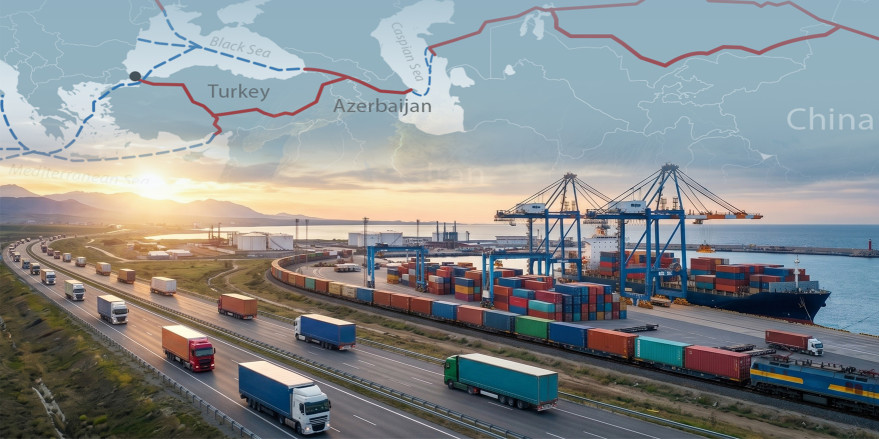
The expansion of Chinese rail traffic adds another dimension. Azerbaijan received 472 block trains from China during the first ten months of 2026, a 49% annual increase. This development reflects the growing relevance of the Middle Corridor, which connects Chinese manufacturing centres and Central Asian markets with Europe through Kazakhstan, the Caspian Sea, Azerbaijan, Georgia and Türkiye.
The financial implications are particularly important for an economy seeking to diversify its sources of foreign-currency earnings. Azerbaijan generated approximately $3.654 billion in transportation service exports in 2025, against imports of $1.728 billion, producing a positive balance of $1.926 billion. This surplus demonstrates that transportation has already become a meaningful contributor to the country's external economic position. Foreign customers purchasing Azerbaijani transportation services effectively generate export revenue through the use of domestic infrastructure.
The Port of Baku provides another indication of this potential. During January–October 2026, container handling exceeded 112,000 TEU, representing a 31% annual increase and a historical record for the facility. Meanwhile, the Astara Terminal handled 753,614 tonnes of cargo, up 37% from the corresponding period of 2025. October alone brought a record 122,216 tonnes through Astara.
These developments reveal the growing importance of Azerbaijan's two major international transport directions. The Middle Corridor connects East Asian and European markets, while the North-South International Transport Corridor links Russia and northern Eurasia with Iran and markets further south, including India. Astara's geographical position makes it an important component of the latter network, while the Port of Baku serves as a central gateway for trans-Caspian cargo movements.
The financial performance of existing infrastructure provides further evidence of the sector's commercial potential. In 2025, the Port of Baku generated approximately 59.2 million manats in revenue and transferred around 9.8 million manats to the state budget. Azerbaijan Railways, meanwhile, earned approximately 384 million manats from freight transportation, including 333.9 million manats from international shipments. These figures illustrate how international cargo flows translate into corporate revenues and public-sector receipts.
The broader economic contribution is equally significant. Between 2021 and 2025, value added in Azerbaijan's transportation sector increased from 6.4 billion manats to 9.1 billion manats. Employment across the sector expanded from approximately 147,000 to 185,200 people. Although these figures cover the entire transportation industry, they demonstrate the capacity of infrastructure development and expanding trade activity to stimulate employment and domestic value creation.
For Azerbaijan, the next stage of development involves increasing the economic value generated by each tonne of transit cargo. Railway tariffs and port handling charges represent the initial revenue layer. Warehousing, cargo consolidation, packaging, insurance, customs brokerage and distribution services provide additional opportunities. Industrial facilities located near logistics hubs could further transform transit corridors into centres of commercial activity, allowing Azerbaijan to capture a larger share of the value generated along international supply chains.
This approach also has implications for fiscal sustainability and external economic resilience. Transportation service exports provide an additional source of foreign currency alongside hydrocarbons, while taxes and potential dividends create channels for public revenue. A larger non-oil services surplus can strengthen the current account and broaden the foundations of Azerbaijan's external balance.
The country's geographical position has always offered a logistical advantage. The emerging commercial challenge is to convert that advantage into higher domestic value added, stronger corporate earnings and sustainable export revenues. With railway freight volumes rising 13%, transit traffic expanding 20% and Chinese block-train arrivals increasing 49% in the first ten months of 2026, Azerbaijan's logistics sector is acquiring greater economic weight.
The ultimate measure of success will be the revenue, productivity and domestic value generated by these growing cargo flows. Azerbaijan's transport infrastructure is increasingly becoming an economic asset in its own right, offering the country an opportunity to diversify its export structure and establish a more substantial position in Eurasian trade.
Here we are to serve you with news right now. It does not cost much, but worth your attention.
Choose to support open, independent, quality journalism and subscribe on a monthly basis.
By subscribing to our online newspaper, you can have full digital access to all news, analysis, and much more.
You can also follow AzerNEWS on Twitter @AzerNewsAz or Facebook @AzerNewsNewspaper
Thank you!