
When diaspora politics collides with Armenia's new reality [OPINION]
![When diaspora politics collides with Armenia's new reality [OPINION]](https://www.azernews.az/media/2026/06/24/5725672682568256_1.jpg)

Akbar Novruz
Read moreThere is a familiar Washington ritual playing out on Capitol Hill on Tuesday that would once have seemed unremarkable. Armenian-American activists in T-shirts bearing the faces of prisoners held in Baku, bipartisan Congressional amendments demanding the enforcement of Section 907 of the Freedom Support Act, and Aram Hamparian, executive director of the Armenian National Committee of America, the country's most powerful Armenian lobbying group, warning at a press conference that the current peace deal between Armenia and Azerbaijan is "a consolidation of ethnic cleansing and preparation for a new war." The thing that adds a new dimension to the process is that the very Armenian government approved this agreement, and the prime minister of the country, recently confirmed in power by his resounding victory in elections, described it as a first step "towards eternity and development of the Armenian nation." The diaspora and the homeland used to discuss the future of Armenians. But now they no longer talk about the same future.
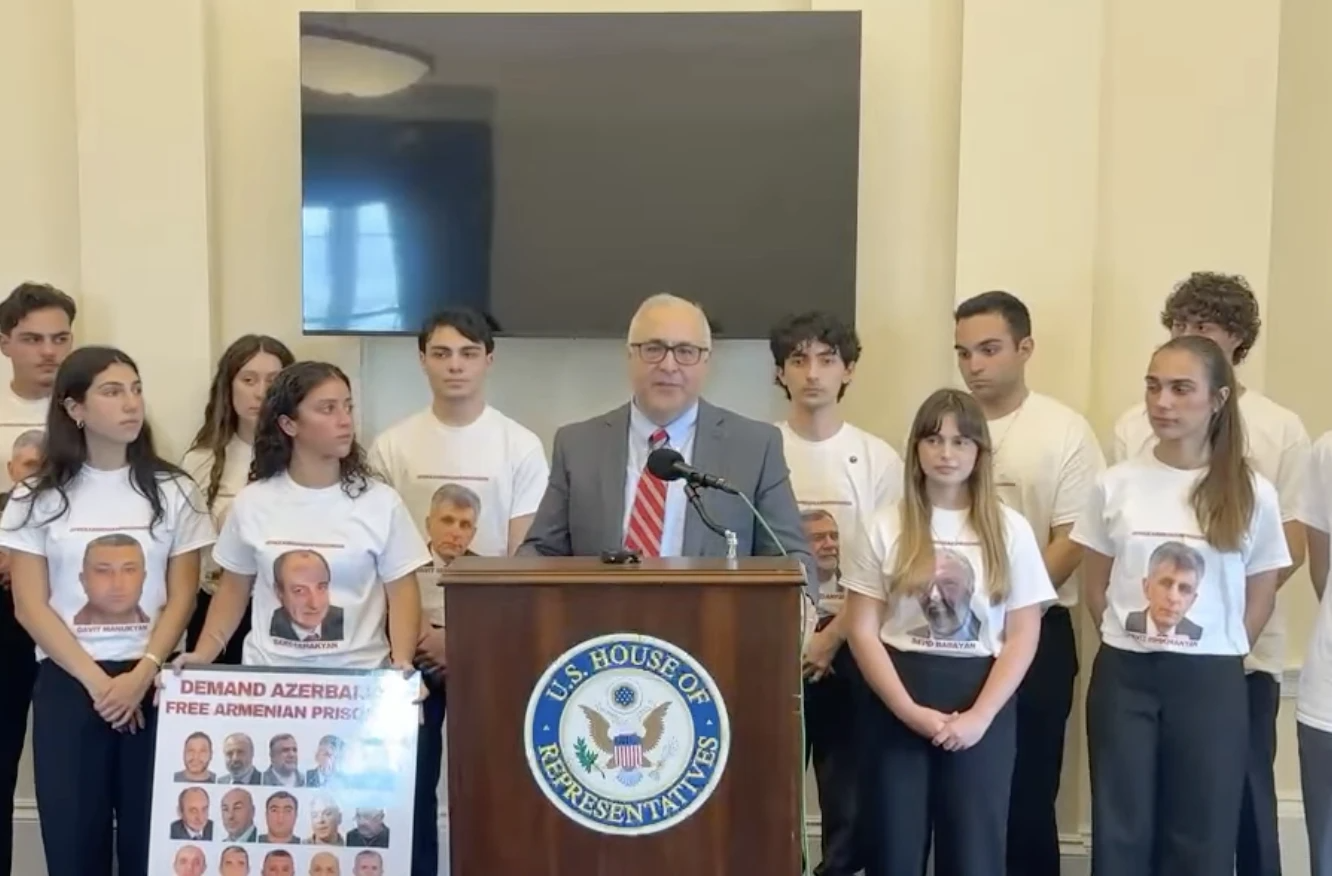
ANCA describes itself as the largest and most influential Armenian-American grassroots lobby group in the US, an assertion which, judging by its legislative and media clout, is definitely true. ANCA’s lobby network has managed to keep Section 907 of the Freedom Support Act alive for over thirty years, which is a provision prohibiting US military assistance to Azerbaijan that has no equivalent in sanctions legislation anywhere in America against a post-Soviet nation. Moreover, ANCA managed to win several Congressional resolutions and affect foreign aid funding as well as keep the bipartisan support of the Armenian Caucus for seven presidential administrations.
The problem is that success in Washington and success for Armenia have, since August 2025, been increasingly different things. The Washington Summit that ANCA characterized as "dangerous" and as a "sidelining of justice" was also the Summit where Pashinyan, elected and re-elected twice and most recently backed by 49.81% of the Armenian electorate last week, signed the joint declaration along with President Ilham Aliyev and POTUS Donald Trump, effectively terminating the institutionalized conflict of Karabakh. On the same day, Trump issued the waiver of Section 907, paving the way for American military aid to Azerbaijan. This move was termed as "reckless" by ANCA. As per Secretary of State Rubio, an Armenia-Azerbaijan war will be "destructive, counterproductive and the last thing we need."
Four consecutive US administrations have waived Section 907 despite sustained ANCA pressure. The Trump administration waived it to unlock the peace process. A Section 907 amendment was narrowly defeated in the House Foreign Affairs Committee by a 26-24 vote, with unprecedented unanimous Democratic support, but was defeated nonetheless. The leverage ANCA has been building for 30 years has not, so far, secured a single Armenian prisoner's release from Baku. Pashinyan's diplomacy, by contrast, produced the release of four Armenians in January 2026. The comparison is uncomfortable for an organisation whose authority rests on the claim that its Washington strategy serves Armenian interests. Better yet, the appeal court hearing continues for Armenian citizens in Baku, despite all the atrocities that have been committed over the years.
But whose side is the diaspora on?
The rift between ANCA and Yerevan has been made apparent in the case of Samvel Karapetyan, the Russian-Armenian billionaire who financed anti-Pashinyan political activity, details of which were revealed in the Dossier Centre material leak before the June 7th Armenian election. At the time when Karapetyan was being held in Yerevan after being accused because of his financial backing of church figures opposing Pashinyan's rule, Hamparian went public defending him as "one of Armenia's major philanthropists, employers and taxpayers." The Dossier Centre documents show how Karapetyan was connected with FSB databases, Gazprom real estate deals involving Putin's rumored girlfriend, Alina Kabaeva, and the anti-Pashinyan political campaign before the elections. ANCA's support of Karapetyan has put it, either consciously or unconsciously, at odds with the Russian-backed political operation, which was voted against by two-thirds of Armenians.
This is precisely the ecosystem that the critics of ANCA, including those within the community of Armenian-Americans itself, find most disturbing. The Mitrokhin Archive, based on KGB records smuggled out of Russia in 1992, provides evidence of Soviet manipulation of the Armenian diaspora networks as conduits for intelligence gathering and politicking. This is not proof of any direct link between the Soviet-era practices and today’s democratically run organisation called ANCA, which operates openly and in accordance with the rules of the American political game. However, the historical precedent of Soviet and post-Soviet Russian intelligence working with the Armenian diaspora network as its field of influence is important for understanding the claims of Russian money, diaspora manipulation, and anti-normalisation efforts made in recent years, starting in August 2025.
Now the harder question
But the much more difficult question, difficult because it has not been demonstrated that ANCA is affected by outside influence, is whether an organisation whose members and funding come primarily from the US, and whose leaders are based in Washington, has the right to overrule the wishes of Armenians who live in Armenia. Diasporic lobbying is a legitimate part of democracy. Armenian Americans can pay taxes, vote, and lobby for whatever they want in Congress.
In question here are the views put forward by ANCA that its positions reflect those of the Armenian people, despite being consistently at odds with the positions held by Armenia’s elected government, its duly re-elected Prime Minister, and, as demonstrated by last week’s election, with the majority of the Armenian people. The Armenian people, having been asked to choose between Pashinyan’s peaceful approach and their opponents', opted for the former in a ratio of two to one. While many of these individuals left the country during the war, and some recognize the difficulty of living in an isolated place like Armenia, there is a substantial group that, despite their comfortable lives in developed countries like the United States, uses rhetoric that impacts the lives of those residing in Armenia. They seem unaware that we are on the brink of a new era, where linking peace and war in this way may represent one of the greatest obstacles imaginable.
ANCA has its foundation, as it seems, but whether it is the right platform for such a campaign or whether its insistence on the Washington pressure model has, at this particular point in time, become an obstacle to bilateral talks that would secure their release is a question yet to be answered.
Here we are to serve you with news right now. It does not cost much, but worth your attention.
Choose to support open, independent, quality journalism and subscribe on a monthly basis.
By subscribing to our online newspaper, you can have full digital access to all news, analysis, and much more.
You can also follow AzerNEWS on Twitter @AzerNewsAz or Facebook @AzerNewsNewspaper
Thank you!