
Int'l conference on prevention of genocides like Khojaly held in Sarajevo
By Nigar Orujova
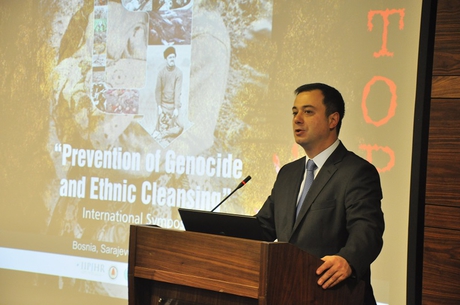
An international conference titled "From Khojaly to Srebrenica: Prevention of Genocide and Ethnic Cleansing", initiated by Heydar Aliyev Foundation Vice President Leyla Aliyeva, was held in Sarajevo, Bosnia and Herzegovina, on July 10.
The conference, which is part of the "Justice for Khojaly" international campaign, was organized in cooperation with the Youth Foundation under the Azerbaijani President and the country's Embassy in Bosnia and Herzegovina.
The campaign, initiated by Leyla Aliyeva, the OIC Youth Forum General Coordinator, is aimed at increasing international civil awareness through demonstration of photos and images of the people suffering in the Nagorno-Karabakh conflict and Khojaly Massacre in particular, and reaching out globally via media, the Internet and live events.
The event brings together representatives of non-governmental organizations from 15 European countries, and members of diplomatic missions based in Bosnia and Herzegovina.
Prior to the conference, participants visited a monument to the victims of Khojaly and Srebrenica in Bosnia and Herzegovina-Azerbaijan Friendship Park built on the initiative and with support of the Heydar Aliyev Foundation.
The participants also viewed the exhibition "From Khojaly to Srebrenica", which was opened in the Bristol Hotel in Sarajevo by Chairman of Azerbaijan`s State Committee for Work with Religious Organizations Elshad Iskandarov and Mayor of Novi Grad Semir Efendic. The exhibition includes works by Azerbaijani artist Nazim Mammadov about the Khojaly genocide.
At the opening ceremony of the conference, a letter of Heydar Aliyev Foundation Vice President Leyla Aliyeva was read out to the participants.
The letter noted the similarity of genocide in Khojaly and Srebrenica. It was stressed that impunity relating to the fact that the Khojaly genocide did not get worthy political and legal assessment of the international community caused genocides in Srebrenica, Rwanda and elsewhere.
The importance of bringing the perpetrators to justice and the need for joint action so that such crimes would not reoccur was particularly emphasized.
Addressing the meeting, State Committee Chairman Elshad Iskandarov, President of the Conference of INGOs of the Council of Europe, Jean-Marie Heydt, Novi Grad Mayor Semir Efendic, representative of EMISCO Veysel Filiz, and coordinator of TIKA in Bosnia and Herzegovina Zulkuf Oruj stressed the importance of the event, which was held on the eve of the 18th anniversary of the Srebrenica genocide.
Speakers said such activities are of particular importance to ensure justice for victims of all genocides that have occurred in the world, to bring the perpetrators who commited atrocities in Khojaly to justice, and to protect international law.
A documentary of European filmmakers called "Infinite Corridor" and dedicated to the Khojaly massacre was shown at the end of the event.
The most important issue of the conference, which first examined the relationship between the genocides committed in the 20th century, is that it is intended to be a platform for re-evaluation of the facts of genocide, which became a black stain in the history of mankind, and also to discuss the necessary tools and principles to prevent such crimes.
Turkish diaspora in U.S. urges recognition of war crimes
Recently, the union of the Turkish diaspora in the U.S., Pax Turcica, made an appeal urging recognition of the war crimes committed in Srebrenica and Khojaly.
The appeal says: "In July 2013, the international community remembers the 1995 Srebrenica Genocide, the worst atrocity on European soil since the Second World War. Over 8,000 Bosnian Muslims, mostly men and boys, were executed by the Bosnian Serb forces led by Ratko Mladic and Radovan Karadzic. Both the International Criminal Tribunal for the Former Yugoslavia and the International Court of Justice issued verdicts recognizing this war crime as an act of genocide."
According to Pax Turcica, while the war crimes in the Balkans drew a fitting international response, another one committed in Eastern Europe during the early 1990s did not.
"In the last days of February 1992, the armed forces of Armenia massacred hundreds of Azerbaijani civilians, including women, elders and children, during their assault on the town of Khojaly. The victims of this massacre have been denied justice up to date due to the ongoing Armenian occupation of Nagorno-Karabakh and surrounding Azerbaijani territories, and as the Armenian government continues to deny responsibility for the massacre."
Pax Turcica urges to join the campaign for proper recognition and remembrance of the victims of the war crimes in Srebrenica and Khojaly.
The Khojaly massacre is one of the most heinous and bloodiest events of the 20th century. Late into the night of February 25, 1992, the town of Khojaly came under intensive fire from the town of Khankendi and Askeran already occupied by Armenian armed forces. Thousands of fleeing civilians were ambushed by the Armenian forces. Punitive teams of the so-called Nagorno-Karabakh defense army reached the unprotected civilians to slaughter them, mutilating and scalping some bodies. 613 civilians were killed, including 106 women, 70 elderly and 83 children. A total of 1,000 civilians were disabled.
More than 8,000 Bosnian Muslims, mainly men and boys, were killed in the genocide which happened during the Bosnian War in July 1995 in the town of Srebrenica in Bosnia and Herzegovina, by units of the Army of Republika Srpska. The mass killings were described by the Secretary General of the United Nations as the worst crime on European soil since World War II.
An official document on the aggression of Armenia against Azerbaijan and recognition of the Khojaly genocide was adopted at the House of Peoples (upper chamber) of the Parliamentary Assembly of Bosnia and Herzegovina on February 26, 2013, the 21st anniversary of the massacre.
Prior to the Bosnia and Herzegovina parliament, the parliaments of Turkey, Pakistan, Mexico and Columbia recognized the Khojaly massacre as genocide.
The Czech Republic became the first EU country that officially condemned Armenia for the massacre of Azerbaijani civilians in Khojaly, and recognized this as a crime against humanity.
Besides, the Romanian Democratic Liberal Party's parliament group issued a statement on the Nagorno-Karabakh conflict condemning the Khojaly genocide.
Earlier, the U.S. states of Connecticut, West Virginia, Massachusetts, Texas, Maine, New Jersey, Georgia, New Mexico, Arkansas, Mississippi, Oklahoma, Tennessee and Pennsylvania recognized the Khojaly massacre.
Here we are to serve you with news right now. It does not cost much, but worth your attention.
Choose to support open, independent, quality journalism and subscribe on a monthly basis.
By subscribing to our online newspaper, you can have full digital access to all news, analysis, and much more.
You can also follow AzerNEWS on Twitter @AzerNewsAz or Facebook @AzerNewsNewspaper
Thank you!