
Exxon’s return to Azerbaijan gives US energy ties a new dimension

Akbar Novruz
Read moreIt may surprise some people to know that Azerbaijan’s oil history started on land. Oil wells existed here in the 19th century, well before any ideas about oil rigs in the Caspian came into existence, and when the Soviet Union dissolved in 1991, the country’s onshore oil fields had been heavily exploited. Since then, everything, including the cameras, has moved offshore. Towards the end of last month, ExxonMobil announced a return to onshore drilling.
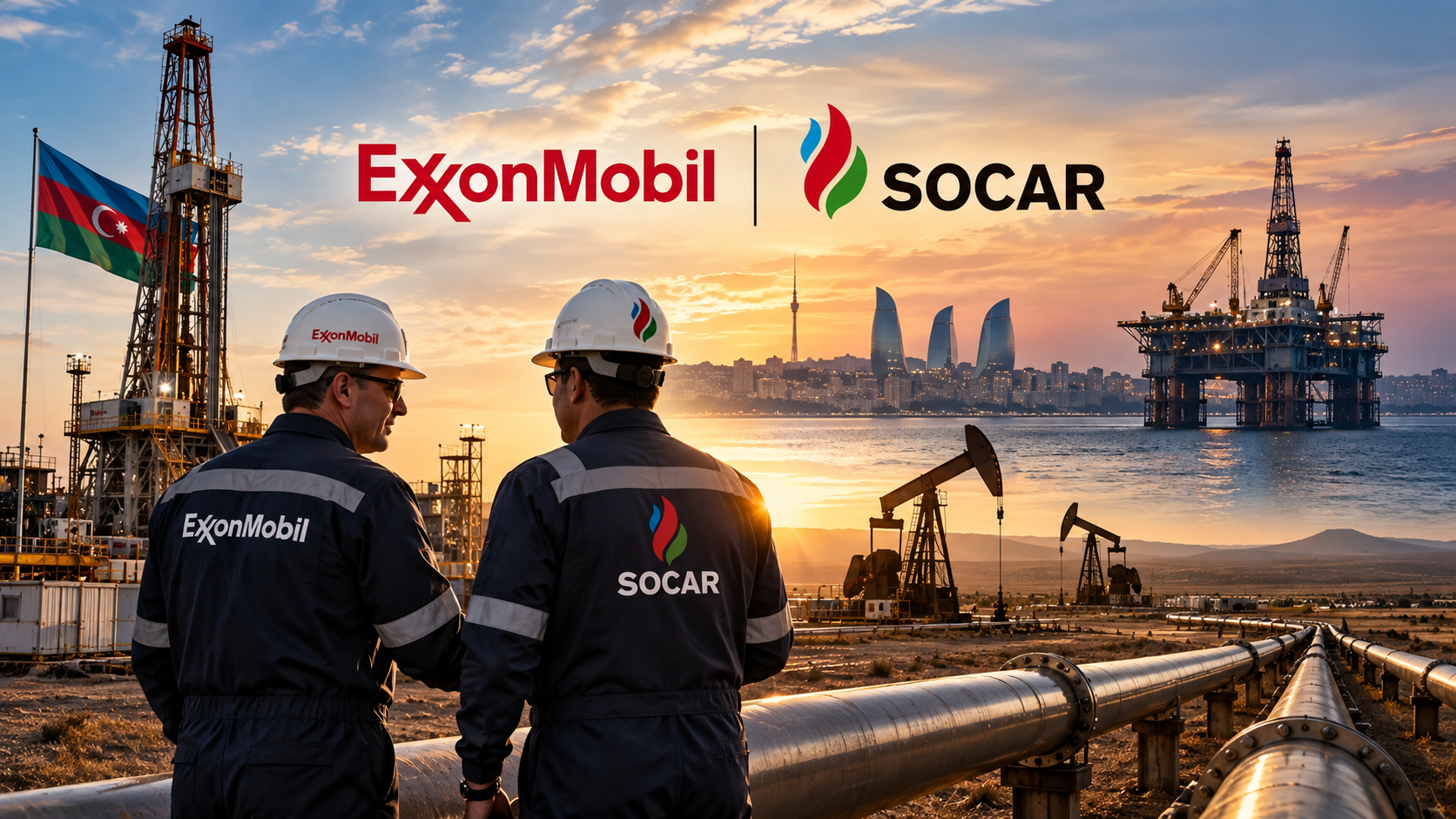
ExxonMobil, the US-based supermajor, has made a joint 50:50 production sharing agreement with SOCAR, which is Azerbaijan's state-owned oil company. This agreement involves the exploration, development, and production of unconventional hydrocarbons within an area in the Middle Kura Basin. ExxonMobil will be the operator of this project. The announcement made during the Azerbaijan International Investment Forum is expected to get approval from the parliament, following a series of negotiations over the past year, initiated by the Trump administration. "Together, we will combine Socar's knowledge of Azerbaijan with ExxonMobil's global experience and technology to better understand the basin's potential and pursue opportunities for safe and efficient development," said Bart Cahir, Exxon's senior vice-president for unconventionals.
Well, perhaps the timing for the initiative should not be considered as much of a coincidence - the offshore clock is ticking. The Azeri-Chirag-Gunashli complex, the offshore workhorse that bankrolled modern Azerbaijan, peaked at about 823,000 barrels a day in 2010. By 2025, it was producing roughly 330,000, a fall of around 60%. New offshore projects, including the Absheron gas development, are helping fill the gap, but few observers think a mature Caspian can carry the budget forever. Of course, until a new basin is found, the current numbers should be approached with caution.
Azerbaijani President Ilham Aliyev has insisted the oil and gas sector will keep its leading role for the next decade, and has framed the Exxon deal in ambitious terms: successful exploration, he said, "could lead to another oil and gas boom in Azerbaijan". That is a large claim for an agreement whose published terms specify no budget, no confirmed reserves, no output target, and no date for first commercial production.
The Middle Kura Region lies along the Kura River, which flows through Georgia, Türkiye, and Azerbaijan before entering the Caspian Sea. It houses the Muradkhanly region, which was once the biggest oilfield in Azerbaijan: oil production started in 1971 and peaked in the late 1970s; it then plummeted into the 1980s. Traditional drilling exploited what was easiest to extract. Now, the goal is the rock itself.
According to research from Azerbaijan's Institute of Geology, the core unconventional layer is the Maykop shale, which sits at depths of 4,500 to 5,000 metres in the central part of the basin and 2,000 to 3,000 metres closer to its edge. Azerbaijani academic work points to the Yevlakh-Agjabedi depression as the main prospect. Earlier wells in the Maykop gave mixed results, but they were not modern, multi-stage horizontal shale wells. That is what Exxon, whose business is exporting lessons from the Permian Basin and other US shale fields to similar geologies, now proposes to try.
For 15 years now, shale has provided most of the increase in global oil production, and this has enabled the United States to become the largest producer of crude. Copying that elsewhere is not as easy as it looks because the legal and regulatory environment is different from that in Texas; there are few service sectors; and the rock is never quite the same. No one should expect a miracle “Azerbaijani Permian.” An achievable goal would be a sequel for the national oil company of a declining flagship.
With all that said, it is in keeping with the larger trend in SOCAR’s strategy. In the same forum, SOCAR signed a framework agreement to inject $1.65 billion from the Azerbaijani company into Haynesville shale resources of Comstock Resources in the USA; the final agreement is supposed to be signed no later than October 31st and the transaction is expected to close at the end of the year, as well as a memorandum with Apollo regarding the potential investment of the fund in the upstream projects of SOCAR. Taken together, the logic is quite symmetrical. Exxon applies shale technology in Azerbaijan, and SOCAR invests in US shale gas that is expected to be liquefied and exported from the USA.
Washington's blessing matters too, cause, a flagship Exxon project gives American commercial interests a tangible stake in Azerbaijan, and sits comfortably alongside the strategic partnership charter the two governments signed in February.
Historic Maykop tests were uneven, onshore crudes in the area include heavier, more resinous streams than the light Azeri blend, and no dedicated takeaway infrastructure for shale output exists. If it does not, it still gains a map of its own subsurface and a new partner who has learned the ground.
*the cover image has been generated by AI
Here we are to serve you with news right now. It does not cost much, but worth your attention.
Choose to support open, independent, quality journalism and subscribe on a monthly basis.
By subscribing to our online newspaper, you can have full digital access to all news, analysis, and much more.
You can also follow AzerNEWS on Twitter @AzerNewsAz or Facebook @AzerNewsNewspaper
Thank you!