
Armenia’s trust problem puts its peace strategy under pressure
Akbar Novruz
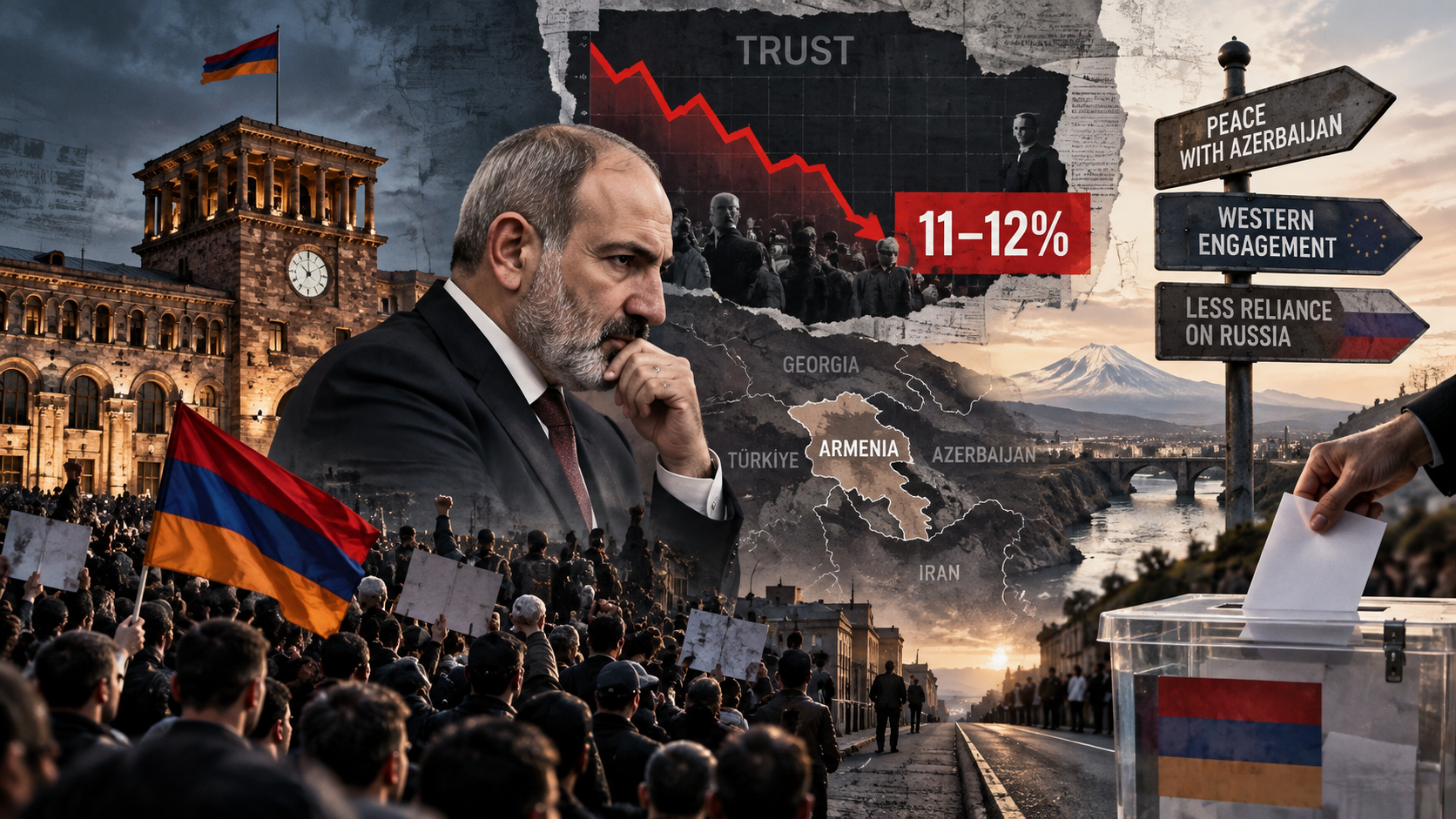
Read moreAt an academic conference on South Caucasus transport and logistics last week, Gevorg Poghosyan, an economist at Armenia's National Academy of Sciences, said something that should have made more headlines than it did: trust in Armenia's current government has fallen to somewhere between 11% and 12%. Perhaps this isn’t the kind of figure a democracy brings along into a period of reorientation in its foreign policy. It usually comes before.
"Public anxiety in Armenia is increasing, and statements from members of the ruling team regarding the threat of a new war are only heightening tensions and eroding public trust in state institutions. Additionally, the absence of a clear program for internal reforms and a lack of explanations regarding the objectives of changes in foreign policy and geopolitical direction raise the risk of further radicalization of public sentiment."
This observation was made by Gevorg Poghosyan, an academician at the National Academy of Sciences of Armenia, during his speech at the international expert conference titled "Prospects for the Development of Transport and Logistics Relations in the South Caucasus."
Mr Poghosyan's diagnosis is worth taking seriously precisely because it is not a hostile one. His complaint is not that Nikol Pashinyan's government is negotiating peace with Azerbaijan; he is largely sympathetic to the direction of the idea itself. His complaint is that Yerevan keeps explaining the process to its own public almost entirely through the language of threat. Hand over Tigranashen or risk war, amend the constitution or risk war. Poghosyan notes, pointedly, that this framing appears more often in statements from Armenian officials than from Baku itself, an odd rhetorical choice for a government that insists it is building peace rather than merely avoiding catastrophe.
This is the real issue, as the academician puts it, one of sequencing. There is a true reorientation taking place in Armenia, that is a reorientation away from automatic Russian reliance towards an uncertain engagement with the West, and negotiations with Azerbaijan. All of these issues affect the nature of Armenian national identity, the involvement of the Armenian diaspora, and the place of the Armenian Apostolic Church in public affairs. None of these is trivial. But, according to Mr Poghosyan, the public has been offered scant information regarding the end point, the duration of the process, or even the intermediary steps. "What does this entail? How long will it last? Where are things heading? Is there a roadmap?" are, in his telling, questions the government has left largely unanswered. Experience in other countries on this front leaves no doubt – efforts to push ahead with reform programs without winning popular consent often backfire when such patience is needed most.
As all stated, it would also be a mistake to accept this account uncritically. Nikol Pashinyan's defenders have a reasonable rebuttal as well; he does actually speak often and directly to the Armenian people, explaining what he does well before he does it; and his party’s recent success at the ballot box indicates that the strategy hasn’t been a total failure. And of course there are ample reasons for those who have traditionally supported the Armenian political order prior to 2018 to push the idea of a government out of control and the citizens confused, because the idea of the gap in trust between government and citizenry is also a convenient way to argue that Pashinyan should step down. It is a valid question as to whether Poghosyan’s take is a disinterested social scientific point of view or rather a political point disguised as such.
What is harder to dismiss, whatever one makes of Mr Poghosyan's motives, is the gap between the ballot box and the comment section.
Pashinyan's party has won the elections on the platform of normalizing relations with Azerbaijan. However, during this period, Armenian social media has appeared to be far less reconciled with this process, with the tone of hostility towards Azerbaijan and Azerbaijanis being rather similar to that during summer 2020 when clashes at the Tovuz border prompted violent confrontations between diaspora communities in Brussels, Los Angeles, Paris and Moscow. Nevertheless, it leaves a rather disturbing thought about the current diplomacy of Yerevan: is this a government quietly tolerating revanchist sentiment at home while projecting conciliation abroad, or a government that has simply lost whatever capacity it once had to shape its own public's mood? Neither answer is especially reassuring for the durability of what has been negotiated so far.
Armenian PM has been willing to say, repeatedly and in public, that peace with Baku requires concessions Armenians will find painful. What he has been considerably less willing to do is walk his own electorate through the specific sequence, which constitutional provisions change, on what timeline, with what safeguards, and what Armenia gets in exchange at each stage, that would let that pain feel like a plan rather than a surrender extracted under pressure.
There is, underlying all of this, a historical reckoning Armenian public discourse has arguably never fully completed. The administrative borders both republics inherited from Soviet nation-building satisfied nobody when they were drawn; Baku's Azerbaijani-majority districts were allocated to Armenia, which Azerbaijanis consider unjust. But as far as Baku is concerned, it has managed to come to terms with the boundaries decades ago. The Armenian political elite in Yerevan, however, throughout different administrations, never did so - opting for a maximalist approach, one of keeping the territories under control at the cost of removing the population there from them, which proved to be much more expensive, both in terms of lives lost and wasted years, than the logic of population exchange within existing borders, which has ultimately been the case after three decades of warfare.
Now, Poghosyan's warning about "alternative methods of exerting political influence", his careful way of flagging the risk of unrest outside constitutional channels, deserves to be taken at face value regardless of who is making the argument or why. And maybe the academician is illustrating a situation he wants to see it as. The latter part is indeed difficult to speculate.
However, a government running on an 11% trust rating (if true as claimed), pursuing a historically unpopular set of territorial and constitutional compromises, without a public roadmap its own citizens can follow, is not a government with much room for error. The calculations of Baku regarding the prospects of peace in the region already assume that the situation in Yerevan will stay volatile for quite some time; the question of how long that volatility will be limited only to the parliamentary floor and voting boxes, or will extend beyond, might have less to do with whatever document is signed somewhere else than with the readiness of Armenia’s leadership to clarify its goals to its own citizens.
Here we are to serve you with news right now. It does not cost much, but worth your attention.
Choose to support open, independent, quality journalism and subscribe on a monthly basis.
By subscribing to our online newspaper, you can have full digital access to all news, analysis, and much more.
You can also follow AzerNEWS on Twitter @AzerNewsAz or Facebook @AzerNewsNewspaper
Thank you!