
Azerbaijan’s farm exports near $1 billion as economy pushes beyond oil

Qabil Ashirov
Read moreOil and gas continue to hold a dominant position in Azerbaijan’s exports, but changes in the country’s export structure in recent years show that the economy is gradually relying on a broader range of sectors. The figures for the first eight months of 2026 once again highlight the growing role of the non-oil sector, particularly agriculture and agro-industry, in this process.
According to a report by the State Customs Committee, Azerbaijan exported $21.8 billion worth of products in the first eight months of 2026, of which $6.28 billion, or 28.78%, came from the non-oil and gas sector. The change becomes more visible when compared with the same period of last year, when non-oil and gas products accounted for 14.06% of total exports.
A more detailed breakdown of non-oil exports is provided in the latest report by the Center for Analysis of Economic Reforms and Communication.
According to the report, Azerbaijan’s non-oil exports, excluding non-monetary gold, increased by 17.6% in January-August 2026 to $2.81 billion. A number of non-oil products recorded significant increases during the period.
Agriculture occupies a particularly important place within this picture. Agricultural exports increased by 19.2% in January-August to $732 million, while exports of agro-industrial products rose by 22.1% to $255.8 million. Combined exports of agricultural and agro-industrial products increased by 19.9% to $987.8 million, bringing them close to the $1 billion threshold.
Yet the importance of these figures goes far beyond the export revenues they generate.
The development of agriculture and agro-industry is a strategic issue for virtually every country because it is directly linked to national food security. Unlike many other sectors of the economy, agriculture produces goods that are essential for the daily lives of the population. A country that has a strong domestic agricultural base is better positioned to maintain a stable food supply and reduce its exposure to disruptions in international markets, external price shocks and supply-chain problems.
For Azerbaijan, this issue is particularly relevant because agriculture can simultaneously contribute to export diversification and strengthen domestic food security. Increasing agricultural production means that a larger share of domestic demand can potentially be met by local producers, while the development of agro-industry allows agricultural raw materials to be processed domestically instead of being exported with limited added value.
This is where the structure of the latest export figures becomes particularly important. Agro-industrial exports grew by 22.1%, faster than agricultural exports, which increased by 19.2%. The difference may appear relatively small, but it points to an important economic direction: agriculture is increasingly connected with processing, packaging, logistics, storage and food manufacturing.
The greater the share of agricultural products that can be processed domestically, the greater the potential economic value generated before those products reach either domestic or international consumers. This can also create additional employment and income opportunities in rural areas and strengthen links between agriculture and manufacturing.
At the same time, agriculture has an important role to play in addressing food inflation. Azerbaijan, like other countries, cannot isolate domestic food prices completely from international developments. Import prices, transportation costs, energy prices, fertiliser costs, exchange-rate movements, seasonal factors and trading margins can all affect the final price paid by consumers.
However, the development of domestic agricultural production can expand the supply available to the domestic market and reduce the economy’s dependence on imported food products. A larger and more productive domestic agricultural sector therefore has the potential to act as one of the mechanisms that can help contain food-price pressures over the longer term.
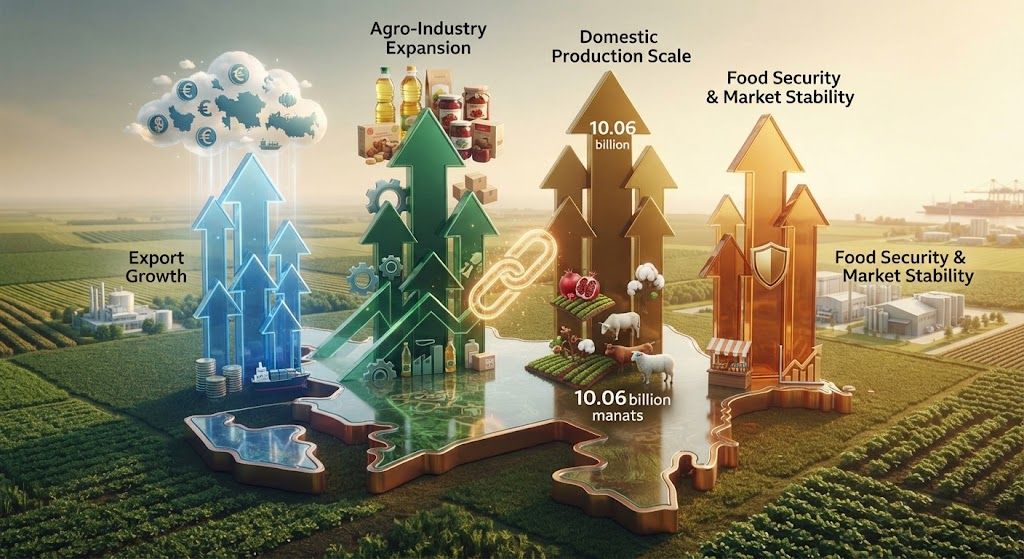
The latest domestic production figures demonstrate the scale of the sector. According to the State Statistics Committee, Azerbaijan produced 10.06 billion manats ($5.92 billion) worth of agricultural products in January-August 2026, with real agricultural output increasing by 2.6%. Crop production increased by 3.1%, while livestock production grew by 2%. Agriculture, forestry and fishing accounted for 6.2% of GDP during the period.
At the same time, the scale of the domestic food market is substantial. Retail sales of food products, beverages and tobacco products amounted to 24.1 billion manats ($14.18 billion) in January-August 2026. Food products, beverages and tobacco prices increased by 6.9% year-on-year during the period, while the annual increase in August alone reached 7.2%.
These figures demonstrate why agricultural development should be viewed through two different but interconnected lenses. One is the external market: agriculture and agro-industry are contributing to the diversification of Azerbaijan’s export basket and generating additional foreign-exchange revenues. The other is the domestic market: stronger agricultural production and food processing can contribute to food security and expand domestic supply.
This makes the development of agro-industry particularly important. Azerbaijan has an opportunity to move further from simply producing agricultural commodities toward processing, packaging and exporting products with greater added value. Such a model can strengthen the agricultural sector while also supporting broader industrial diversification.
The nearly $1 billion in combined agricultural and agro-industrial exports recorded in just eight months of 2026 is therefore more than another export statistic. It illustrates the growing economic and strategic importance of a sector that can simultaneously contribute to export diversification, rural development, domestic production, food security and efforts to contain food-price pressures. The long-term significance of agriculture for Azerbaijan may ultimately be measured not only by how much the country exports, but also by how effectively it can ensure a stable, affordable and increasingly domestically supplied food market.
Here we are to serve you with news right now. It does not cost much, but worth your attention.
Choose to support open, independent, quality journalism and subscribe on a monthly basis.
By subscribing to our online newspaper, you can have full digital access to all news, analysis, and much more.
You can also follow AzerNEWS on Twitter @AzerNewsAz or Facebook @AzerNewsNewspaper
Thank you!