
Cotton cultivation boom links tradition with modern value-chain growth

Akbar Novruz
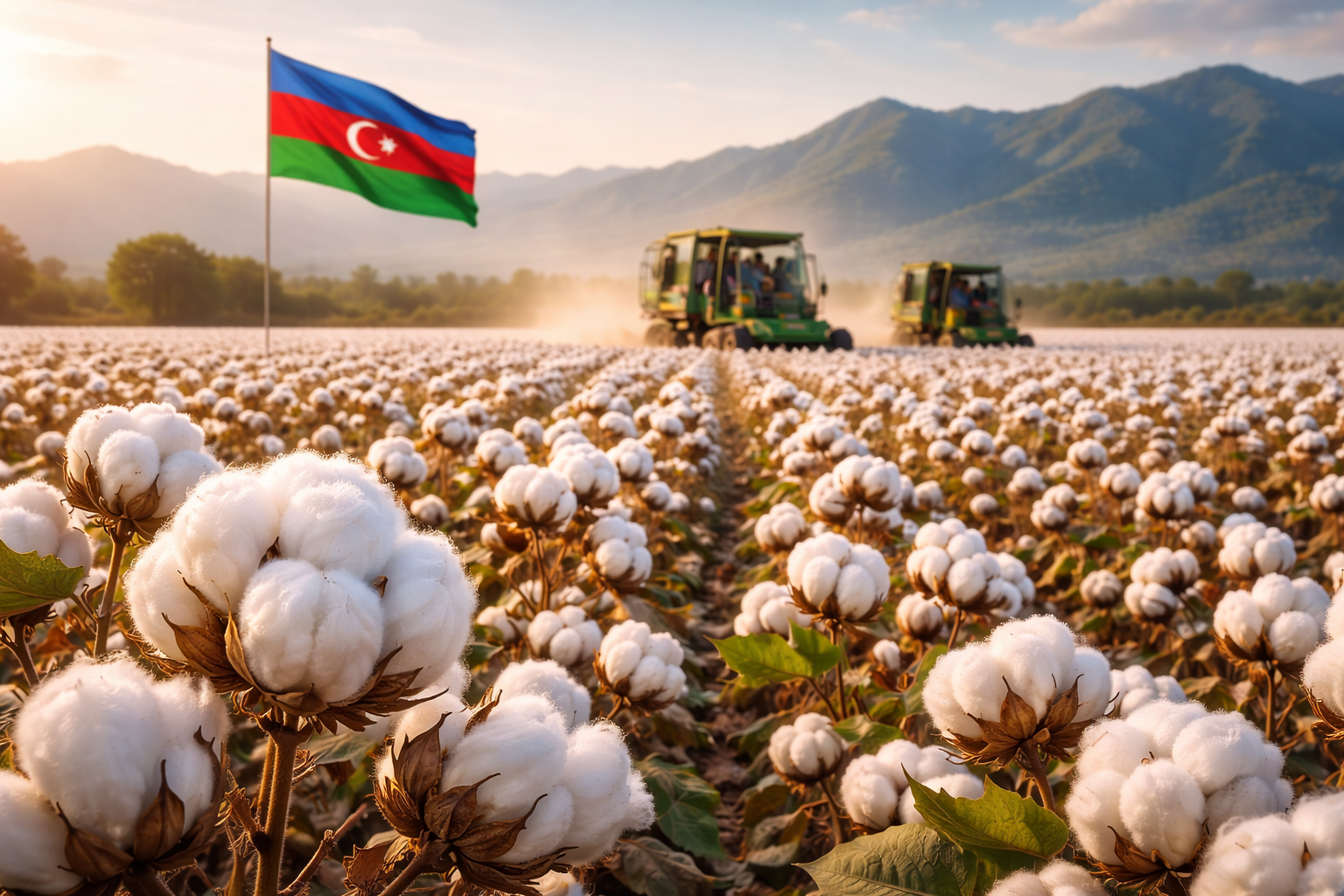
Read moreAzerbaijan is on the verge of realising the biggest cotton harvest since the country gained its independence. This represents a kind of breakthrough within the agricultural sector and further enhances the position of the country within the global cotton industry. Cotton production begins to take on the sense of an important agricultural crop for Azerbaijan again. Almost complete harvests of the 2025 harvest suggest a revival of the industry after a few years of shrinkage.
According to a statement made by Azerbaijan’s Ministry of Agriculture by early December, 353,914 tons of raw cotton were gathered from 100,468.1 hectares of agricultural land, and this year's crop average of 35.23 centners of cotton per hectare is a record high in Azerbaijan after independence.
In US dollar value, the amount of raw cotton is measured in tens of millions of agricultural products, thus accentuating the significance of cotton beyond its simple nominal value of export.
This increase has come against the background of various harvest decreases experienced in previous years. To give a proper comparison, Azerbaijan harvested just over 307,000 tons in 2024, while in 2023, harvests decreased to 276,300 tons. This shows that in 2022 and 2020, harvests stood at approximately 323,000 and 337,000 tons, respectively, making 2025’s harvest a definitive turnaround in renewed focus on this sector.
Cotton farming has been conducted in 16 areas during the 2025 economic year, with the largest area of agricultural land allocated towards cotton farming in nine traditional cotton-growing districts: Aghjabedi, Beylagan, Barda, Bilasuvar, Imishli, Neftchala, Saatli, Sabirabad, and Salyan. The nine areas comprise approximately 86,000 hectares of cotton plantations.
As of December 8, the Beylagan region showed the highest level of productivity in the country with an average harvest of 41.07 centners per hectare, with a total output of 36,543.9 tons from 8,898.3 hectares. The list includes a number of high-performing areas, such as Neftchala with 39.64 centners per hectare, Bilasuvar with 39.45 centners per hectare, Tartar with 37.46 centners per hectare, and Barda with 35.80 centners per hectare
In the cotton belt, Barda recorded an average harvest of 30,249.4 centners from 8,448.8 ha of land, yielding 35.8 centners per ha, one of the better performances in the country.
The reinforcement of cotton lint and yarn output indicates improvement in the field. In January-November 2025, Azerbaijan manufactured 76,856.5 tons of cotton lint, a rise of 33.8 per cent from previous years, and cotton yarn worth 19,737.4 tons, a rise of 22.9 per cent. The large storage stocks, measuring 28,308.2 tons of cotton lint and 5,214.7 tons of cotton yarn on December 1, indicate growing material availability.
The trend is also seen in the export results. The total export of cotton yarn from January to October 2025 was 12,029.40 tons, with a value of US$27.45 million, which indicates a rise of 17.8 per cent and 8.8 per cent over the same period of the previous year, respectively. All these figures clearly indicate how the growth of the cotton crop itself contributes to the generation of more value-added exports instead of remaining basic exports.
Further information from mid-2025 reveals that raw cotton production in the first half of the year had shown a substantial increase of more than 46,000 tons, and that cotton yarn production was up by nearly 25 per cent in the first seven months.
Expectations for further expansion led the Agricultural Subsidy Council to announce an increase in the support levels for cotton crops in the 2026 agricultural year very recently. Farmers will get 215 manats per ton (approx US$126) for irrigated cotton and 200 manats per ton (approx US$118) for non-irrigated cotton, thus pragmatic efforts are being promoted through this upliftment too.
The subsidies will be applicable in specific regions, including Aghjabedi, Beylagan, Barda, Neftchala, Saatli, Sabirabad, and others, while other regions will be denied yield subsidies. Justification is based on promoting both yield and specialisation.
There have been new state standards set for cotton in 2025. These seek to enhance the quality control of cotton lint assessment, ranging from maturity to purity. This paves the way to better export revenues.
Regardless of the bright spot, there are still issues that need to be addressed. The problem of water, especially in regions where cotton is grown, has been seen as an issue. The need for irrigation systems has been advocated by the growers, especially for the purposes of yield. Development of local high-quality varieties, as well as having improved protection against diseases, is another priority.
There are also some international efforts for the modernisation of agriculture in Rwanda. For example, FAO and IAEA-funded schemes have implemented the use of climate-resilient agriculture and nuclear-supported soil and fertiliser optimisation methods, whose potential for yield expansion and soil and climate change resilience is evident in some pilots.
Apart from cotton fibres, Azerbaijan is slowly developing the textile chain. This is seen in the cotton processing factory in the Sabirabad Industrial District, churning out lint and technical fibres for both domestic and export markets. Using imported technology from countries like Türkiye, Germany, and Italy, the factory’s annual production capacity stands at 8,000 tons of lint and 10,000 tons of fibres, already seeing exports and job creation.
On the one hand, new joint ventures are coming to fruition. Joint projects with Uzbek textile companies aim to create clusters of cotton farming, yarn, textiles, and clothing to make Azerbaijan, besides being a raw material provider, a participant in the textile sector supply chain.
The cotton harvest of 2025 is an indicator not only of quantity growth but also of the qualitative change in Azerbaijan’s agricultural economy. Indeed, thanks to record harvest volumes, growing processing production, supportive policy and rising levels of international partnership, cotton is re-emerging as a driving force not only in rural jobs but also in non-oil exports. If the trend is any indication, particularly with improvements in irrigation systems and the use of modern cultivation methods and textile manufacturing linkages, cotton could become an innovation catalyst for the farm sector in Azerbaijan from its current status as a traditional crop.
Here we are to serve you with news right now. It does not cost much, but worth your attention.
Choose to support open, independent, quality journalism and subscribe on a monthly basis.
By subscribing to our online newspaper, you can have full digital access to all news, analysis, and much more.
You can also follow AzerNEWS on Twitter @AzerNewsAz or Facebook @AzerNewsNewspaper
Thank you!