
Azerbaijan is preparing to turn OIC diplomacy into investment as its next offering
Akbar Novruz
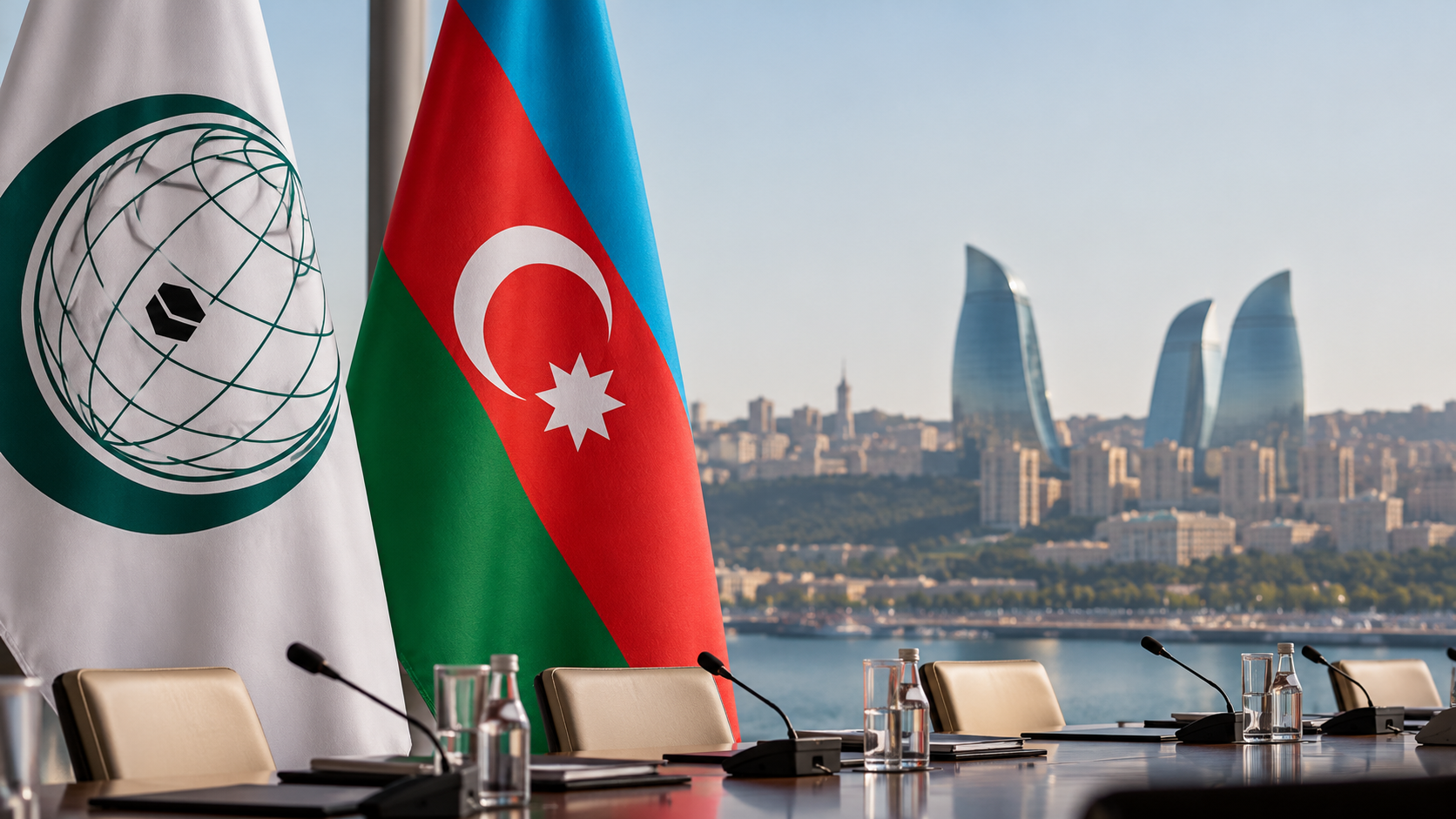
Read moreThe new Secretary-General of the Organisation of Islamic Cooperation had already chosen Baku as his destination quite early. Ismail Ould Cheikh Ahmed, a diplomat from Mauritania who was elected as the Secretary-General in Jeddah on August 27th, was accorded a reception by the President of Azerbaijan, Ilham Aliyev, on October 26th – one of the early visits made at the beginning of his term. It was a symbolic visit meant to indicate that Azerbaijan will be hosting the OIC summit next year.
Politically speaking, it is well deserved. But the more serious aspect concerns what Azerbaijan makes of its opportunity. Being a chairman provides publicity for one year, but it can provide economic gains for a decade if it uses the OIC both as a political organization and as an economic network.
A history of a strong political hand
Azerbaijan became an OIC member soon after gaining independence, and it is already 35 years into its membership in the organization. In 2004, Azerbaijan organized the OIC Youth Forum; in 2013, as president of the UN Security Council, it initiated the first high-level meeting concerning cooperation between the OIC and UN, and in 2017 announced a “Year of Islamic Solidarity” and held the Islamic Solidarity Games. For more than 30 years of occupation of its territory, Azerbaijan received support from the OIC in the form of resolutions and a contact group on the conflict, and after the 2020 war, the OIC criticized the occupation and praised the reconstruction of Azerbaijan. As for Ould Cheikh Ahmed, he congratulated President Aliyev on the restoration of sovereignty and territorial integrity of Azerbaijan and supported him in establishing peace.
Baku has also discovered an issue that allows it to be in the lead, not lag behind: Islamophobia. It has made holding conferences on this matter a part of its diplomacy, which was received with open arms by UN special envoy Miguel Ángel Moratinos, who appreciated its position, and it makes voluntary donations to the UN Alliance of Civilizations. At the last conference, Ilham Aliyev and the Secretary-General talked about their joint fight against disinformation. According to the officials from Azerbaijan, organizations like the European Parliament and PACE associate Islam with extremism. Opponents argue that these same organizations simply criticized the human rights situation in Baku.
Trade, Islamic Finance and more...
But politics, as much as they are intertwined with it, is not business. Intra-group trade within the organization of 57 member states had grown to $555 billion by 2025, accounting for 20.1% of their total goods trade. This is a slight rise from 19.3% in 2021, but is well below the 25% target set by the OIC for 2025. OIC represents roughly one-fifth of the global population and accounts for only 10-11% of its total goods trade, with over half (47.5%) of its total exports coming from fuel exporters.
This too follows suit in the case of Azerbaijan. Türkiye, with a trade relationship of $5.7 billion in 2025, is the most obvious partner within the OIC group for the country, with oil and gas making up the bulk of its exports. This provides an opportunity for improvement through the chairmanship. The Trade Preferential System of OIC Member States and the Islamic Centre for Development of Trade have been put in place to reduce tariffs and facilitate contact between businesses; however, they remain vastly underutilized. Azerbaijan has many manufacturers of processed foods, construction materials, chemicals, and manufactured products that are beginning to emerge from the industrial zones of Karabakh and Alat.
Capital is the second most important prize here. The annual meeting of the Islamic Development Bank Group was held in June in Baku and concluded with 67 agreements valued at $6bn between ten member countries. As part of this agreement, the IsDB has provided a loan of $436m for the construction of the irrigation canal in Karabakh. Since the membership [of Azerbaijan] in the bank in 1992, the organization has provided more than $1.8bn in funding for 84 projects in sectors such as infrastructure, energy, agriculture, and social services, including the railway line from Baku to Kars via Tbilisi, and the Alat Free Economic Zone.
The Islamic finance sector is at a point where it is moving from talk to implementation. The central bank has started a regulatory sandbox where two banks, namely Rabitabank and the International Bank of Azerbaijan (ABB), are providing Islamic banking services, while the governor of the central bank, Taleh Kazimov, says that a legal framework for the issuance of the first sukuk in the country is being drafted by IsDB. There is an agreement between SOCAR and the bank, which has a private sector division. The issuance of a first sukuk, and then a green sukuk with respect to renewable energy projects in the liberated areas, will help Baku get funds from Gulf and Asian investors.
The circumstances are conducive to this endeavor. The “Green Energy Zone” within the liberated territories requires billions in investment, while the UAE, Saudi Arabia, and Qatar are seeking opportunities outside their jurisdictions. The deals signed by September with Abu Dhabi on energy, artificial intelligence, and minerals indicate that sovereign investment can follow diplomacy.
Conversely, geography provides the final argument in support. Azerbaijan represents the western end of the Middle Corridor, linking up OIC members from Central Asia – Kazakhstan, Uzbekistan, Turkmenistan, and others – to Türkiye, the Gulf, and Europe without going through Russia or Iran. With the new Alat port, Baku-Tbilisi-Kars railway, and fibre-optic cable across the Caspian Sea, the route follows mostly OIC countries. Harmonizing customs regulations and electronic documents for transit would increase trade between OIC members at least as much as any tariff preference.
The test for the next two years is whether the chairmanship leaves behind commercial plumbing as well as communiqués: a trade agenda for Azerbaijani manufacturers, a sukuk market with a green window, and corridor deals that give landlocked members a reason to route through Baku. Solidarity has been Azerbaijan's gift to the Islamic world for three decades now. The next gift of Azerbaijan to the Islamic world could be that the Islamic world can conduct business amongst themselves on a large scale.
Here we are to serve you with news right now. It does not cost much, but worth your attention.
Choose to support open, independent, quality journalism and subscribe on a monthly basis.
By subscribing to our online newspaper, you can have full digital access to all news, analysis, and much more.
You can also follow AzerNEWS on Twitter @AzerNewsAz or Facebook @AzerNewsNewspaper
Thank you!