
France’s wave of unrest exposes a deepening crisis of governance

Ulviyya Poladova
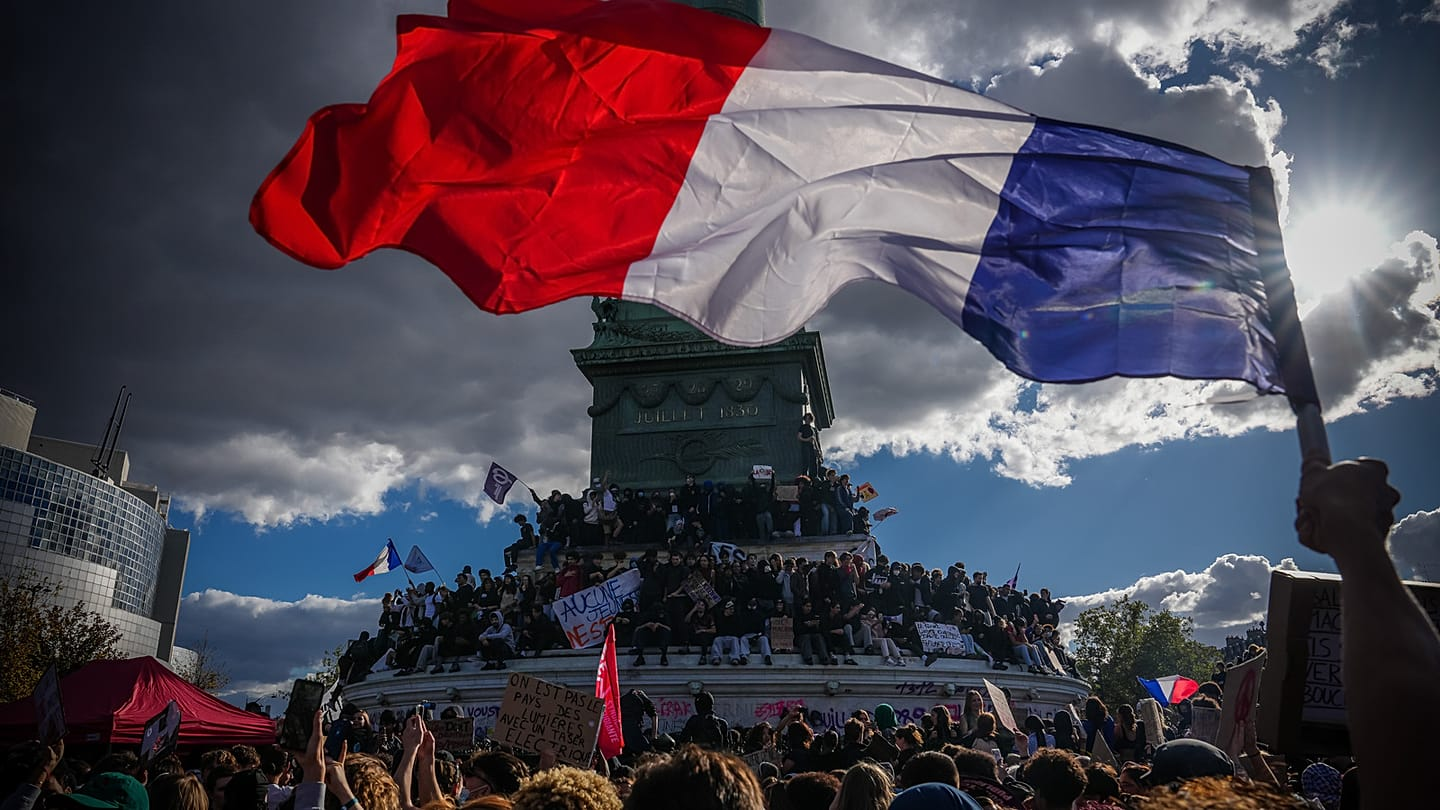
Read moreIn mid-October 2026, France found itself plunged into a period of acute societal upheaval. What began as a series of widespread demonstrations across the country against the rising cost of living, surging fuel prices, and the perceived decline of public services, rapidly spiraled into some of the most destructive civil unrest the nation has witnessed. Over 500,000 protesters had taken to the streets in Paris, Marseille, Lyon, and other major urban centers. While the initial demonstrations were characterized by the varied voices of students, teachers, labor unions, and a renewed iteration of the "Yellow Vest" movement, the atmosphere soon darkened as clashes erupted between segments of the crowds and security forces, leading to widespread vandalism, arson, and thousands of arrests.
The violence has sent shockwaves through the French political establishment, drawing comparisons to the historic social unrest of 1968. President Emmanuel Macron, addressing the nation amidst the chaos, issued an urgent appeal for order. He pledged to confront the economic grievances fueling the anger while simultaneously condemning the rioters and vowing that those responsible for the violence would be held accountable.
To understand the scale of the current instability, we need to look beneath the veneer of the immediate riots to the protracted economic anxiety gripping France. For years, the country has struggled with slowing wage growth, a high tax burden, and the worsening effects of global inflationary pressures. The protests initially began with high school students and public sector employees taking to the streets. Students were angered by mounting problems in the education system, including teacher shortages, overcrowded classrooms and the poor condition of school buildings, while public sector workers protested against a freeze on wages.
Less than a month later, the demonstrations had grown significantly. On October 17, not only school students but also university students, trade union members and supporters of the Yellow Vests movement took to the streets across France. They protested against the rising cost of living and declining quality of public services, demanding higher wages and pensions as well as better learning conditions.
Authorities had initially expected between 60,000 and 110,000 people to demonstrate in major cities. However, according to the French Interior Ministry, around 550,000 people ultimately took part in the protests nationwide, including 110,000 in Paris alone. Organizers put the total turnout at 800,000. Interior Minister Laurent Nuñez said approximately 110 marches were held across the country.
The political climate in France has become increasingly brittle. The current unrest has laid bare a profound crisis of confidence in the Macron presidency. This approach of the administration, characterized by a centralized, technocratic style of governance, has served to alienate significant portions of the electorate. Within this charged atmosphere, a potent narrative has taken hold among opposition groups and disillusioned citizens that the administration is not just unable to cope with economic and political problems, but is also actively pursuing policies that exacerbate the polarization of society.
France, which has long presented itself as a champion of democratic values and political freedoms, is now facing growing discontent at home.
Look closely at the chaos on the squares. The peaceful students and workers who came out to defend their rights are not the ones setting fires. Into their midst have been inserted trained, organized radical groups whose task is to loot, to burn, to riot - and in doing so to bury legitimate protest under a cloud of smoke.
The script is familiar to anyone who has studied how fear is used as a tool of power. Manufacture vandalism, let the cameras record it, and suddenly the public is taught to hate the protesters instead of the government. Then the police violence that follows is no longer brutality because it is "order being restored."
With elections approaching, Macron's political standing has sunk to the lowest point of his career. A government this unpopular has every reason to want the country ungovernable, because chaos on the eve of a vote creates the perfect pretext to declare a state of emergency or impose military rule. There is also the matter of money. Allegations of large-scale financial fraud, corruption, and the opaque spending of public funds have crept closer and closer to Macron's own circle. Riots are a convenient distraction. While the country stares at burning cars, no one is asking where the money went.
France’s public debt crisis
France’s public debt currently stands at around €3.6 trillion, or 119% of GDP, its highest level since 1946, when the country was recovering from World War II. Much of the debt was accumulated during years of low interest rates. Now that borrowing costs are rising, servicing it is becoming increasingly expensive.
Two factors are making the situation worse. First, France has run a budget deficit every year since 1975, meaning the government must continue borrowing not only to cover its current spending but also to refinance existing debt. Second, political divisions in recent years have weakened investor confidence in French government bonds, forcing the country to offer higher returns to attract buyers. This year, yields on French 10-year government bonds approached 5%, their highest level since 2002. France is now paying more to borrow than Greece and Italy, two countries that were at the centre of the eurozone debt crisis.
The outlook is troubling. Debt-servicing costs are projected to rise by 59% by the end of the decade. They have already become one of the largest items in the national budget and could significantly exceed defence spending by 2030, leaving the government with less room to fund public services and respond to growing social demands.
Illustration generated by AI
Here we are to serve you with news right now. It does not cost much, but worth your attention.
Choose to support open, independent, quality journalism and subscribe on a monthly basis.
By subscribing to our online newspaper, you can have full digital access to all news, analysis, and much more.
You can also follow AzerNEWS on Twitter @AzerNewsAz or Facebook @AzerNewsNewspaper
Thank you!