
Škoda eyes Baku as a rail workshop for the Caucasus
Akbar Novruz
Read moreBoarding the Baku Metro during rush hour, the scale of the challenge is obvious, having experienced it, even for an occasional commuter. In 2025, the network carried 226.8 million passengers, roughly 621,000 per day, down 1.4% from approximately 230 million in 2024. The metro operated across 27 stations and 40.7 kilometres of track, while the number of passenger carriages entering service increased by 9% to 381, according to AZCON Holding's annual report. Train intervals were shortened by 15 seconds to just one minute and 45 seconds during peak operations. Yet the pressure on the ageing network remains considerable. Under the government's 2025–2030 transport development programme, authorities plan to construct another 10 stations and procure 299 additional next-generation carriages, expanding capacity while gradually replacing Soviet-era rolling stock.
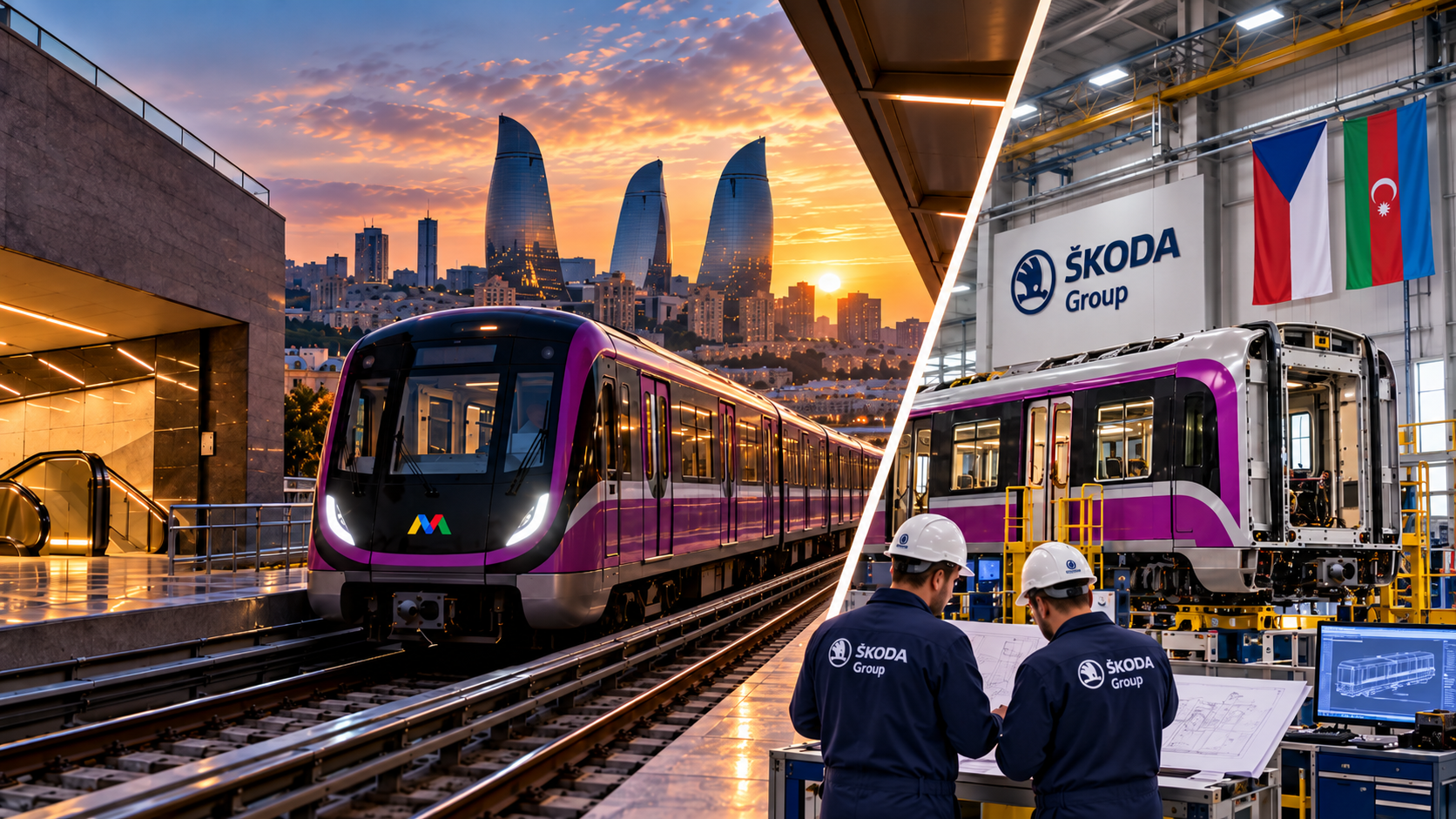
This week saw one of its contestants make an even bolder bid than usual. On October 12th, a group from the Czech Republic representing the Confederation of Industry and Transport, including transport minister Ivan Bednárik, visited AZCON holding in Azerbaijan. Among them were the Chairman of AZCON, Shahin Babayev, Vusal Aslanov of Baku Metro, and Rovshan Rustamov of Azerbaijan Railways. The vice-chairman of Škoda Group, Tomáš Ignačák, presented his proposals for not just trains, but a factory as well.
The plan is that of a joint venture with a local partner, developed in stages through local manufacturing and servicing, using local component producers and engineers. "Our ambition is not only to supply modern vehicles but, together with local partners, to build long-term cooperation in servicing, technology and education," Mr Ignačák said. The long-term goal, as announced by the company, is to have a manufacturing base in Baku able to service other markets in the region.
The project is well-suited to the nature of the competition in the rail market. The sale of a train is one-time activity; maintenance over 30 years is the annuity. The ownership of spare parts, shops and expertise determines the one who gets the profit margin for the lifespan of the train, and who will depend on the supplier in the end. For Azerbaijan, a country that has invested a decade into developing its transportation industry, it seems quite attractive.
Škoda indeed has credentials to give it a shot; it has its roots from the works of engineering established by Count Waldstein in 1859 and currently has approximately 10,000 staff members spread out in plants in the Czech Republic, Finland, and Türkiye. The year 2025 saw the firm generate €1.45bn in revenue and €143m EBITDA. Both include TEMSA, the Turkish bus maker. The company is part of PPF, an investment group that originated in the Czech Republic and has €42.6bn in assets and 37,000 employees in 25 nations. It should not be confused with Škoda Auto, the carmaker owned by Volkswagen.
A market with a plan, and a queue
The interesting aspect of Baku is that the demand is institutionalized. There is a state program agreed upon in January 2025 detailing the expansion process where AZCON has allocated nearly $2.5 billion. In June, Baku Metro has entered into loan agreements amounting to $180 million with the Asian Infrastructure Investment Bank which shall finance works in the depots of Darnagul and Khojasan and upgrading stations. This accounts for only 7% of the total budget, but the payments are being made in batches.
However, it is also disputed. In January, representatives of Baku Metro met Stadler Rail to discuss the purchase of up to 300 coaches and new signaling, and Stadler Rail is certainly not new in Azerbaijan as since a 2019 deal, Stadler FLIRT and KISS trains have been acquired by Azerbaijan Railways. The Czech firm's CEO Petr Novotný visited Baku in February, while negotiations with AZCON started already back in May 2025. The current fleet is being renewed on a local level as well: the current generation of trains are built in Baku in accordance with a contract with Global Transport Solutions, and this company had delivered around 150 new-generation carriages to date.
According to local sources, suppliers will be chosen taking into consideration such criteria as compliance with technical requirements, the cost of purchase, energy consumption, maintenance and operation conditions. Having a factory promise is beneficial; however, it is not sufficient in order to win the competitive bidding process. Škoda has no orders for the carriages in the state program yet.
Now, in the bigger scheme of all things, the human capital offer could carry greater weight than the actual factory itself. The offer consists of vocational training for engineers and technicians from the local community, involvement of Azerbaijani firms in the production of components and transfer of European manufacturing technologies. Azerbaijan would benefit from reduced reliance on external suppliers for maintenance, spare parts and repairs, which has historically been a drawback for importers of railway vehicles. The workshop where the major maintenance and assembly of components occurs is different from a facility specializing in welding of car bodies. It will be the type of work done in Baku that will determine the number of engineers to train.
The bottom line is that no investment amount, production capacity, or timeframe has been established. This is still an idea that has not been turned into an agreement. There is also an obvious business issue: producing several hundred metro trains is quite a small batch for European industry. This is why the regional idea plays such an important role. Baku would have to export trains to Georgia, Central Asia, and maybe beyond, and compete with other factories, such as Škoda's plant in Türkiye and the Czech Republic. The path, however, is clear. Azerbaijan has the cash, a government intent on diversifying industry, and a strategic location coveted by many. If Škoda and a local partner can turn a presentation into a signed joint venture, Baku could acquire something durable and efficient in the long run!
*the cover image has been generated by artificial intelligence and does not depict a real-life resemblance
Here we are to serve you with news right now. It does not cost much, but worth your attention.
Choose to support open, independent, quality journalism and subscribe on a monthly basis.
By subscribing to our online newspaper, you can have full digital access to all news, analysis, and much more.
You can also follow AzerNEWS on Twitter @AzerNewsAz or Facebook @AzerNewsNewspaper
Thank you!