
Europe’s $995 gas shock offers Azerbaijan windfall with limits

Akbar Novruz
Read more$1,000 - yes, you heard it right. Those were the figures for European natural gas prices, which have approached per thousand cubic metres after experiencing a sharp weekly increase. Now that I have your attention, the precise figure was $995.08, to be exact, for the sake of our sensitive economists.
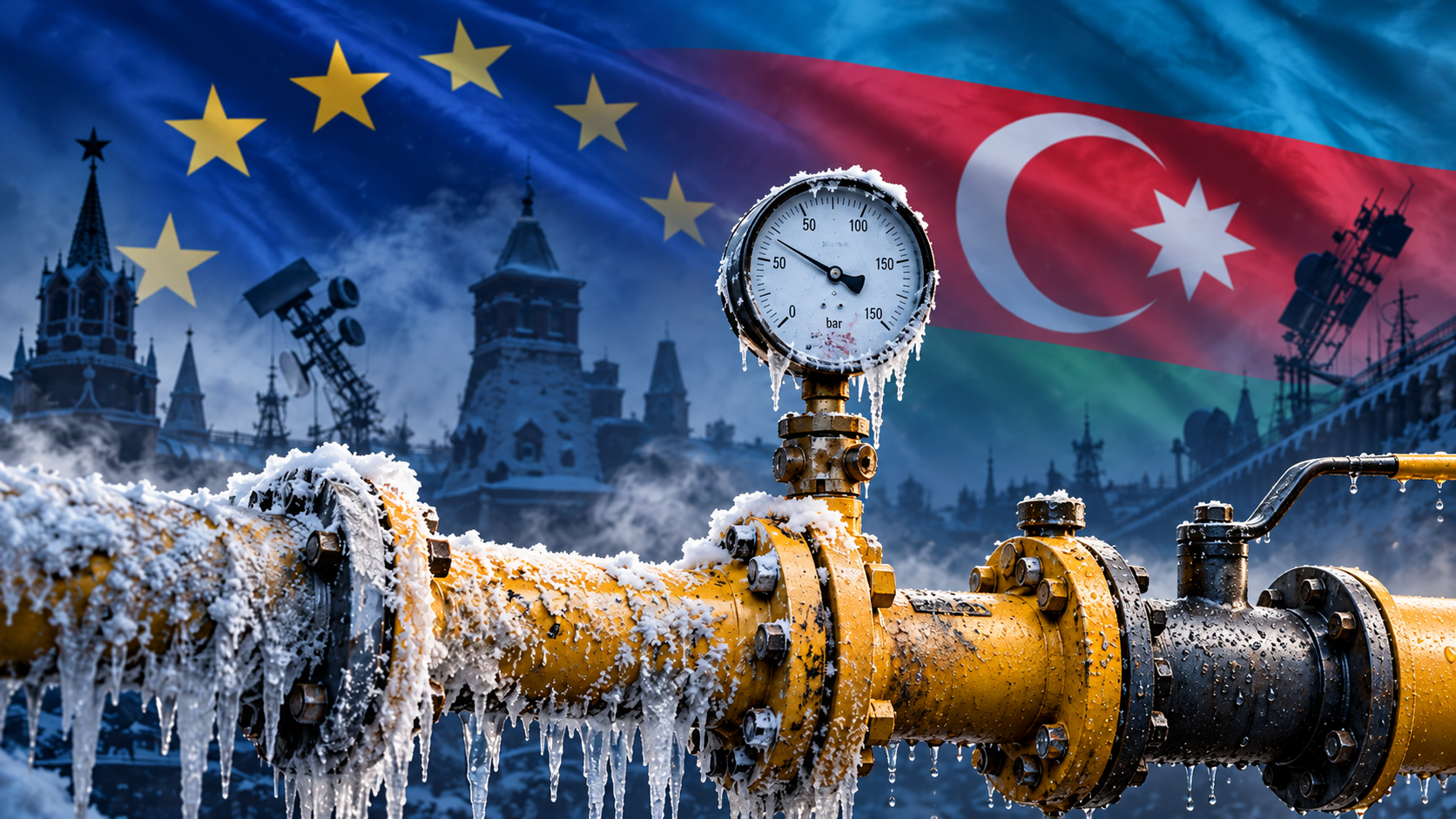
This is the price per thousand cubic metres of gas in the Dutch Title Transfer Facility, the main market in Europe, registered on October 14. It is the record high since December 2022, when the latest energy crisis hit, and marks an increase by 10.67% for the week despite a decline by 0.68% for the day. In the case of a state that exported 12.7 billion cubic metres of gas in the first six months of the year, most of it to Europe, one might be inclined to see the number as an opportunity. But there is more to it.
EU storage stands at roughly 73% full, according to The Wall Street Journal, against a five-year average of 89%. Germany, the bloc's largest consumer, is closer to 60%. Brussels has quietly relaxed its mandatory winter filling target from 90% to 80%, an admission of how tight the autumn has been.
Well, the cause, honestly, lies mostly beyond Europe's borders. With the Strait of Hormuz blocked by the war involving Iran and following an attack by Iran that damaged Qatar’s Ras Laffan LNG facility, there has been very little output of LNG coming out of the Persian Gulf region. “We believe the market will have to come to terms with the fact that going into most of the Northern Hemisphere winter, we will see very limited LNG supply from the Persian Gulf,” noted analysts at ING. It appears that LNG prices in North Asia have almost tripled since the onset of the conflict, leaving Europe to battle it out with Japan, Korea, and China for every cargo. Morningstar has stated that should winter prove to be particularly cold, the price range will reach €90 to €120 per megawatt hour compared to €86 to €87 currently.
However, not everyone is bearish on the other side of that. Citi, noting stronger-than-expected injections and industrial demand destruction, keeps a fourth-quarter base case of €56, well below futures. The spread between forecasters is itself part of the story.
Baku's side of the ledger
The position of Azerbaijan seems perfect for making a profit out of this development. As noted by the Ministry of Energy of Azerbaijan, 25.4 billion cubic metres of gas was produced in the country within the first six months of 2026, with the export volumes being equal to half of this amount, i.e. 12.7 billion cubic metres of gas. Most of this gas is carried by the Southern Gas Corridor to the west, with the Trans-Adriatic Pipeline having gained 1.2 billion cubic metres a year in its capacity in January.
Simple mathematics explain why the temptation exists. Had there been an increase of $100 per 1,000 cubic metres of oil exported in the first half, there would be an additional income of $1.27 billion. In comparison to current levels that are well above most forecasts, the potential upside, in theory, is in the billions.
But practically speaking, very little of this math stands as it is.
The main point is that the TTF price does not indicate how much Azerbaijan earns. Gas from the Southern Gas Corridor is sold mainly via long-term contracts, with terms of the prices being kept secret. As such, such contracts will usually involve oil indexing and hub-related components with delayed effects, meaning that a price surge on a Tuesday might have an impact on earnings many months later and might be averaged out. The income earned through exports relies on the pricing formula, reset dates, and volume.
The second constraint is the volume. Higher prices do not produce more fuel. Capacity of production and pipelines are finite, even following the enlargement of TAP, and this extra capacity has to be filled by fields which are fully occupied. Given current production and pipeline capacities, the upside is in getting a higher price per unit of fuel that would have been sold at lower prices anyway. This is an upside, but still a margin story and not a volume one.
A third issue, however, is a bit more subtle than the first two. Azerbaijan also exports gas to Georgia, Syria, Türkiye, and even domestically, but all of this at different prices and under different conditions. The European hub price serves as a benchmark price for one part of the portfolio. As much as it sounds ambitious and practical in the field, in the long run it is not sustainable.
The discrepancy between spot prices and government estimates highlights the completely different approach to the market situation in Baku. Thus, on July 31st, Central Bank Chairman Taleh Kazimov estimated the price of natural gas at $327 per thousand cubic metres in 2026 and $294 in 2027. As for the draft 2026 SOFAZ budget, the Chamber of Accounts said that it included an estimate for a European hub price at $440 based on BP data, which should not be considered as the average export price of Azerbaijan. In its assessment of May, the International Monetary Fund estimated Azerbaijan's average export price at $521.9 in 2026 and $424.3 in 2027. As per Reuters on October 12th, Rabobank forecasted the average price of gas in Europe at €45 per megawatt-hour in 2027.
Those figures differ because they measure different things: hub prices, contract prices, calendar-year averages, before and after the war. But the common thread is conservatism. Even the IMF's $522 is about half of this week's spot price, and the Central Bank's $327 is a third.
This is not necessarily a miscalculation on the part of conservatives. Fiscal planners in oil-producing economies have known for some time now how to plan with prices significantly lower than the market rate, because this way any sharp rise in prices results in savings, not expenditures. The same goes for Azerbaijan, which transfers its hydrocarbon profits to SOFAZ, because an exceptional year can partially be saved and not used.
The truth of the matter is, however, that such an assessment is incomplete. While Europe's race for gas is boosting Azerbaijan, by allowing higher prices for a portfolio that has already been secured and being one of a handful of countries other than Russia that can deliver more via pipelines, such a boost will be both irregular and limited in size, considerably less than implied by the $995 headline number. The people in Baku appear to realize this. The more lasting reward is not a single cold October. It is the fact that Europe now values a reliable supplier.
Here we are to serve you with news right now. It does not cost much, but worth your attention.
Choose to support open, independent, quality journalism and subscribe on a monthly basis.
By subscribing to our online newspaper, you can have full digital access to all news, analysis, and much more.
You can also follow AzerNEWS on Twitter @AzerNewsAz or Facebook @AzerNewsNewspaper
Thank you!