
Azerbaijan looks beyond oil with $5.3 billion industrial expansion

Qabil Ashirov
Read moreAzerbaijan's State Program for the Development of the Mining and Metallurgy Industry for 2027–2030 is a large-scale industrial plan designed to form new production chains within the country's non-oil industry. The core essence of the program is to process Azerbaijan's mineral resources domestically as much as possible, create higher added value, and ultimately supply more finished and semi-finished industrial products to foreign markets.
According to the official presentation, a total of 5.3 billion AZN in investments is envisioned within the framework of the program for 2027–2030. Of this amount, 1.1 billion AZN is expected to be formed from the state budget, 2.2 billion AZN from the funds and borrowed capital of state-owned enterprises, and 2 billion AZN from private sector funds and borrowed capital. Thus, approximately 80% of the total investment is planned to be attracted from non-budgetary sources.
As a result of these investments, the contribution of the mining and metallurgy sector to GDP is projected to increase from 700 million AZN in 2025 to 1.8 billion AZN in 2030, while the sector's annual export potential is expected to rise from 1.3 billion AZN to 3.4 billion AZN. In other words, the goal is to increase the added value and annual export potential of the sector by approximately 2.6 times.
This is where the main change begins: instead of extracting and selling raw ore, Azerbaijan seeks to generate more revenue from processing that ore domestically.
For example, the Dashkesan iron ore project is one of the clearest examples of this model. It envisages the creation of an enterprise capable of producing 2 million tons of hot briquetted iron (HBI) annually. It is reported that approximately 1.7 million tons of this will form export potential. HBI is no longer just a mining product; it is a processed raw material used in steel production.
Thus, the economic chain does not end with the extraction of iron ore: the ore is enriched, then transformed into the production of pellets and HBI, resulting in a higher-value raw material for the steel industry.
The next stage of this chain is the production of more steel and metal products within Azerbaijan. In other words, the goal is both to generate revenue from HBI exports and, if used in domestic metallurgy, to reduce the need for imported raw materials for steel producers. This can expand domestic production opportunities for construction, mechanical engineering, agricultural machinery, metal structures, and other fields.
A similar approach is applied to non-ferrous metals. The integration of copper, zinc, and lead reserves in the Filizchay deposit into economic circulation is planned. This is significant in terms of introducing new metal products into Azerbaijan's export basket. Within the State Program, the economic potential of the Zaylik alunite deposit will also be evaluated separately. The goal here is to explore the possibilities of creating a raw material base from alunite for the production of alumina and subsequently aluminum.
In the aluminum sector, Ganja's "Azeraluminium" electrolysis plant aims to reach an annual production capacity of 100,000 tons. In addition, the feasibility of creating a new primary aluminum plant with a capacity of approximately 200,000 tons per year is being studied. An important point here is that the 200,000-ton plant is not yet a confirmed project; its economic efficiency, investor capabilities, and technical parameters are currently being evaluated.
At a lower downstream stage, the conversion of aluminum into rolled products is envisioned. The State Program plans to increase the annual production capacity of rolled aluminum products to 50,000 tons and promote the local production of items such as profiles, wires, cables, foils, sheets, strips, and beverage cans.
This distinction is crucial. Selling a ton of raw material does not yield the same economic outcome as selling a ton of finished industrial product. Along with processing raw materials, the production of finished goods creates economic value through energy, labor, technology, logistics, engineering, packaging, and other services. Therefore, the core philosophy of the program is essentially the transition from "ore to metal, metal to product."
This model can also alter Azerbaijan's overall export structure. Currently, the weight of oil and gas in the country's foreign trade remains very high. At the same time, growth in non-oil-and-gas exports is observed. According to the State Statistical Committee, in January–July 2026, total exports amounted to $20.14 billion, while non-oil-and-gas exports reached $5.93 billion. The 2.8-fold increase in non-oil-and-gas exports compared to the same period of the previous year demonstrates the formation of new channels in the structure of foreign sales.
The 2.6-fold increase in the export potential of the mining and metallurgy sector by 2030 can be evaluated as part of this diversification process. This does not mean that oil and gas exports will necessarily decrease in absolute physical terms. However, if exports of new metals, aluminum, gold, and other industrial products expand rapidly, the share of oil and gas in the total export basket may decline relatively.
Another significant factor is the ongoing shift in Azerbaijan's energy policy. The expansion of green energy production could impact both the formation of new export products and the domestic energy balance in the future. Azerbaijan plans to increase renewable energy capacities by 2030 and develop regional energy interconnections for exporting green electricity to Europe. Official announcements have also mentioned the possibility of reaching 6 GW of solar and wind energy capacity by 2030.
This is where the connection between green energy and industry emerges. A significant portion of electricity generation in Azerbaijan is still carried out by burning natural gas in thermal power plants. Increasing the share of solar, hydropower, and wind energy in production can partially replace the use of gas in the electrical grid. This can create an additional opportunity to free up a portion of gas from electricity generation, redirecting it toward exports and other industrial needs.
The President of Azerbaijan stated in 2025 that increased green energy production would allow for savings on natural gas used for electricity domestically and its redirection to exports. The European Commission has also noted that domestic production of renewable energy can help save natural gas, making more gas available for exports and increasing industrial competitiveness.
From this perspective, it is no coincidence that a section of the 69-kilometer Hajigabul–Gazakh mainline gas pipeline is slated for renovation in 2027–2028 to provide gas to the metallurgical plant in Dashkesan. New industrial enterprises require large volumes of stable and reliable energy supplies. Consequently, the mining-metallurgy program is not just about mines and plants; behind it lies the expansion of gas, electricity, railways, ports, logistics, and other infrastructure.
As a result, a more complex yet diversified industrial model is taking shape for Azerbaijan. While oil and gas will continue to serve as the country's primary export and energy pillars, the growth of processing sectors—such as mining and metallurgy, aluminum, gold, copper, zinc, lead, and steel—can transform the structure of non-oil exports. Meanwhile, the expansion of green energy creates new opportunities for this industrial model in terms of additional energy resources and alternative uses for natural gas.
The main point, transcending the figures themselves, is the production logic behind those numbers: Azerbaijan's objective is not merely to extract more ore, but to generate more products, greater added value, and higher export revenues from the ore it extracts. The combined impact of the 5.3 billion AZN investment program, a 2.6-fold increase in added value and export potential, new metallurgy and aluminum capacities, and growing green energy opportunities can enable Azerbaijan's non-oil industry to secure a larger share within the export structure.
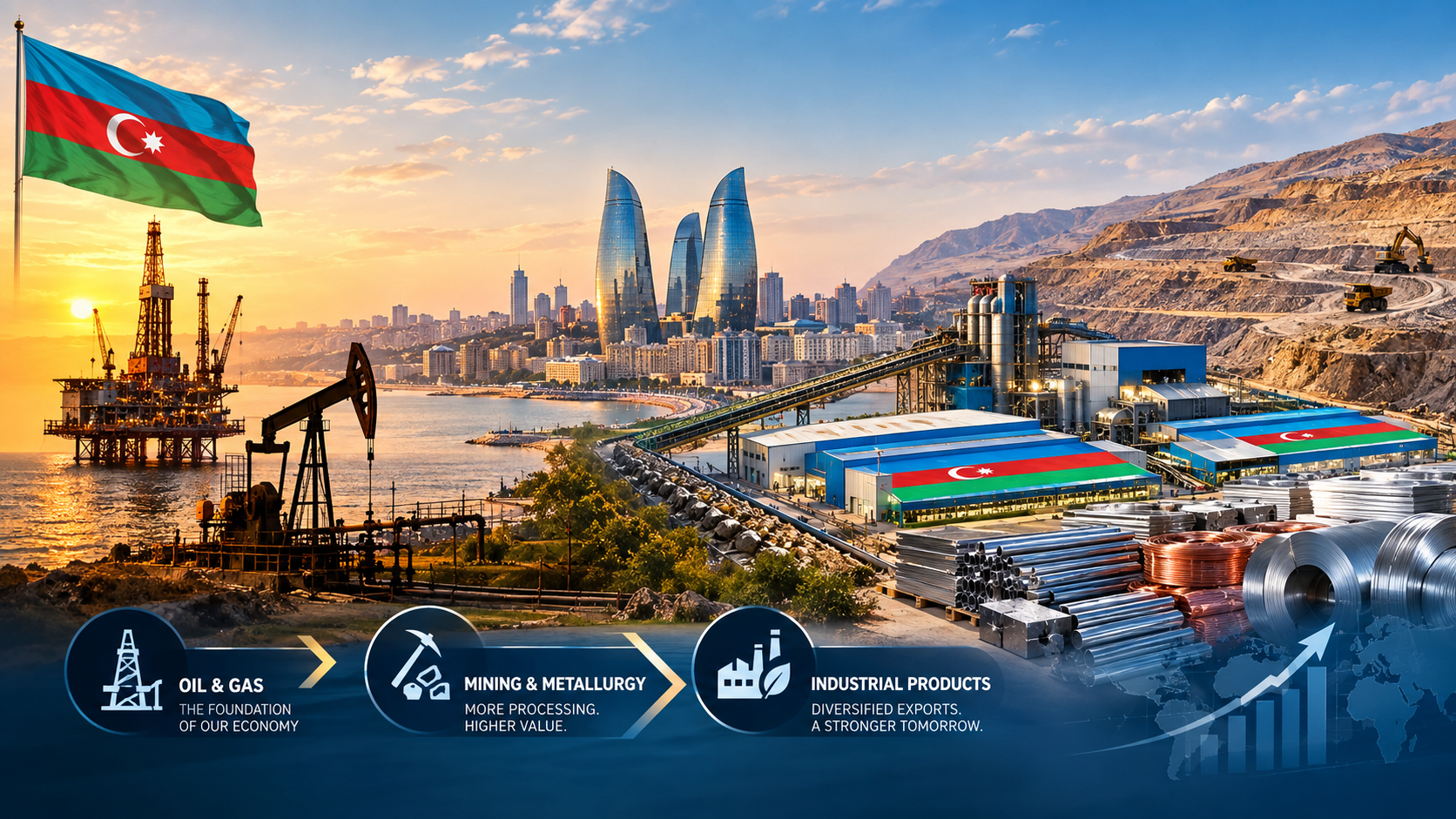
* AI-generated picture
Here we are to serve you with news right now. It does not cost much, but worth your attention.
Choose to support open, independent, quality journalism and subscribe on a monthly basis.
By subscribing to our online newspaper, you can have full digital access to all news, analysis, and much more.
You can also follow AzerNEWS on Twitter @AzerNewsAz or Facebook @AzerNewsNewspaper
Thank you!