
Azerbaijan turns to metals, AI and industry to reduce oil dependence
Akbar Novruz
Read moreAzerbaijan’s Ministry of Finance is increasingly highlighting the country’s evolving economic structure as part of a farsighted strategy to broaden the foundations of growth beyond hydrocarbons. The document, “Statement on Preliminary Indicators for the 2027 State and Consolidated Budgets”, provides a clear illustration of this direction. Based on a conservative oil price assumption of $65 per barrel, the report projects that the non-oil economy will expand at an average annual rate of 4.4% through 2030, while growth in the oil and gas sector is expected to remain more modest, at around 2.3%. As a result, the share of non-oil GDP, projected at 77.4% in 2027, is expected to rise to 82% by 2030.
Rather than signalling a retreat from the country’s established energy strengths, the projections point to Azerbaijan’s broader objective of developing new sources of economic growth alongside its hydrocarbons sector. The figures underline a gradual diversification process in which manufacturing, mining, technology, services and other non-oil activities are expected to play an increasingly important role in the country’s economic development.
Thus, during the first eight months of 2026, the energy sector produced 26.2 billion manats out of 87.7 billion manats of Azerbaijan’s GDP, or nearly 30%, while also continuing to make up some 70.5% of the country’s exports worth of $21.8 billion. As far as the language employed goes, the strategy pursued is not one where hydrocarbons should become smaller in proportion, but rather all other sectors should grow more rapidly to increase their presence compared to the hydrocarbon sector.
Most recently, however, the most tangible evidence of this strategy was delivered on September 22, when President Ilham Aliyev presided over a meeting adopting the "State Program for the Development of the Mining (Metal Ores) and Metallurgical Industry for 2027-2030". The objective is clear and, for Azerbaijan’s state-level planning, rather unusually quantified, which the country aims to double its annual potential for exporting products in these industries to reach roughly $2 billion per year according to the world’s prices of 2025, with a total export revenue from the export of copper, gold and silver increasing from 600 million manats in 2025 to 1.6 billion manats in 2030, nearly tripling its present level. Among new facilities scheduled for construction under this program, there is a processing plant in the Dashkesan iron-ore deposit, a pellet plant, a hot-briquetted iron plant, a new rolling mill for Baku Steel Company, an electrolysis plant for Azeraluminium in Ganja, and a flotation plant in the Soyudlu gold deposit, a complete industrial chain from extraction to manufacturing.
Already in the first six months of 2026, gold, copper and aluminum exports combined have brought in $397m in revenue; raw copper concentrate exports increased elevenfold year on year, from $12.3m to $135.9m – an increase that, according to experts, is mainly due to higher extraction capacities at the polymetallic deposits that have become more lucrative and less to the increase in copper price of 8-12%. At the same time, Dashkesan Dəmir Filiz, a subsidiary of the state-owned company for the production of gold AzerGold, is working on launching the first large-scale domestic supply of iron concentrate in the country – after the revaluation of resources, which resulted in the addition of 67.4m tonnes to the deposit base at the Dashkesan complex, amounting to 185m tonnes according to a 21-year extraction program prepared jointly with British consultancy Micon International. Additionally, gold, copper and molybdenum deposits found in Kalbajar, Aghdara and Zangilan (regions which Azerbaijan was able to regain control of only in 2020) are being accounted for.
Yet, nothing solves the more persistent problem which the budget paper recognizes: the money has yet to match the ambition. The total figure of FDI investment in Azerbaijan amounted to $6.6bn in 2025, dropping 6.4% from 2024 when the figure stood at $7.3bn, with oil and gas still taking up 78.1% of all foreign investment that year. However, there was some real improvement in the first half of 2026, with $3.7bn in inflows, 13.8% higher than in 2025, although even this recovery has once again been largely driven by oil and gas, with $2.8bn invested in them versus $867m in the rest of the economy. Growth in capital investment of 2.2-2.4% per year until 2030, admits the ministry itself, will be insufficient to finance the technological breakthrough needed.
The World Bank and other institutions point to familiar structural culprits: capital concentrated in hydrocarbons limits the spillover of skills and technology elsewhere, corporate governance transparency lags international norms, domestic competition remains thin, and Azerbaijan's underdeveloped securities market gives foreign portfolio investors few easy ways to enter or exit non-oil positions. Intellectual-property protection, increasingly relevant as Baku courts software and AI investment, remains a work in progress by the government's own admission.
What is shifting, modestly but visibly, is the geography of who is willing to bet on the non-oil bridge anyway. The US' FDI into Azerbaijan grew by 47%, reaching $131.6 million, after the Strategic Partnership Charter signed in February concerning Industry 4.0, transportation, and digital infrastructure. The investments of Holland grew by over 300%, reaching $60.1 million during the same period. Both figures do not match the scale of hydrocarbon capital; however, they are the investments connected with technology – artificial intelligence, data centers, telecommunications – which cannot be created through raw extraction alone. The strategy of Azerbaijan now includes creating such relationships with Türkiye, China, Israel, and some of the Gulf states, hoping that the sum of such technological partnerships will eventually amount to the structural change that has been included in the forecast by its own Ministry of Economy. As far as it goes, almost every nation has some-what of a '2030 ambition,' and for Baku, whether 2030 will see 82% non-oil GDP or something else will depend less on its five-year plans and more on the presence of capital, hopefully.
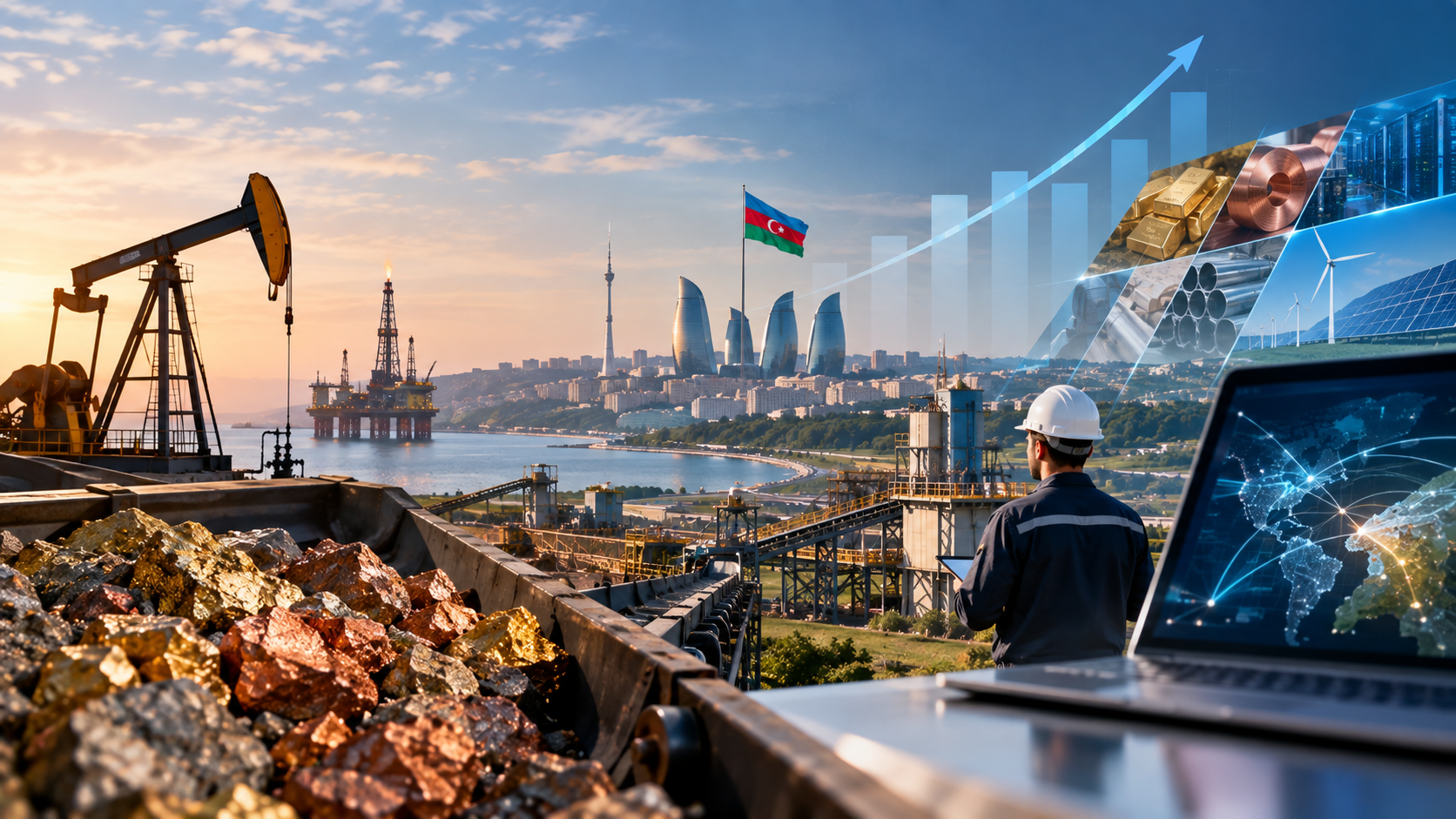
*the image on the base cover is generated by artificial intelligence.
Here we are to serve you with news right now. It does not cost much, but worth your attention.
Choose to support open, independent, quality journalism and subscribe on a monthly basis.
By subscribing to our online newspaper, you can have full digital access to all news, analysis, and much more.
You can also follow AzerNEWS on Twitter @AzerNewsAz or Facebook @AzerNewsNewspaper
Thank you!