
Middle Corridor moment: How crisis rewriting global trade paths

Akbar Novruz
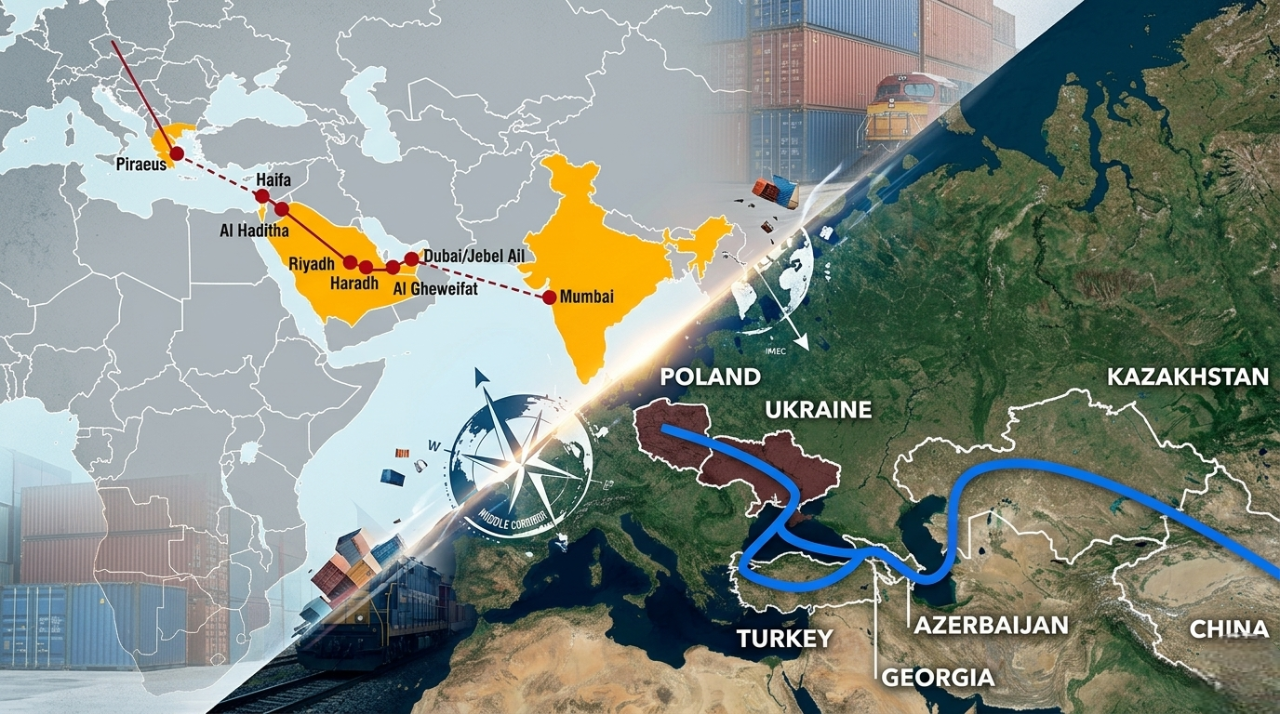
Read moreAt the recent G20 summit held in New Delhi in September 2023, when the leaders announced the formation of the India-Middle East-Europe Economic Corridor (IMEC), they were very much aware that they were sending a message that this would be a geopolitical strategy for the West to counter China's BRI. As six weeks have passed since the conflict in Gaza, and the IMEC project has lost all momentum, it felt like the entire concept just evaporated overnight. Now, with the Iran war, which has been going on for six weeks, and Tehran having control over part of the Strait of Hormuz and missiles raining down on Haifa, it has done the rest.
In the meantime, some 3,500 kilometers northward, another equally vital passageway is slowly being developed. The Trans-Caspian International Transport Route, commonly referred to as the Middle Corridor, connects China to Europe via Kazakhstan, through the Caspian Sea to Azerbaijan, then Georgia, and finally Türkiye. In 2025, container traffic through this corridor amounted to 76,900 twenty-foot equivalent units, representing a 36 percent growth over 2024. Freight operators and insurance carriers who had begun diverting shipments from the Red Sea, now threatened by the ongoing Iran war that started in late February, have quickened this process even more. The corridor serves as an insurance policy against any additional disruption of the regular maritime routes.
The problems that IMEC faces are not accidental to the ongoing situation. They are inherent in the very design of the project. The first leg of the corridor from the west demands an operational port of Haifa as an entrance point in the Mediterranean Sea, which is currently under attack by Iranian missiles. The first leg of the corridor from the east demands Saudi-Israeli normalization for land transit through the Arabian Peninsula, a process that has been frozen since October 2023. The first leg of the corridor demands an open-door policy of Jordan, which has become politically impossible due to popular hostility towards Israel.
Not even the most hopeful planners of the corridor itself can deny that these are issues that will be resolved in the long term. According to Egypt's foreign minister, present at meetings between India and the country in October 2025, the resolution of "the Palestinian issue" is "essential" to IMEC's success - a requirement that, given the ongoing extension of the conflict into Lebanon, Syria, and now Iran, has become further away from reality than ever. In addition, the war with Iran has brought an extra element of danger to the equation, in the form of increased insurance costs for shipping goods across the Gulf, as well as the mobilization of the port facilities in Haifa to wartime status.
| Factor | IMEC | Middle Corridor |
|---|---|---|
| Current operational status |
Western leg non-operational | Fully operational, accelerating |
| Conflict exposure | Direct (Haifa, Hormuz, Houthis) | Bypasses all active conflict zones |
|
Regional peace |
Saudi-Israel normalisation stalled | Armenia-Azerbaijan peace agreed Aug 2025 |
| Infrastructure readiness | Eastern leg functional; western leg paper-only |
BTK modernised 2025; Poti terminal opened |
| Insurance environment | Prohibitive in the Gulf/Red Sea/Israel | Stable; Caspian/Black Sea route unaffected |
| Political backing |
US, EU, India committed; |
US, EU, China, UK all invested; joint venture operating |
The distance between the Barents Sea to the north and the Arabian Sea to the south is around 5,000 kilometers. However, only 190 kilometers of the total distance – a land route called the Ganja Gap located in Azerbaijan – can accommodate transportation from one point to another without passing through either Russia or Iran. Azerbaijan plays a pivotal role in one of the world’s most significant but unknown logistic chokepoints.
Indeed, the security profile of this route corridor has significantly improved since last summer. Thanks to the Armenia-Azerbaijan peace agreement initialled in the White House back in August 2025, the only serious source of potential conflict for the South Caucasus has been eliminated. This is why Aliyev stressed in his recent Tbilisi speech that "the South Caucasus is becoming a region of peace, calmness, security and cooperation." According to Kobakhidze, "global geopolitical changes have further strengthened the significance of the Middle Corridor" and made the Black Sea and South Caucasus "a strategically important space." While the wars rage in Ukraine to the north and in Iran to the south, the territory that links China's supply chains with Europe has been consciously protected from military interference. Indeed, wars continue to the north of Azerbaijan, as well as to its south. In this case, the international cargo carriers cannot help choosing the Middle Corridor, as it is their safest way of transportation.
The constraint within the corridor is currently on the supply side rather than on the demand side. The pressure is greatest on ports in Azerbaijan, Kazakhstan, and Turkmenistan, where ferry capacity on the Caspian Sea has failed to keep up with booking requests due to the ongoing Iran war. KTZ Express plans to purchase six new ferries, while the Azerbaijan Caspian Shipping Company is commissioning a new Ro-Pax ferry and considering two new container vessels. A new multimodal terminal was inaugurated in Poti, Georgia, in June 2025, with the capability of handling 120 wagons and 200,000 twenty-foot equivalent units per annum. The Baku-Tbilisi-Kars railway, a 826-kilometre route between Azerbaijan and Türkiye through Georgia, finished upgrading its Georgian segment in 2025, increasing its line capacity considerably. The World Bank and EBRD have concluded that investments worth €18.5 billion in infrastructure would be necessary in Central Asia alone to unlock the corridor's full potential until 2030.
TRIPP Corridor (Trump Route for International Peace and Prosperity), which entails the construction of a railway line and oil/gas pipeline along the southern part of Armenia from mainland Azerbaijan, passing Nakhchivan to Türkiye, will create an additional layer to the capabilities of the Middle Corridor. Azerbaijan’s section will be almost complete soon, while Armenia’s part is scheduled to start in the latter half of 2026.
In operation, TRIPP would practically turn Armenia into a transit state in the very same corridor network that had never included it before, expanding the Middle Corridor and bringing in redundancy along the route. Azerbaijan has spent $21bn on OTS countries, including Türkiye, where work on the Kars-Iğdır-Aralık-Dilucu railroad line, which runs 224km from the Turkish border down to the border of Nakhchivan, is underway. The Iran conflict has certainly delayed TRIPP, but it hasn’t changed the rationale behind it.
The fight between IMEC and the Middle Corridor has, over the last three years, been seen as a fight between two equally grand plans. It’s no longer as such. While one corridor cuts through active battlegrounds, relies on normalizing relationships that are not progressing, and moves cargo via a sea dominated by Iranian naval strategy, the other one avoids Russia and Iran altogether, has settled down its most serious regional conflict, and sees growth rates not seen before in its history.
Here we are to serve you with news right now. It does not cost much, but worth your attention.
Choose to support open, independent, quality journalism and subscribe on a monthly basis.
By subscribing to our online newspaper, you can have full digital access to all news, analysis, and much more.
You can also follow AzerNEWS on Twitter @AzerNewsAz or Facebook @AzerNewsNewspaper
Thank you!