
Armenia’s TRIPP debate exposes contradictions of its regional isolation

Akbar Novruz
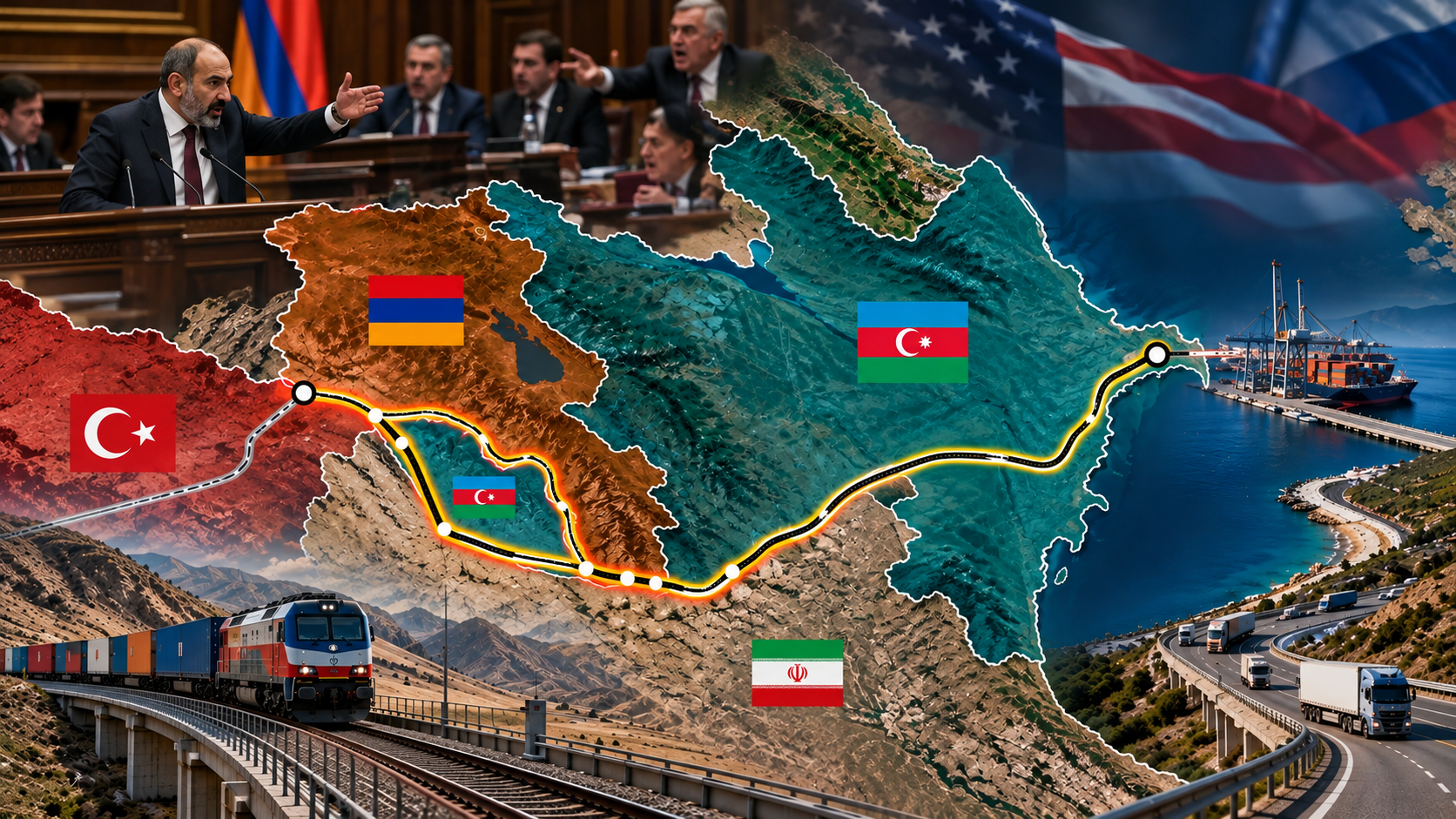
Read moreFor a road that has not yet been fully built, the Trump Route for International Peace and Prosperity has already become a remarkably busy political battlefield. Armenia's parliament has approved the American-backed scheme to reconnect the South Caucasus. Its opposition, meanwhile, appears determined to treat the prospect of opening a border as another reason to keep the argument alive.
On October 28th, the Armenian National Assembly approved the Armenian-American TRIP idea with 63 votes to 32 (ten MPs abstained). Of the total 63 MPs who took part in the vote, all belonged to the dominant Civil Contract party. Those voting against the measure were 32, and they belonged to the two leading opposition parties, while 10 deputies did not take part. In an earlier vote on the document of Donald Trump’s “Peace Council” [e.g., Board of Peace], the same chamber had unanimously supported it with a vote of 90 to zero.
Opposition leader Anna Grigoryan of the Armenia faction argued that, although the agreement is formally between Yerevan and Washington, Azerbaijan's interests are more clearly represented than Armenia's. She questioned reciprocal customs treatment and demanded credible estimates of potential revenues. Strong Armenia's Narek Karapetyan advanced a different objection: why implement TRIPP before Azerbaijan signs the bilateral peace treaty?
They are different cases altogether. While asking about who holds the power to control the border and who gains from the lengthy concession might be proper parliamentary inquiry, making every progress toward connectivity dependent on settling each and every outstanding diplomatic issue could be counterproductive and create the same deadlock that divided the region for decades.
Speaker of Parliament Ruben Rubinyan stated the government’s position succinctly: it is really positive that the implementation of TRIPP is independent of the signing of the peace treaty. There are both practical and political aspects to this statement. If reconciliation cannot move forward until the very last stage of its legal completion is reached, then the small confidence-building measures leading up to the signing of the treaty remain elusive indefinitely.
What does the agreement actually say?
The issue of sovereignty should not be reduced to rhetoric. The Armenia-US framework, which was officially published, clearly ensures the supremacy of Armenian control over policing, border security, customs, immigration, taxation, and official statistics. Armenia has the right to authorize an infrastructure security plan, and any private security personnel will have to be licensed in Armenia. This agreement does not entail extraterritoriality in terms of Azerbaijani control.
However, the financial and operational terms are significant. A TRIPP Development Company with a 74% American share and a 26% Armenian share for the first 49 years is proposed. After the subsequent extension of the contract period for 50 years, the shares will change in favor of the American owners to 51% and 49% correspondingly. Rights to develop and use the territory are very long-term, and the final shareholders' agreement and charter of the company have not yet been signed.
Here we have a very uncomfortable distinction for the opposition. A deal to build and manage infrastructure does not mean that the territory is being handed over. It would be more logical for the opposition to focus on getting a good procurement process and reciprocal access rather than scare people with talk of national security threats.
Peace first, or peace by doing?
Armenian Foreign Minister Ararat Mirzoyan has proposed that TRIPP implementation could start even before the signing of the Armenia-Azerbaijan peace deal. The document has not been signed or ratified and was merely initialed in Washington on August 8, 2025. Baku continues to insist on Armenia addressing its constitution, which is said to imply territorial claims; however, Yerevan rejects the precondition. Both sides' arguments are not rendered void by an infrastructure vote.
But for the government, the dependence of commerce is a political stabilizer. For Azerbaijan, it means an unimpeded route to Nakhchivan through Armenia. In return for this, Armenia can reconnect its railway network through Azerbaijan and connect through Nakhchivan to Russia, Central Asia, and even Iran. This is a possibility, not a guaranteed success; its success will depend on scheduling, customs, and tariffs.
Some small signs of engagement are already present. Azerbaijan's customs statistics state the export of goods to Armenia as high as $23.45 million for the period from January to September 2026. In September, the export of diesel oil from Azerbaijan stood at nearly 17,000 tonnes, while grain and fertilizer have transited Azerbaijan on their way to Armenia. This volume of trade does not negate decades of antagonism, but demonstrates that business does not wait for the last signature.
The neighbours are watching
The best argument for TRIPP is the one that both governments make in different words: that trade creates people who want trade to continue. Count the fact that TRIPP also redraws the map of diplomacy. A development firm sponsored by the United States along Iran’s border puts, some would say a damper on Tehran's plans while questioning the conventional wisdom that Moscow should be the main guarantor of Armenian transit security. But Iran’s stance toward Armenia isn’t that of enmity; indeed, on October 16, foreign minister Abbas Araghchi showed confidence in Armenia amid worries about America at her doorstep.
The most extreme contradiction is that the opposing sides fear different possibilities. While one fears that Washington may gain too much operational influence, the other believes that Yerevan should use the same deal to extract something more from Baku. Both points of view can be voiced in parliament, but there needs to be an alternative to both. Otherwise, with all the foreign powers being mistrusted and all the reciprocal concessions being deemed inappropriate, Armenia ends up having exactly what its officials constantly complain about. A more reasonable litmus test would be the ability of the Armenian authorities to implement the clauses of sovereignty, make known the terms of concessions, and ensure the reciprocity of border controls.
However, for Baku, access to Nakhchivan via Araz route through Iran serves as another way to get there. For Yerevan, staying cut off from regional traffic bears strategic implications too. These facts do not undermine the legitimacy of the questioning of US intervention. However, they reveal the flaws of a politics of resistance that turns every change into a capitulation and provides no clear way to escape from isolation.
In a nutshell, TRIPP is a bet that infrastructure can build constituencies for peace quicker than politicians tear them down. The opposition of Armenia may be absolutely right in demanding guarantees and transparent economy as well as final peace agreement. It seems rather difficult to argue against the demand of making these demands a permanent ban for any new opportunities. South Caucasus has demonstrated long enough that a closed border can maintain a conflict. The other experiment is much more significant – whether it can solve it.
Here we are to serve you with news right now. It does not cost much, but worth your attention.
Choose to support open, independent, quality journalism and subscribe on a monthly basis.
By subscribing to our online newspaper, you can have full digital access to all news, analysis, and much more.
You can also follow AzerNEWS on Twitter @AzerNewsAz or Facebook @AzerNewsNewspaper
Thank you!