
U.S. ready to contribute to refugee assistance projects in Azerbaijan
By Sara Rajabova
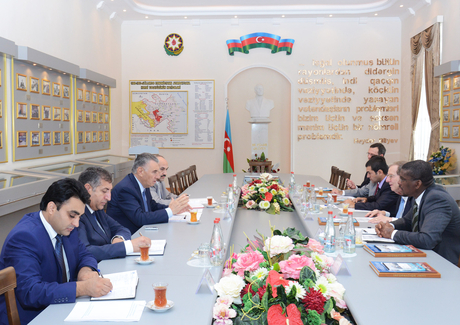
Azerbaijani Deputy Prime Minister, Chairman of the State Committee on Refugees and IDPs, Ali Hasanov met on September 19 with U.S. Ambassador to Azerbaijan Richard Morningstar and officials of U.S. State Department Bureau of Population, Refugees, and Migration.
During the meeting, Hasanov briefed about the Armenia-Azerbaijan Nagorno-Karabakh conflict, which turned 1.2 million Azerbaijanis into refugees and internally displaced persons (IDPs).
Hasanov said that the U.S. non-governmental organizations have provided greatest assistance to the displaced people.
"Over the past 20 years, international humanitarian organizations have allocated $900 million to Azerbaijan, and $450 million of this sum accounted for NGOs.
Morningstar, regional coordinator for refugees of the U.S. State Department Bureau of Population, Refugees, and Migration Joshua Fisheli, U.S. Mission to Azerbaijan Charge d'Affaires Dereck Hogan, representative of the military cooperation office of the embassy Bob Peters highlighted rapid economic development in the country and the work carried out to improve the social conditions of refugees and IDPs.
They noted Washington's readiness to participate in projects aimed at improvement of living conditions of refugees and IDPs.
The government of Azerbaijan, whose every 8th citizen is a refugee, is successfully implementing a program on improving the living conditions of refugees and IDPs displaced during the brutal war with Armenia in the early 1990s.
Extensive measures were launched to ensure social protection of the refugees since Azerbaijan's oil strategy began to bear fruit.
According to the State Committee, during the period from 1993 to 2013, 4.3 billion manats has been spent to address the social problems of refugees and IDPs in Azerbaijan.
The government data shows that 46.5 percent of these funds, or two billion manat were allocated from the state budget, 34.9 percent, or 1.5 billion manat from the State Oil Fund of Azerbaijan, 18.6 percent, or 0.8 billion manat were provided by international organizations.
The poverty rate among IDPs decreased from 75 percent in 2003 to 15 percent in 2012.
Armenia occupied over 20 percent of Azerbaijan's internationally recognized territory, including Nagorno-Karabakh and seven adjacent regions, after laying territorial claims against its South Caucasus neighbor that sparked the lengthy war in the early 1990s.
The UN Security Council's four resolutions on Armenian withdrawal have not been enforced to this day.
Peace talks aimed at resolving the long-standing conflict, mediated by Russia, France and the U.S. through the OSCE Minsk Group, are underway on the basis of a peace outline proposed by the Minsk Group co-chairs and dubbed the Madrid Principles. The negotiations have been largely fruitless so far.
Here we are to serve you with news right now. It does not cost much, but worth your attention.
Choose to support open, independent, quality journalism and subscribe on a monthly basis.
By subscribing to our online newspaper, you can have full digital access to all news, analysis, and much more.
You can also follow AzerNEWS on Twitter @AzerNewsAz or Facebook @AzerNewsNewspaper
Thank you!