
When brotherhood becomes interference: Azerbaijan and Türkiye face a delicate test [OPINION]
![When brotherhood becomes interference: Azerbaijan and Türkiye face a delicate test [OPINION]](https://www.azernews.az/media/2026/10/13/azerbaijanturkiye_flags_over_golden_straits.png)

AzerNEWS Staff
Read moreNo friendship in any part of the world is characterised by such a close relationship as that of Azerbaijan and Türkiye. There is talk of brotherhood and of “one nation, two states” from the officials of both capitals. But closeness comes with its own danger. The closer countries become, the more likely it is for them to start meddling in each other’s affairs like they were members of one family.
The post came from Oktay Saral, a senior adviser to Türkiye’s president. He wrote that blocking headscarved pupils from education in Azerbaijan was “unacceptable”, sharing a post from the Turkish account Mahfil.
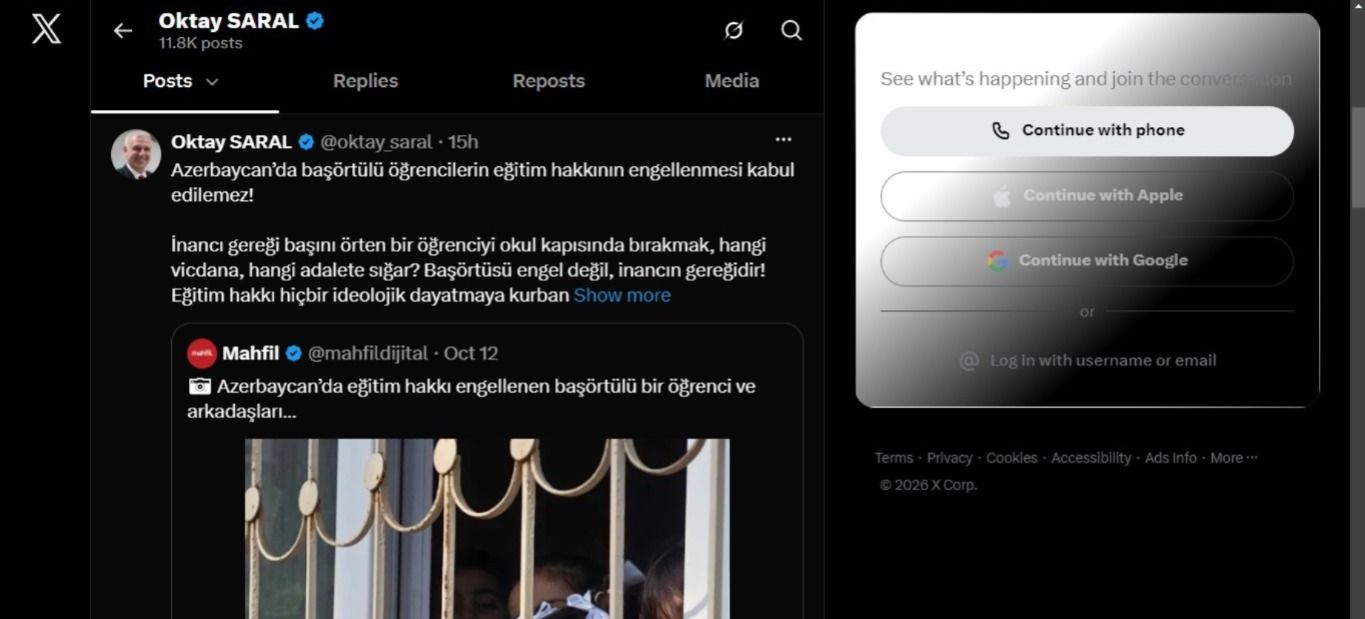
This, in turn, provoked a response from the New Azerbaijan Party (YAP), which came in a rather harsh tone. This response was not directed at the Turkish government as a whole but at Mr Saral and certain officials in the governing AKP.
The language used was clear enough, although it was narrow in scope and the party made sure to make that known. YAP stressed its "partnership relations" with the AKP and the "historical bonds of brotherhood" between the two peoples. Its complaint was about tone: a drift, in some Turkish media and political circles, from solidarity towards supervision.
One nation, two states - in that order
The core idea in this particular statement is concerned with grammar. "'One nation, two states' is the motto of the alliance, and it is attributed to Heydar Aliyev," while the second part of the motto is to be understood as follows: "it implies one nation and two independent states." The term, it claimed, did not justify any domination of "its political and ideological approaches."
But it would also be disingenuous to suggest that this problem of tone only appears in one particular tweet. There has always been a certain strand of commentary within Türkiye, which is sometimes associated with the political elite, talk shows, and even some social media accounts, whereby Azerbaijan is viewed as a kind of junior partner – or, more explicitly put, almost as a vassal: a younger brother who feels indebted and who needs help when it comes to his decisions concerning religion, foreign policy, and education. Such opinions may either be stated bluntly or suggested implicitly by talking about "our Azerbaijan". It is not a widespread point of view, and there is no trace of such a position in the official rhetoric of either side. Nevertheless, a minority opinion expressed in an assertive enough way sets the tone, which, in a relationship of such intimacy, matters greatly.
This is more of a reminder than a criticism of what has brought success to their partnership. In 2025, Türkiye and Azerbaijan had $5.7 billion worth of trade while in the first eight months of 2026, the figure reached $3.2 billion. Azerbaijani investments in Türkiye are worth over $20 billion, with SOCAR’s $7 billion STAR refinery leading. Meanwhile, Turkish investments in Azerbaijan are valued at over $18 billion. Over 4,000 Turkish businesses are operational in Azerbaijan, where Turkish contractors have invested in close to 600 projects worth about $21 billion. There are few examples of bilateral relations between countries that involve such high levels of mutual investment.
Now, let's get back to the trigger of the tension, that is, the issue of education. The constitution proclaims Azerbaijan as a secular state, which is also guaranteed by the Turkish constitution, and ensures freedom of religion. The argument is that regulations of schools are purely internal legal issues, and that it is unacceptable to make them a tool of "political manipulation." It also requests that Turkish politicians not use such sensitive issues as headscarves as "a tool for political pressure on Azerbaijan."
Differences on religion and its relationship to public affairs have existed everywhere, including Türkiye. The problem is not with the discussion itself but with where it takes place. Türkiye knows this principle better than most. When foreign governments have sought a say in how religious institutions on Turkish soil are governed, Ankara has always replied that this is a matter for Turkish law and Turkish sovereignty. Azerbaijan asks for nothing more than the same courtesy. The issue of policy that is discussed on social media by foreign experts amounts to pressure, no matter what the motive is.
Bottom line
Some time ago, Türkiye stood alongside its brotherly nation, Azerbaijan, in the struggle to liberate Karabakh. This is an undeniable fact. However, Azerbaijan did not regard Türkiye’s support as a debt that could never be repaid. At the 8th Congress of the New Azerbaijan Party (YAP), held in Baku a few weeks ago, President Ilham Aliyev emphasised that Azerbaijan had paid for every bullet down to the last coin. Azerbaijan not only covered the costs of its military effort but also made its own sacrifices, with Azerbaijani servicemen fighting to restore the country’s territorial integrity.
History, however, offers an equally powerful example of Azerbaijan’s willingness to support Türkiye. During the Turkish War of Independence in 1921, Nariman Narimanov, then head of the government of Soviet Azerbaijan, responded to Mustafa Kemal Atatürk’s request for financial assistance by arranging for 500 kilograms of gold to be sent to Ankara. Azerbaijan also provided oil and other fuel supplies to support the Turkish struggle. Narimanov’s response to the question of repayment became a lasting expression of the relationship between the two states but one nation: “A brother does not lend to a brother; he lends a helping hand.” The assistance was rooted in solidarity, not an expectation of political or financial return.
These historical episodes reveal the foundations upon which Azerbaijani-Turkish relations were built: mutual support, shared sacrifice and the understanding that brotherhood cannot be reduced to a balance sheet. Neither country should regard its contribution as a reason to claim superiority over the other. The strength of the relationship lies in the fact that both nations have stood by each other at different moments in history, each contributing in accordance with its circumstances and capabilities.
Alliances do not necessarily collapse because of differences over policy; they can also weaken because of attitudes. A relationship built on shared sacrifice, extending from Karabakh to the energy corridors linking the two economies, should be able to withstand criticism and disagreement. What it cannot easily withstand is a perception that one side considers itself superior to the other.
The way forward should be clear. Ankara can make it clear that individual advisers speak for themselves and do not necessarily represent the position of the Turkish state. Baku, in turn, can direct its objections at particular statements or individuals rather than allowing them to define its view of Türkiye as a whole. Both countries can then return to what their partnership has done best from the beginning: building together. Those who would benefit from a rupture in Azerbaijani-Turkish relations are neither in Ankara nor in Baku. The fraternity remains, as do the two flags.
Here we are to serve you with news right now. It does not cost much, but worth your attention.
Choose to support open, independent, quality journalism and subscribe on a monthly basis.
By subscribing to our online newspaper, you can have full digital access to all news, analysis, and much more.
You can also follow AzerNEWS on Twitter @AzerNewsAz or Facebook @AzerNewsNewspaper
Thank you!