
"Eternal Friendship" portrays new language of Azerbaijan-Uzbekistan alliance [OPINION]
!["Eternal Friendship" portrays new language of Azerbaijan-Uzbekistan alliance [OPINION]](https://www.azernews.az/media/2026/08/23/pre_1.jpg)

Ulviyya Poladova
Read moreThere are diplomatic agreements that make headlines for a day, and there are agreements designed to shape relations for decades.
The treaty signed by Azerbaijan and Uzbekistan on 23 August belongs to the second category.
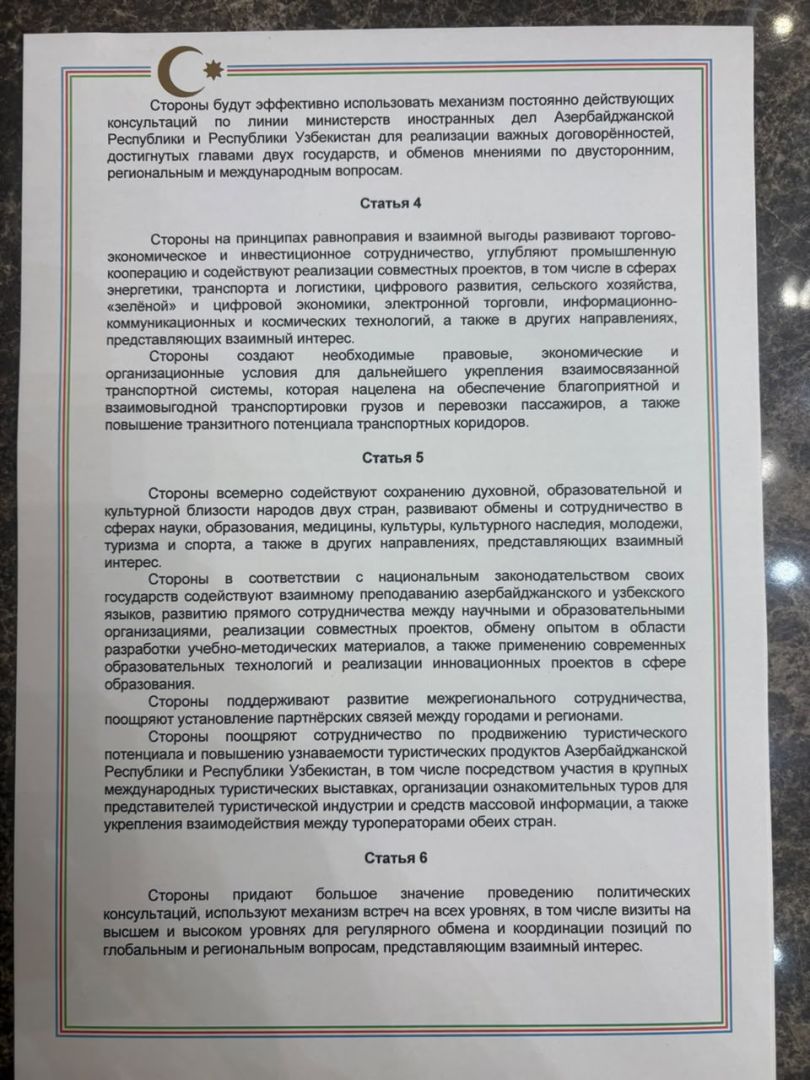
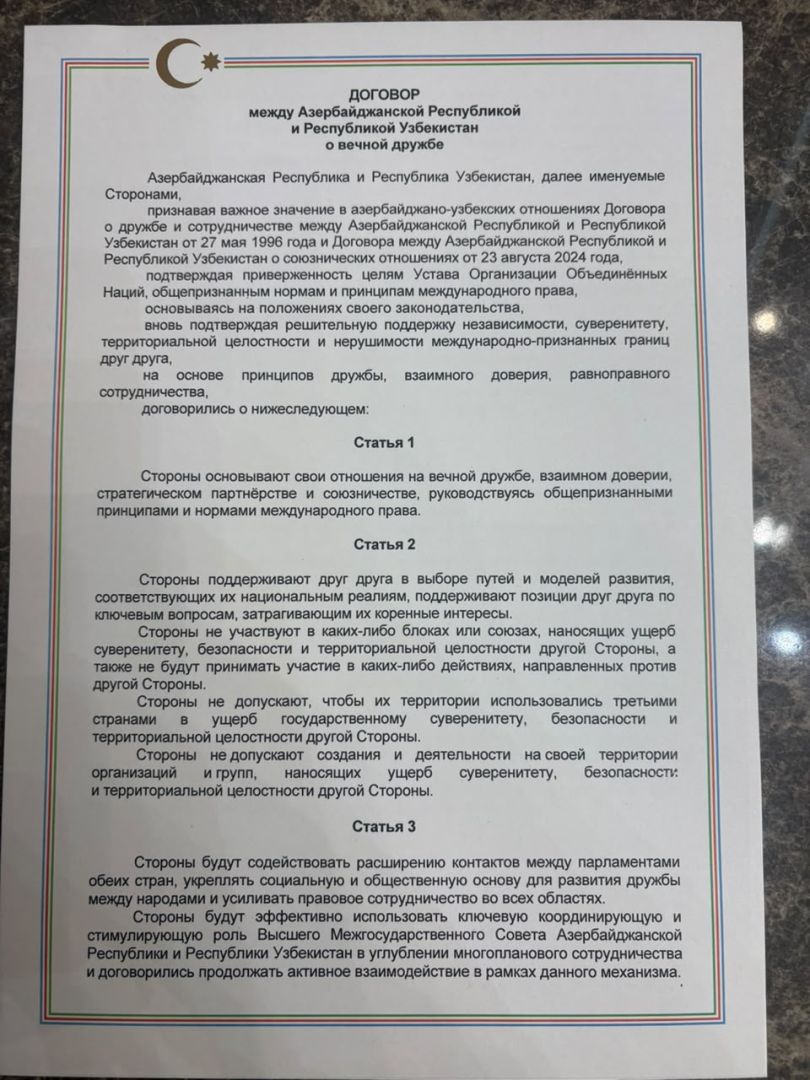
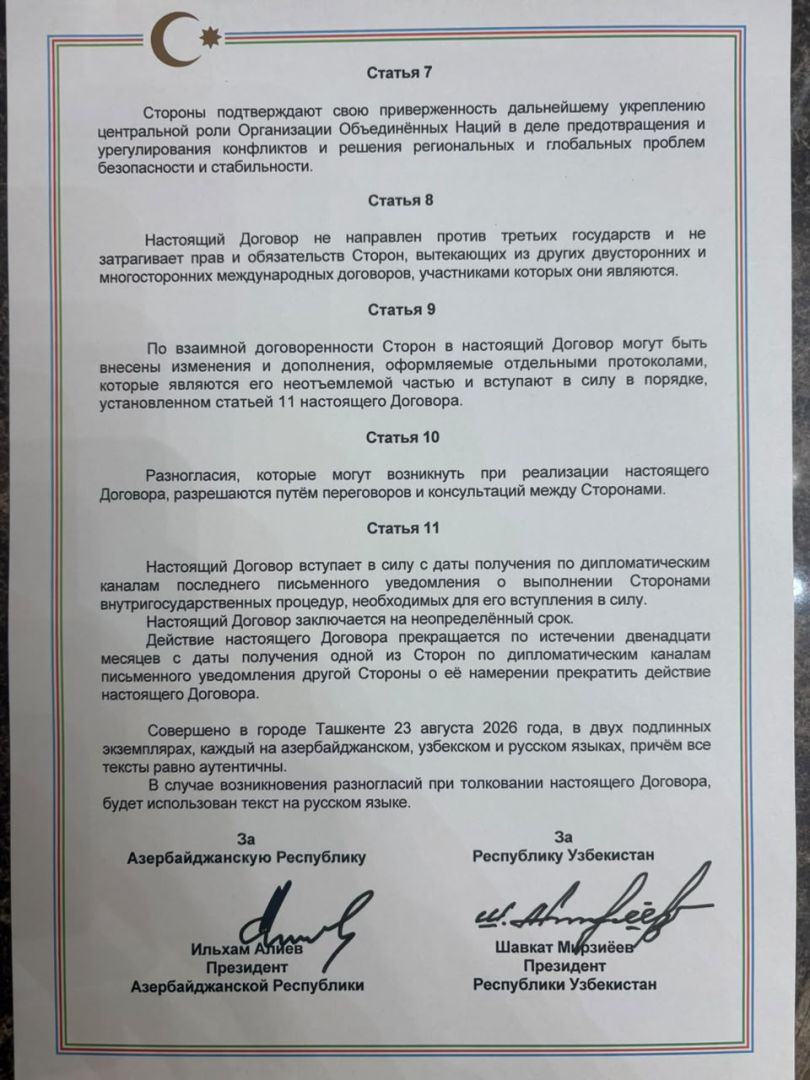
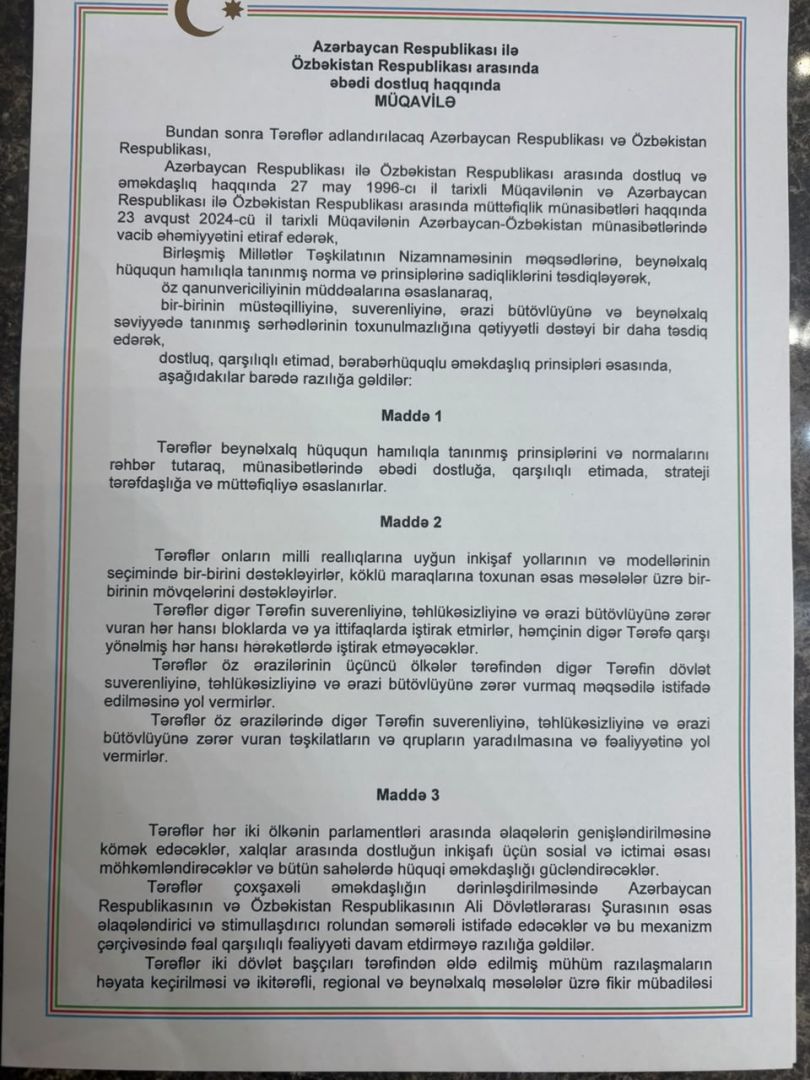
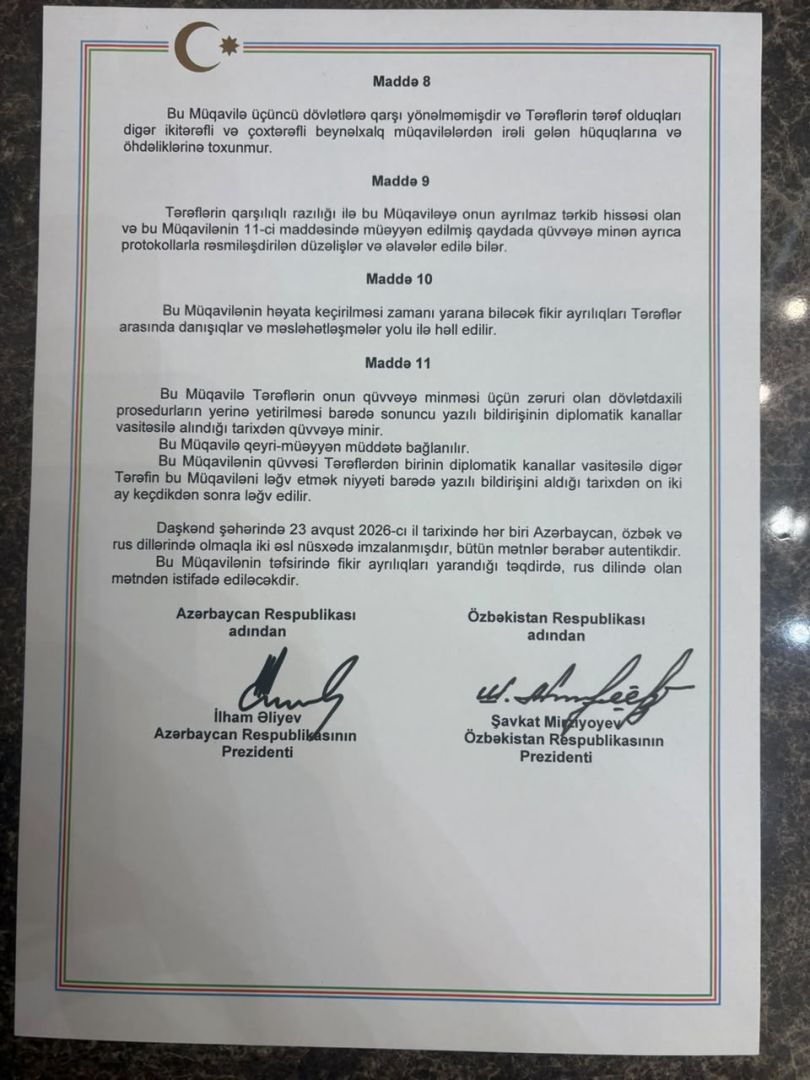
During President Ilham Aliyev’s state visit to Uzbekistan, the two presidents signed the Treaty on Eternal Friendship between the Republic of Azerbaijan and the Republic of Uzbekistan. Its title is striking. But the substance is even more significant.
The document does not simply celebrate the historical, cultural and linguistic bonds between two Turkic nations. It attempts to institutionalise them.
For years, Baku and Tashkent have described their relationship in the language of brotherhood, strategic partnership and alliance. The new treaty takes that political vocabulary and gives it a much more durable framework. The relationship is no longer being built around individual leaders or individual political moments. It is being designed as a long-term strategic commitment. And this is what the message is about, and in the meantime, that makes the agreement important far beyond its symbolism.
The two sides undertake more than to participate in blocs or alliances that could harm the sovereignty, security or territorial integrity of the other. They commit to preventing their territories from being used by third parties to pursue such objectives.
That is a significant provision in a region where geography has repeatedly turned small disputes into larger geopolitical problems.
The South Caucasus and Central Asia sit between major powers and competing geopolitical projects. Both Azerbaijan and Uzbekistan have therefore developed foreign policies that place considerable emphasis on sovereignty, strategic autonomy and the right to pursue their own development models.
The treaty explicitly reinforces that principle and effectively says that Baku and Tashkent will not merely support one another diplomatically. They will also seek to ensure that their respective territories do not become instruments against one another.
That is a much more strategic proposition than traditional friendship diplomacy; however, security is only one part of the agreement.
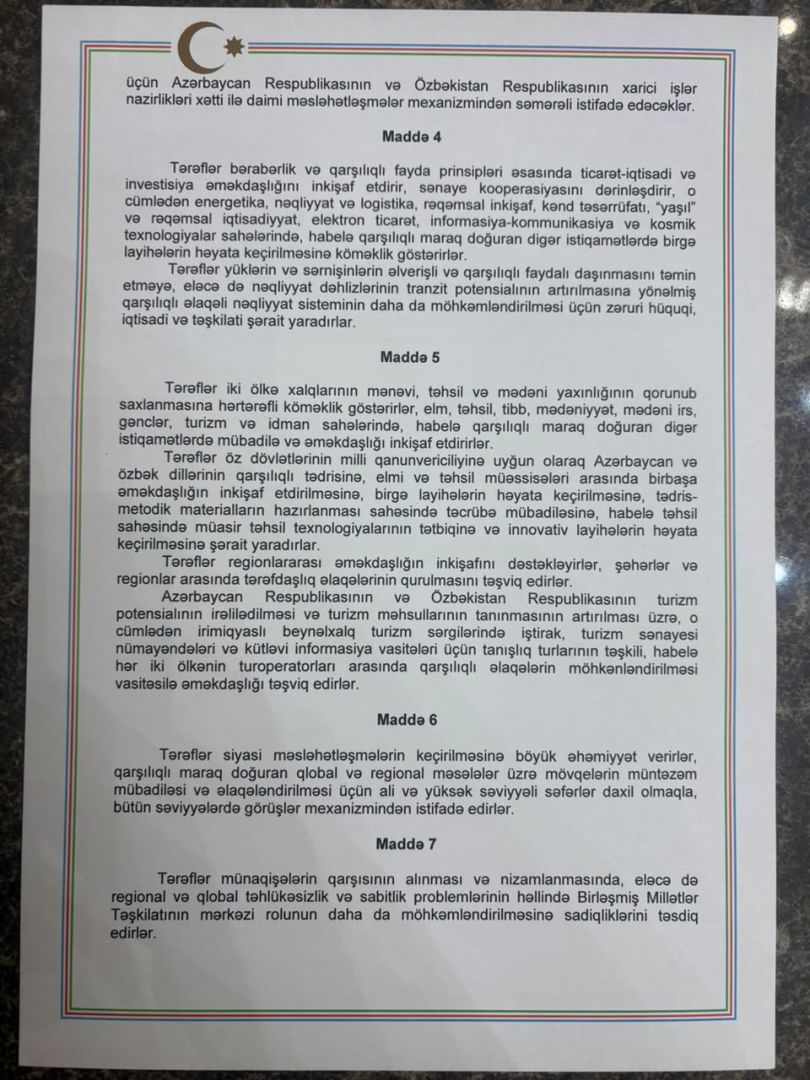
Perhaps the more consequential story is economic, where the treaty commits the two sides to expand trade, investment and cooperation in energy, transport and logistics, digital development, agriculture, the green economy, e-commerce, information and communications technologies and space technology. This is where the agreement intersects with the changing geography of Eurasia.
Azerbaijan and Uzbekistan occupy different ends of an increasingly important east-west economic corridor.
Uzbekistan provides access to one of Central Asia's largest markets and economies. Azerbaijan provides a gateway across the Caspian Sea towards the South Caucasus, Türkiye and Europe.
The treaty therefore gives political backing to an economic relationship that is already accelerating.
Bilateral trade reached $795 million in 2025, more than three times the previous year's figure. Transit between the two countries reached 1.4 million tonnes.
Those figures are not the end of the story. They are an indication of what could come next.
The agreement's emphasis on transport corridors is particularly revealing.
Baku and Tashkent are not simply promising to increase trade. They are committing to improving the infrastructure through which that trade moves.
That means logistics, transit capacity and interconnected transport systems.
In geopolitical terms, this is important because connectivity increasingly determines influence.
Countries that can connect markets gain strategic leverage. Countries that control important transport routes become harder to bypass.
Azerbaijan has spent years building its position as a transport bridge between Central Asia and Europe. Uzbekistan, meanwhile, has been seeking greater access to international markets and alternative trade routes.
Their interests are therefore complementary. The treaty gives that complementarity a political framework and also extends into the digital economy.
The inclusion of digital development, ICT, e-commerce and space technology shows that Baku and Tashkent are thinking beyond traditional commodities and transit.
That is particularly important for Uzbekistan, whose economic transformation is increasingly focused on industrialisation, technology and investment. For Azerbaijan, deeper engagement with Uzbekistan provides an opportunity to expand its own economic links with Central Asia.
The partnership is therefore evolving from an energy-and-transport relationship into a broader economic ecosystem. The treaty includes commitments covering education, science, healthcare, culture, tourism, youth and sport. It also specifically supports the reciprocal teaching of Azerbaijani and Uzbek.
At first glance, that may appear less strategically important than transport or security, but it is not. Because long-term alliances require more than governments. They require institutions, businesses, universities and societies that know one another and have an interest in maintaining the relationship.
The two countries have already been moving in this direction through sister-city agreements, cultural exchanges, educational cooperation and civil-society contacts.
The treaty essentially gives these relationships a permanent political umbrella, where the word “eternal” matters and weighs more than being simply rhetorical. Diplomatic agreements normally reflect the interests of the governments that sign them. This treaty attempts to frame the relationship across generations.
Moreover, Azerbaijan and Uzbekistan are both key members of the Organisation of Turkic States. Their bilateral relationship strengthens the wider institutional and economic links connecting the Turkic states. But this should not be mistaken for the creation of a new geopolitical bloc. The more practical interpretation is that Baku and Tashkent are building a network of strategic partnerships based on sovereignty, economic connectivity and shared cultural identity.
The treaty is therefore less about confronting someone else than about giving the two countries greater room to pursue their own interests, and that may ultimately be its most important feature.
Today, the world around Azerbaijan and Uzbekistan is changing rapidly, where supply chains are being redesigned, transport corridors are becoming strategic assets, energy markets are shifting, digital technology is altering economies, and most importantly, regional powers are seeking greater autonomy.
In that environment, reliable partnerships matter, and Azerbaijan and Uzbekistan have decided that theirs should be one of them. The relationship began with history and brotherhood. It progressed into a strategic partnership, and it finally became an alliance.
Now it has been given a new political label: eternal friendship.
The real test, however, will not be the language of the treaty. It will be whether Baku and Tashkent can turn their commitments into factories, investments, transport links, technology projects, educational exchanges and stronger regional connectivity.
If they do, the 23 August agreement will be remembered not as a ceremonial document celebrating an old friendship, but as the moment when that friendship was converted into a long-term strategic doctrine.
Here we are to serve you with news right now. It does not cost much, but worth your attention.
Choose to support open, independent, quality journalism and subscribe on a monthly basis.
By subscribing to our online newspaper, you can have full digital access to all news, analysis, and much more.
You can also follow AzerNEWS on Twitter @AzerNewsAz or Facebook @AzerNewsNewspaper
Thank you!