
President Aliyev joins regional leaders for landmark environmental summit

AzerNEWS Staff
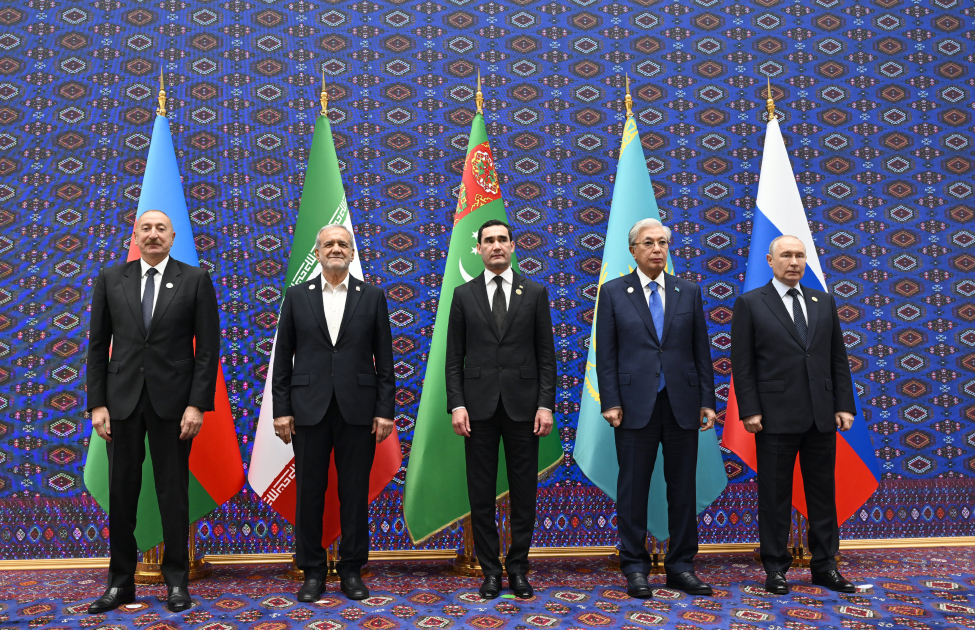
Read moreThe rapid decline of the Caspian Sea’s water levels is set to take centre stage as Azerbaijan’s president, Ilham Aliyev, joins regional leaders in Turkmenistan for a high-level environmental summit aimed at strengthening cooperation to protect the world’s largest inland body of water.
The meeting, taking place in the Avaza National Tourist Zone on the Caspian coast, is intended to address mounting ecological challenges, including falling water levels, climate change, biodiversity loss and pollution. The initiative was put forward by Turkmenistan, which has called for closer scientific and practical cooperation among the five countries bordering the sea.
President Ilham Aliyev arrived in Turkmenistan on 8 October for a series of high-level regional meetings, including the Caspian Environmental Summit. His visit also includes the eighth Consultative Meeting of the Heads of State of Central Asia and Azerbaijan and a meeting of the Council of Heads of State of the Commonwealth of Independent States (CIS).
On 8 October, President Aliyev met Turkmenistan’s president, Serdar Berdimuhamedov, in Avaza. The two leaders discussed bilateral relations, transport, logistics, economic cooperation and issues concerning the Caspian Sea. The president of Azerbaijan also addressed the eighth consultative meeting, where Azerbaijan’s growing engagement with Central Asia was a central theme.
On 9 October, the Azerbaijani leader arrived at the Avaza complex for the CIS leaders’ meeting, which is also taking place during the visit. His participation in the wider programme reflects the importance Azerbaijan attaches to regional dialogue, including cooperation on environmental protection. Official reports confirm the bilateral talks, while Turkmenistan’s authorities have identified the Caspian Environmental Summit as one of the main events of the visit.
A sea under mounting pressure
The Caspian’s declining water levels have become a growing concern for countries across the region. Azerbaijan has warned that the sea is approaching historically low levels, with potential consequences for coastal communities, shipping, fisheries and fragile habitats.
The environmental pressures are complex, as changes in precipitation and evaporation, rising temperatures, river inflows and wider climatic shifts all affect the Caspian’s water balance. The sea has no natural outlet to the world’s oceans, making its level particularly sensitive to changes in the amount of water entering and leaving its basin.
For Azerbaijan, the implications extend beyond environmental conservation. The Caspian is an important transport corridor connecting the South Caucasus with Central Asia and forms part of trade routes linking Europe and Asia. Changes in water depth can create additional challenges for ports, shipping operations and regional logistics.
The decline also threatens the sea’s distinctive biodiversity. Its ecosystems support numerous fish species and provide habitats for wildlife, including the endangered Caspian seal. Changes in coastal conditions and the availability of suitable habitats could intensify existing pressures on these populations.
Aliyev has previously highlighted the seriousness of the problem. In an address marking World Environment Day in June 2026, he identified the Caspian’s declining level, water scarcity, floods and droughts among the environmental challenges facing Azerbaijan.
The summit therefore offers an opportunity to move beyond expressions of concern towards a more coordinated regional response, although the effectiveness of any agreement will depend on its implementation.
Moreover, one significant point to consider is that the Caspian is bordered by Azerbaijan, Iran, Kazakhstan, Russia and Turkmenistan. Although the countries have different economic priorities and political interests, they share responsibility for the sea’s environmental future.
The summit’s agenda is expected to cover ecological security, climate change, biodiversity conservation, the protection of biological resources, pollution prevention and scientific research. Cooperation on monitoring changes in water levels and assessing their causes will be particularly important.
No single country can adequately address the Caspian’s environmental challenges in isolation. Coordinated research, comparable monitoring data and the exchange of scientific expertise could help governments better understand the changes affecting the sea and develop measures to protect its ecosystems.
The meeting is also expected to build on the Tehran Convention, formally known as the Framework Convention for the Protection of the Marine Environment of the Caspian Sea. The agreement provides a regional legal framework for cooperation on pollution prevention and the protection of the marine environment.
Strengthening its implementation could help the five countries improve environmental monitoring, share information and coordinate practical measures. Previous discussions among Caspian states have also highlighted the importance of protecting biological resources and applying modern environmental technologies.
Yet the scale of the challenge means that political commitments alone will not be sufficient. Regional cooperation will need to be supported by sustained scientific work, effective environmental policies and the resources required to put agreed measures into practice.
Turkmenistan seeks a stronger regional response
Turkmenistan proposed a high-level environmental gathering during the 80th session of the United Nations General Assembly in September 2025. President Serdar Berdimuhamedov called for an environmental forum dedicated to the Caspian, with the initiative subsequently developed into a leaders’ meeting.
At a Caspian Sea Day conference in Tehran on 11 August 2026, the Turkmen side announced plans to hold the high-level meeting in Avaza on 9 October.
The initiative reflects growing concern about the Caspian’s environmental condition and the need to place its protection higher on the regional agenda. Avaza, which has become a venue for international meetings and diplomatic exchanges, is hosting several major gatherings during the current visit by regional leaders.
For Azerbaijan, participation also provides an opportunity to raise an issue with direct implications for its environment, economy and international transport links. Aliyev’s discussions with Berdimuhamedov on 8 October included the Caspian Sea and cooperation within international organisations, underlining the place of environmental issues within the broader bilateral relationship.
The summit’s significance will ultimately be measured not simply by the number of leaders attending or declarations adopted, but by whether the five countries can establish practical mechanisms for addressing shared ecological risks.
With water levels continuing to attract concern and coastal ecosystems facing mounting pressure, the Caspian’s future presents a test of regional cooperation. The meeting in Avaza offers a platform for developing a common approach; turning that ambition into lasting environmental progress remains the more difficult task.
Here we are to serve you with news right now. It does not cost much, but worth your attention.
Choose to support open, independent, quality journalism and subscribe on a monthly basis.
By subscribing to our online newspaper, you can have full digital access to all news, analysis, and much more.
You can also follow AzerNEWS on Twitter @AzerNewsAz or Facebook @AzerNewsNewspaper
Thank you!