
America’s Silk Road runs through the Caspian
Akbar Novruz
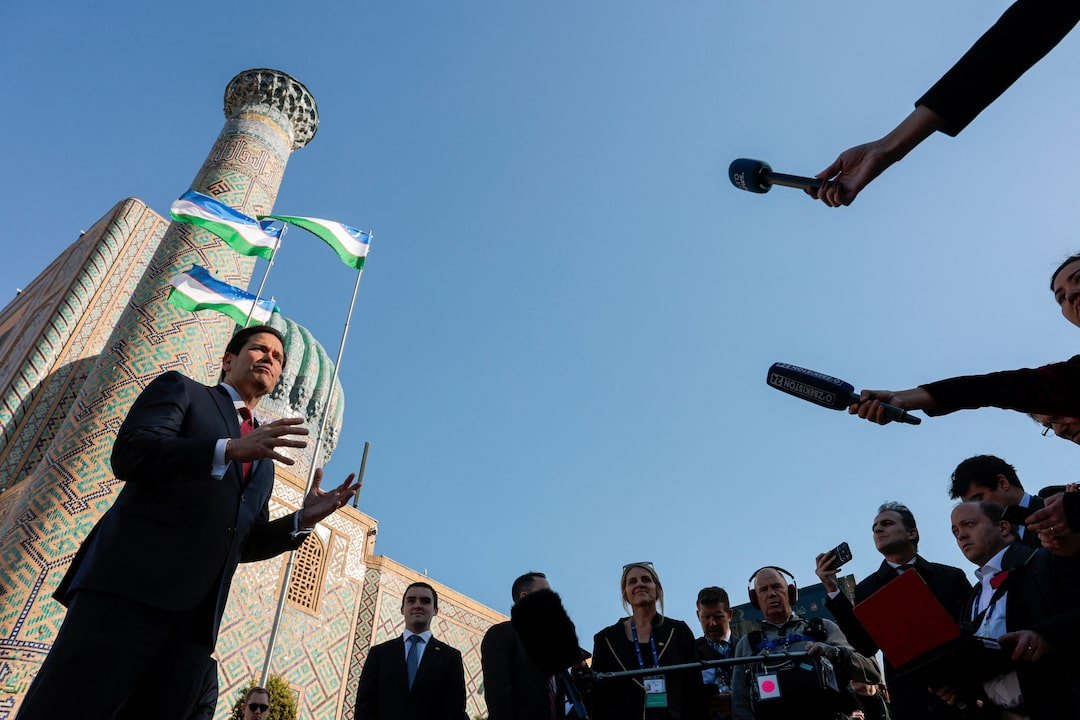
Read more"Who rules East Europe commands the Heartland; who rules the Heartland commands the World-Island; who rules the World-Island commands the world." Halford Mackinder wrote that sentence in 1919, and diplomats have quoted it ever since, usually to make a point about Russia. This week it found an unlikely new audience in Samarkand, the Silk Road city where America's secretary of state, Marco Rubio, convened the foreign ministers of Kazakhstan, Kyrgyzstan, Tajikistan, Turkmenistan and Uzbekistan, with more than 100 American companies behind him.
The numbers were designed to impress. Uzbekistan announced 54 agreements, potentially worth $12bn, at a business council attended by some 400 delegates. It follows the White House summit last November, which produced more than $25bn in announced deals, including Boeing orders from Uzbekistan Airways and Tajikistan's Somon Air. The joint statement issued on October 19th pledges "enduring partners of choice" and a Central Asia that "returns to the center of the global economy". Rubio promised "concrete deals", and Tashkent produced a list.
Uzbekistan has claimed an incredible 54 deals worth an estimated $12bn at a business forum that attracted some 400 participants. This follows the White House gathering in November, which yielded more than $25bn in announced transactions, including orders from Uzbekistan Airways and Tajikistan's Somon Air for Boeing aircraft. The statement of cooperation agreed upon on October 19th speaks of "enduring partners of choice" and a Central Asia that will again be "at the heart of the global economy". Rubio wanted "concrete deals"; in return, Tashkent delivered.
Now, let’s strip out the diplomatic verbiage; the reasoning is geostrategic in the most classical sense. Central Asia lies at the intersection of Russia, China, and Iran; it is the only part of Eurasia where all three countries seek a stake in the region, and none controls the game. Russia’s conflict with Ukraine has made Russia an unappealing headquarters for multinational companies, forcing the region’s governments to diversify. China has become the most powerful external investor in the region and increasingly builds the region’s telecommunications networks and renewables, services, mines, and pipelines. The strategic intent of the United States here is clear: to prevent the continent from uniting into a closed Eurasian landmass on its own terms, wired to Western supply chains.
Old idea with a new budget
But it would be wrong to think that this is a discovery. An ex-official of the US Department of State who was responsible for Central Asian policies during the George W. Bush administration has noted irritably that for decades now the US government has been trying to lure regional investments: pipelines, power lines, road connections, even a ministerial on trade that was almost a C5+1 way back before the concept ever came into being. The US accounted for 29.2 percent of foreign direct investment in Kazakhstan in 2005, with General Electric establishing manufacturing of locomotives there and FedEx opening a hub in Almaty.
The difference was not in how much America paid attention; it was in how the region had changed. Uzbekistan, which was supposed to be the prize, was closed to foreign capital under Islam Karimov, whose regime effectively seized the leading American investment in the country and spooked others, even though a 2002 memorandum had promised a hospitable environment. It is the new openness since his tenure that makes the news. Russia’s war on Chechnya has also turned Kazakhstan into an obvious center for regional operations.
Caspian in the hinge
This is where the geography becomes concrete, and it is the party that was not present in Samarkand that comes into play. C5+1 joint statement mentions the Trans-Caspian Trade Route as the route for "unprecedented two-way trade and investment." This route does not magically traverse through the Caspian Sea. The Trans-Caspian Route traverses Azerbaijan through shipping services from Kazakhstan and Turkmenistan to Alat, railway and road transport to Georgia and Türkiye, and then further to Europe. Azerbaijani transits comprise about 63% of cargo flow through the corridor, while expansion of Alat port, which processed 8.2 million tonnes of cargo last year, to 25 million tonnes is underway. In addition, a fibre-optic cable has been laid across the sea from Aktau to Sumgayit this month.
Central Asia's connection to Western markets therefore cannot work without a stable, sovereign gatekeeper on the western shore. Baku has noticed. It has recently joined the Central Asian leaders' consultative format, and its own track with Washington, including a strategic partnership charter signed in February and the American-backed transit route through Armenia, runs in parallel. In November 2025, at the seventh Consultative Meeting in Tashkent, the five Central Asian presidents agreed to admit Azerbaijan as a full participant. Hikmet Hajiyev, Ilham Aliyev’s foreign-policy adviser, put it bluntly: “From now on, Central Asia stands as 6.” President Aliyev described the region and his country as “a single geopolitical and geo-economic region whose importance in the world is steadily growing.” The C5 has become, in practice, a C6. This month’s meeting in Turkmenbashi was Azerbaijan’s first as a full member, and the chair for 2027 passes to Baku. Yet the Samarkand statement names five Central Asian states and the United States, and no sixth; however, it describes a world that depends on it.
Even the most optimistic note is that the Samarkand numbers refer to contracts and transactions rather than funds already invested, and the joint declaration states intentions without any financial commitments. The Uzbeks want to know how much mineral processing American investors will do in their own country rather than export the ore overseas. Central Asia exports more than $15 billion of critical minerals a year, and every tonne must cross a neighbouring state's border to reach the sea. With both southern exits operationally jammed in 2026, the routes that stay politically usable will decide who processes the ore and who holds the leverage. Now, the way to measure results will be to come back in three or four months and count contracts.
Long story short - Mackinder's maxim was about control. Today's version is about connection. The Heartland is not a place to control but a network to maintain open, and the western terminus of that network is a nation that did not subscribe to the Samarkand declaration but may be more important than all those who did.
*photo credit: Reuters
Here we are to serve you with news right now. It does not cost much, but worth your attention.
Choose to support open, independent, quality journalism and subscribe on a monthly basis.
By subscribing to our online newspaper, you can have full digital access to all news, analysis, and much more.
You can also follow AzerNEWS on Twitter @AzerNewsAz or Facebook @AzerNewsNewspaper
Thank you!