
Zangezur Corridor puts S Caucasus at centre of global trade and power rivalry
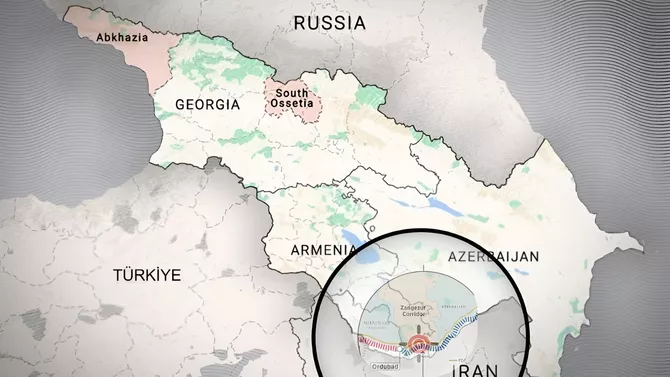
TRIPP could reshape Eurasian transport links and strengthen Azerbaijan’s position as a regional logistics hub, but competing interests among Washington, Moscow, Tehran and regional capitals will determine whether the project delivers lasting economic gains.
By Dr Muhammet Kemaloglu | AzerNEWS
The proposed Zangezur corridor is emerging as one of the South Caucasus’s most consequential geopolitical and economic projects, with implications extending well beyond the restoration of a transport link between mainland Azerbaijan and its Nakhchivan exclave. Its potential to connect Türkiye with the Caspian Sea and Central Asia more directly has placed the route at the intersection of regional trade ambitions, energy security and competition among global powers.
Given its benefits for Azerbaijan, the corridor could reduce transport costs, expand access to international markets and reinforce the country’s ambitions to become a key logistics hub along the Middle Corridor linking China and Europe. For Armenia, it offers the prospect of new trade and infrastructure investment, although questions over sovereignty, border controls and security remain central to negotiations. For the United States, Russia and Iran, the project represents a potential shift in the strategic balance of the South Caucasus.
The central question is no longer simply whether a railway or road can be built. It is whether the countries involved can establish a workable system of transit, security and commercial governance that distributes the benefits without creating new sources of confrontation.
Zangezur’s strategic importance stems from its location. The historical region encompasses areas now within Armenia and Azerbaijan, including territory around Syunik, as well as districts such as Lachin, Gubadli and Zangilan in Azerbaijan. Its mountainous terrain and position between the Caspian region, Türkiye and Iran have made control over its transport routes a recurring source of geopolitical competition.
The historical account underpinning the project argues that the territorial changes of the early 1920s severed a vital land connection between mainland Azerbaijan and Nakhchivan, creating a division that subsequently shaped regional transport and security arrangements. It also highlights the displacement of the region’s Azerbaijani Muslim population during the violence of the early twentieth century.
The scale, causes, and political interpretation of these historical events remain contested and require careful examination of archival records and independent scholarship. Nevertheless, the geographical consequence is clear: Azerbaijan and Nakhchivan have lacked a direct land connection through Armenian territory, making alternative routes economically and strategically important.
For Baku, restoring direct connectivity would address a long-standing logistical constraint while strengthening links with Türkiye and the wider Organisation of Turkic States. It would also give Azerbaijan an additional instrument for diversifying trade routes at a time when Eurasian transport networks are being reshaped by geopolitical tensions and efforts to reduce dependence on established corridors.
TRIPP could strengthen Azerbaijan’s logistics ambitions
The Trump Route for International Peace and Prosperity (TRIPP), also known by its historical name as Zangezur, is presented in the source material as a means of reconnecting Azerbaijan with Nakhchivan through modern Armenia’s Syunik province.
Its economic case rests on more than geographical convenience. A functioning corridor could combine road and railway links with energy infrastructure and fibre-optic networks, creating a route for goods, electricity-related infrastructure and digital communications. Such integration would potentially improve the commercial value of the corridor and attract investment beyond transport alone.
The supplied analysis projects that the route could shorten transport distances by approximately 150 kilometres compared with the Baku–Tbilisi–Kars railway route. It also cites estimates of a $700 million increase in Azerbaijan’s annual exports and a 2% rise in non-oil gross domestic product. These are projections rather than guaranteed outcomes; their realisation would depend on traffic volumes, tariffs, infrastructure costs, operating arrangements and demand from international shippers.
For Azerbaijan, the wider opportunity is to convert its geographical position into a durable economic advantage. Oil and gas exports have long underpinned the country’s international importance, but a stronger role in transit and logistics could broaden its sources of revenue and encourage investment in manufacturing, warehousing, freight services and digital infrastructure.
The Middle Corridor offers a framework for that ambition. Yet the availability of a shorter route does not automatically make it the most competitive. Reliability, predictable customs procedures, transparent pricing and political stability are equally important to businesses choosing between competing transport networks.
Washington’s involvement changes the strategic equation
The corridor’s geopolitical significance has increased as the proposed governance model has evolved. According to the supplied material, the 2020 trilateral ceasefire statement envisaged an arrangement for transport links between Azerbaijan and Nakhchivan, initially involving Russian oversight. The source describes a subsequent 2025 US-backed memorandum as moving the project towards a more international framework, including long-term American involvement and management by an international company.
This shift would have implications for the regional balance of power. Russia has traditionally played a central role in South Caucasus security arrangements. A greater US role could reduce Moscow’s influence over a strategically important transport route while creating a new platform for Washington’s engagement with Azerbaijan and Armenia.
For the United States, the corridor could support broader efforts to diversify Eurasian trade routes, deepen ties with regional partners and limit the leverage of rival powers. China could also benefit from additional options for transporting goods towards European markets, although the extent of that benefit would depend on the final operating arrangements and the route’s commercial competitiveness.
The arrangement would not necessarily eliminate geopolitical risk. A long-term international management structure could provide continuity and reduce the ability of any single regional power to dominate transit. Equally, it could generate new disagreements over who controls infrastructure, sets operating rules and bears responsibility for security.
The details matter. The distinction between an international transit arrangement and a corridor operating outside ordinary Armenian jurisdiction is particularly important. The 2020 statement provides for the unblocking of regional transport links, but the precise customs, border-control and governance arrangements require agreement among the parties. They cannot be assumed to have been settled merely by the project’s strategic designation.
Armenia and Iran have reasons to weigh the costs
For Armenia, opening transport links could offer new commercial opportunities, improve access to regional markets and attract infrastructure investment. The supplied material cites a claim that the corridor could significantly increase Armenia’s economic output, although such estimates should be treated cautiously until supported by transparent modelling.
At the same time, Yerevan faces a fundamental political challenge: securing the economic benefits of connectivity without compromising its sovereignty or domestic security requirements. Any sustainable arrangement will need to reconcile Azerbaijan’s demand for efficient and uninterrupted transit with Armenia’s position on jurisdiction and border management.
Iran’s concerns are different but equally significant. Tehran fears that a new route could weaken its role as a transit link between Azerbaijan and Nakhchivan and diminish its commercial leverage in the region. It also views changes to the strategic balance near its northern border through a security lens.
These concerns underline the risk of treating the corridor solely as an infrastructure project. Its success will depend on whether neighbouring states regard the new arrangements as commercially beneficial and politically tolerable. Excluding regional interests from the negotiating process could encourage resistance, delay construction or undermine the reliability that investors and freight operators require.
The corridor’s advocates frame it as a response to a century of geographical separation and a potential catalyst for regional economic integration. That ambition is understandable, but historical narratives alone cannot guarantee commercial success or lasting peace.
The project faces several practical tests: securing agreement on customs and border procedures, financing and completing infrastructure, defining operational responsibilities, protecting transport links and establishing predictable rules for international companies. It must also demonstrate that its economic benefits will be distributed sufficiently widely to sustain political support.
For Azerbaijan, the opportunity is to strengthen its role as a bridge between Central Asia, the Caspian region, Türkiye and European markets. For Armenia, participation could create a new source of trade and investment. For the wider region, the corridor could help shift the emphasis from competing over routes to benefiting from their shared use.
But the same strategic value that makes Zangezur attractive also makes it vulnerable to rivalry. Washington’s involvement may alter the balance with Moscow and Tehran, while questions over sovereignty and regional ownership could complicate implementation.
The corridor therefore stands at a pivotal point between economic opportunity and geopolitical competition. If its governance is transparent, its transit arrangements are mutually acceptable, and its infrastructure proves commercially viable, TRIPP could become an important component of Eurasian connectivity. If political control takes precedence over practical cooperation, it risks becoming another contested frontier in a region already shaped by decades of conflict.
The ultimate measure of success will not be which power gains the greatest strategic advantage. It will be whether the route can move goods reliably, attract investment and give the countries around it a durable economic incentive to preserve peace.
Dr Muhammet Kemaloglu is a retired colonel, military expert and author of numerous publications on the geopolitics and history of the South Caucasus and Anatolia.
Here we are to serve you with news right now. It does not cost much, but worth your attention.
Choose to support open, independent, quality journalism and subscribe on a monthly basis.
By subscribing to our online newspaper, you can have full digital access to all news, analysis, and much more.
You can also follow AzerNEWS on Twitter @AzerNewsAz or Facebook @AzerNewsNewspaper
Thank you!