
Azerbaijan, Kazakhstan open a new digital gateway to Europe

Ulviyya Poladova
Read moreThe Caspian Sea is becoming more than a link between Central Asia and the South Caucasus. It is emerging as a potential gateway for the digital traffic connecting Asia and Europe.
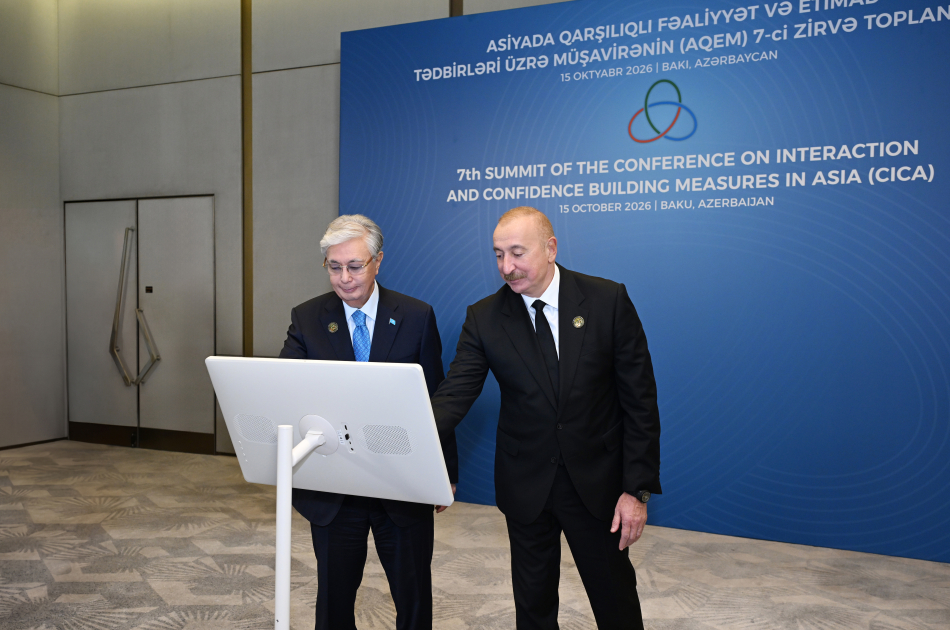
That ambition was reflected in the 7th Summit of the Conference on Interaction and Confidence Building Measures in Asia (CICA), held in Baku, where regional cooperation and connectivity featured against a backdrop of shifting geopolitical alignments and growing concerns over the security of critical infrastructure. The launch of the Trans-Caspian Fiber-Optic Cable Line by Azerbaijani President Ilham Aliyev and his Kazakh counterpart, Kassym-Jomart Tokayev, offers a concrete expression of that ambition.
For years, much of the data traffic between Asia and Europe has depended on routes running through Russia or via the Middle East and the Red Sea. Disruptions to undersea cables have exposed the vulnerabilities of existing networks, strengthening the case for alternative connections. The new link across the Caspian could help diversify those routes, giving Azerbaijan and Kazakhstan a more prominent role in the infrastructure underpinning the digital economy.
The question is no longer simply how goods and energy move across Eurasia, but who will carry its data and, certainly, who will benefit from the growing demand for secure, high-capacity connections.
Implemented by Azerbaijan and Kazakhstan under the Digital Silk Way initiative, the project opens up new opportunities for digital connectivity between Asia and Europe. A cable stretching approximately 380 kilometres has been laid along the seabed of the Caspian Sea between Sumgayit and Aktau. Its capacity exceeds 400 terabits per second. The launch of the line will enhance the strategic importance of the Middle Corridor, not only as a transport route but also as a digital communications link.
The new route will make it possible to transmit data from China and Central Asia to Europe via Azerbaijan, Kazakhstan and Georgia, and then through the Black Sea or Türkiye. This will expand opportunities for international data exchange and make digital communications more resilient. In addition, the countries are becoming providers of strategic digital infrastructure and services. It also creates additional opportunities to attract investment and develop data centres for artificial intelligence, cloud services and computing capacity. This, in turn, opens up prospects for new high-tech industries and services with high added value.
According to President Ilham Aliyev, the project marks another step in strengthening cooperation between Central Asia and Azerbaijan.
"Everyone is well aware that in November last year, Azerbaijan was admitted as a full member of the Consultative Meetings, and already this year, I recently participated as a full member of the community. This is yet another contribution to strengthening our cooperation, because this cable will be utilized by both the countries of Central Asia and the South Caucasus, as well as across a broader geography. So today we have launched a global project," the head of state noted.
A reminder: The subsea cable-laying operation between Aktau and Sumgayit began in July 2026. On August 5, the government announced that this stage had been completed. Work continued around the clock, involving 70 specialists aboard a vessel with a displacement of more than 20,000 tonnes. The remaining tasks included connecting the cable to the coastal infrastructure, completing onshore works and testing the system. On October 6, the laying of the Trans-Caspian Fiber-Optic Cable Line along the seabed of the Caspian Sea was completed.
Over the past few years, the role of Kazakhstan and Azerbaijan as geographic and economic links between Asia and Europe has grown steadily more visible. The Aktau–Sumgayit fiber-optic line opens a new chapter in the development of the two countries' digital infrastructure, turning them from mere participants in international data exchange into active builders and custodians of global network nodes. That matters all the more amid the rising demand for reliable, fast and secure channels for moving information. Beyond that, this route will let Kazakhstan and Azerbaijan ensure direct, high-speed data transmission between the two continents, bypassing the traditional routes that are so often overloaded and vulnerable. One of the project's key advantages is that it creates an alternative path for carrying data. At a time when so many critical services and systems depend on the internet running without interruption, having backup, independent channels becomes a vital factor.
The Sumgayit-Aktau project adds a digital dimension to the Middle Corridor. Kazakhstan and Azerbaijan are seeking to establish the same intermediary role in the digital sphere that they are already developing in freight transportation and energy. Moreover, high-speed digital connectivity, combined with a reliable energy base and growing potential in renewable energy, could help attract investment in data centres, high-performance computing and artificial intelligence infrastructure. At the same time, the actual volume of transit traffic, the commercial utilisation of the line and its impact on the cost of connectivity services will depend on how the infrastructure is operated and on agreements reached with telecommunications operators.
Today the development of digital networks moves in step with the development of transport and energy corridors, becoming an inseparable part of national strategy and international cooperation. This project fits squarely into the idea of integrating different layers of infrastructure, ensuring the all-round development of the Eurasian space. The undersea cable also adds a digital dimension to the growing communications infrastructure along the Trans-Caspian route, which is increasingly drawing the attention of transport, energy and telecommunications projects linking Central Asia with the South Caucasus and Europe. By establishing a direct connection across the floor of the Caspian, the project is expected to reduce dependence on alternative overland routes and to provide additional capacity for carrying data between Central Asia and the markets to the west.
For centuries, the Caspian Sea served as a barrier between its shores. Now it is becoming a link that brings them together. And the two countries on opposite sides of the sea are emerging as bridges between digital worlds. A cable just a few hundred kilometres long is effectively bringing those worlds closer together.
Here we are to serve you with news right now. It does not cost much, but worth your attention.
Choose to support open, independent, quality journalism and subscribe on a monthly basis.
By subscribing to our online newspaper, you can have full digital access to all news, analysis, and much more.
You can also follow AzerNEWS on Twitter @AzerNewsAz or Facebook @AzerNewsNewspaper
Thank you!