
Fuel crisis in Russia and ghost of Soviet scarcity

Qabil Ashirov
Read moreThe war in Ukraine has produced many surprises, but perhaps none is as paradoxical as the emergence of fuel shortages inside one of the world's largest energy powers. Over the past months, Ukrainian drones have systematically targeted transportation hubs in Russian-occupied territories and oil refineries deep inside Russia. Initially, the consequences were visible primarily in the territories annexed by Russia and in areas close to the front line, particularly in Belgorod. Soon, however, the problem spread much further.
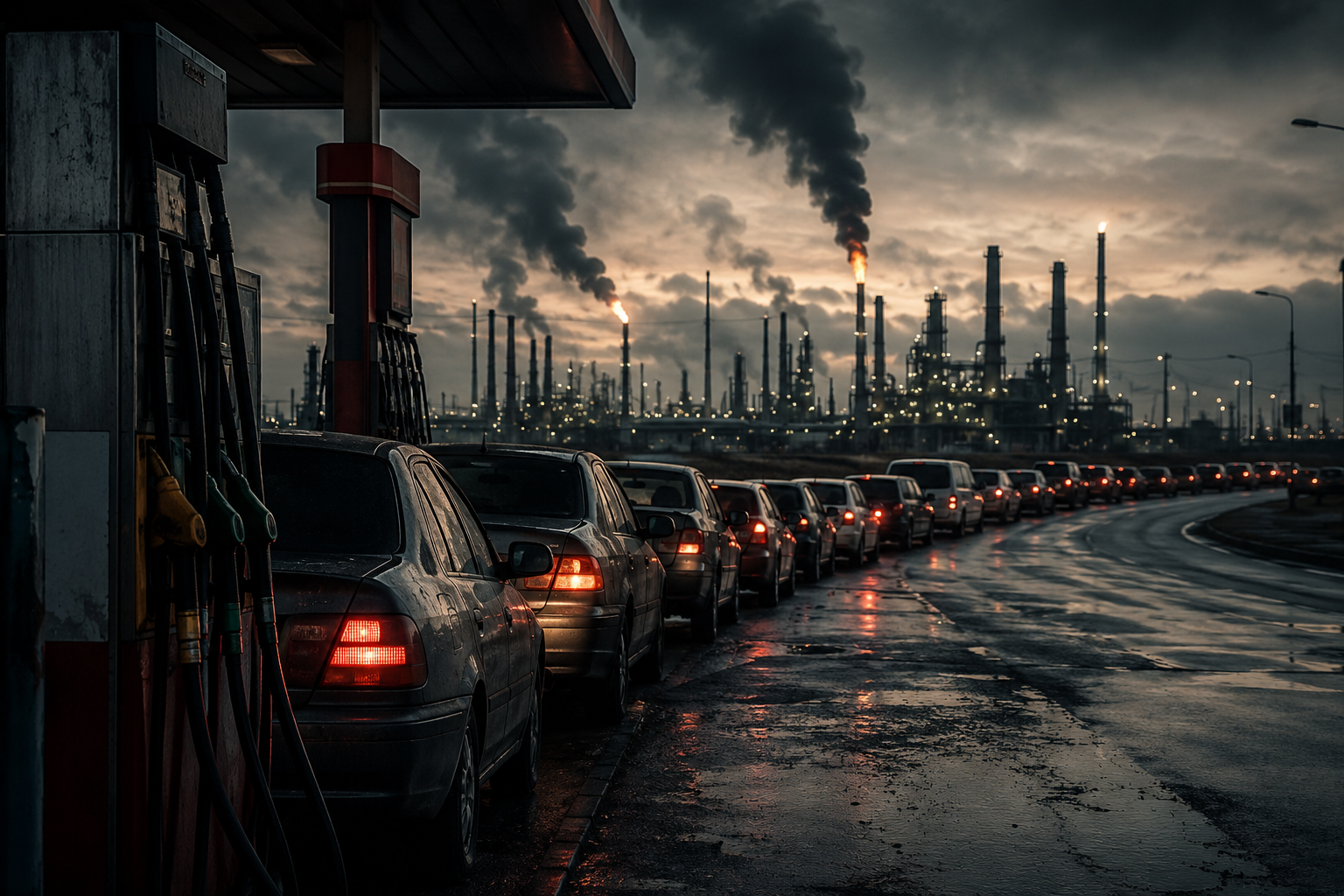
Today, reports of fuel shortages, long queues at petrol stations, and rationing measures have emerged from dozens of Russian regions, including Moscow and St. Petersburg. In Crimea, fuel distribution has reportedly become increasingly restricted, with priority being given to state institutions and essential services. In some regions, petrol stations have imposed limits on daily sales, allowing motorists to purchase only limited quantities of fuel.
At first glance, one might argue that such developments are natural. Russia is, after all, fighting the largest war in Europe since 1945. Wars disrupt supply chains, destroy infrastructure, and create shortages. After all, a broader historical comparison raises questions.
Since February 2022, Russia has relentlessly targeted Ukraine's energy infrastructure, fuel depots, transportation networks, and industrial facilities. Despite suffering far greater physical destruction and possessing significantly fewer economic and natural resources than Russia, Ukraine has managed to avoid a prolonged nationwide fuel crisis. Kyiv experienced a severe fuel shortage during the early months of the invasion, but it rapidly diversified imports, created alternative supply routes through Europe, and adapted its logistics system.
Russia's case is different and therefore deserves closer scrutiny.
The Russian Federation is often described as a militarized state. From education and industry to transportation and shipping, many sectors have long been designed with dual-use capabilities in mind. The country possesses some of the world's largest hydrocarbon reserves and is frequently referred to as a "gas station with nuclear weapons." A state that prides itself on strategic depth, resource abundance, and wartime preparedness should, at least in theory, be better equipped to absorb attacks on several oil refineries.
The emergence of widespread fuel shortages, therefore, gives rise to two competing explanations.
The first explanation is highly speculative but nevertheless popular among certain observers of Russian politics. According to this interpretation, influential individuals or groups inside the system may seek to weaken the President's public legitimacy by allowing or even encouraging shortages to develop. Such arguments gain traction because the memory of the late Soviet shortages and the traumatic collapse of the USSR still occupies a special place in Russian collective consciousness.
The panic buying that swept through Russia during the first weeks of the invasion in 2022 was revealing. Russians rushed to stores to stockpile sugar, buckwheat, flour, and other essential products. The fear of scarcity remains deeply embedded in society. To the Kremlin's credit, it managed that panic remarkably well. The expected run on supermarkets never turned into a broader crisis of confidence.
Some speculative observers, therefore, argue that a gradual erosion of public confidence could be engineered through shortages and administrative failures, paving the way for a political "savior" to emerge later and promise stability.
There is, however, little evidence supporting such claims. They remain in the realm of political speculation.
A second explanation appears more convincing.
The larger and more centralized a state becomes, the more difficult it is to govern efficiently. This was one of the central contradictions of the Soviet Union, and echoes of that experience may still be present in modern Russia.
For example, the USSR possessed virtually everything necessary to become an agricultural superpower: vast fertile lands, enormous water resources, cheap energy, and an immense labor force. Yet the Soviet Union repeatedly struggled to provide its citizens with basic food products and became a major importer of grain.
The paradox was striking. Meat, butter, and dairy products often disappeared from store shelves while remaining available through informal networks and black markets. Scarcity became a defining feature of everyday Soviet life not because the country lacked resources, but because the system struggled to allocate and distribute them efficiently.
The post-Soviet space today demonstrates just how enormous its agricultural potential actually is. Russia, Ukraine, and Kazakhstan are among the world's most important wheat producers and exporters. Before the war, Russia and Ukraine together accounted for a substantial share of global wheat and sunflower oil exports. The broader post-Soviet region also plays an important role in dairy production and certain livestock sectors.
The Soviet experience, therefore, contains an important lesson: possessing vast resources does not automatically guarantee abundance. Institutional capacity, efficient logistics, and effective governance matter just as much.
The current fuel shortages in Russia may reveal precisely this weakness. They suggest that despite years of military preparation and repeated emphasis on strategic resilience, the Russian state may still suffer from the same structural deficiencies that plagued the Soviet system: excessive centralization, bureaucratic inefficiency, poor coordination, and the persistence of informal networks that profit from scarcity.
It is difficult to prove, but it would be naive to assume that wartime shortages do not create opportunities for profiteering. Throughout history, crises have enriched those with privileged access to resources. Wars often generate not only heroes and victims but also speculators and rent-seekers.
This is why the present situation is potentially dangerous.
The black market did not destroy the Soviet Union. However, chronic shortages and the perception that the state could no longer guarantee basic necessities severely damaged public trust in the system. Legitimacy eroded not only because of economic decline but also because citizens increasingly believed that the state had lost its capacity to perform its most fundamental functions.
Russia is not the Soviet Union, and there is little reason to expect a similar collapse. However, history rarely repeats itself in identical form. If fuel shortages continue into the harvest season, the consequences could extend beyond long queues at petrol stations. Agriculture is highly dependent on fuel. A prolonged disruption could contribute to higher food prices, supply chain difficulties, and renewed public anxiety about scarcity.
For a country whose national identity is closely linked to abundance, strategic depth, and energy wealth, the emergence of fuel shortages is more than an economic problem. It is a test of state capacity. And in Russia, questions about state capacity have often turned into questions about political legitimacy.
Here we are to serve you with news right now. It does not cost much, but worth your attention.
Choose to support open, independent, quality journalism and subscribe on a monthly basis.
By subscribing to our online newspaper, you can have full digital access to all news, analysis, and much more.
You can also follow AzerNEWS on Twitter @AzerNewsAz or Facebook @AzerNewsNewspaper
Thank you!