
What Azerbaijan brings to G20 table goes beyond its economic weight

Akbar Novruz
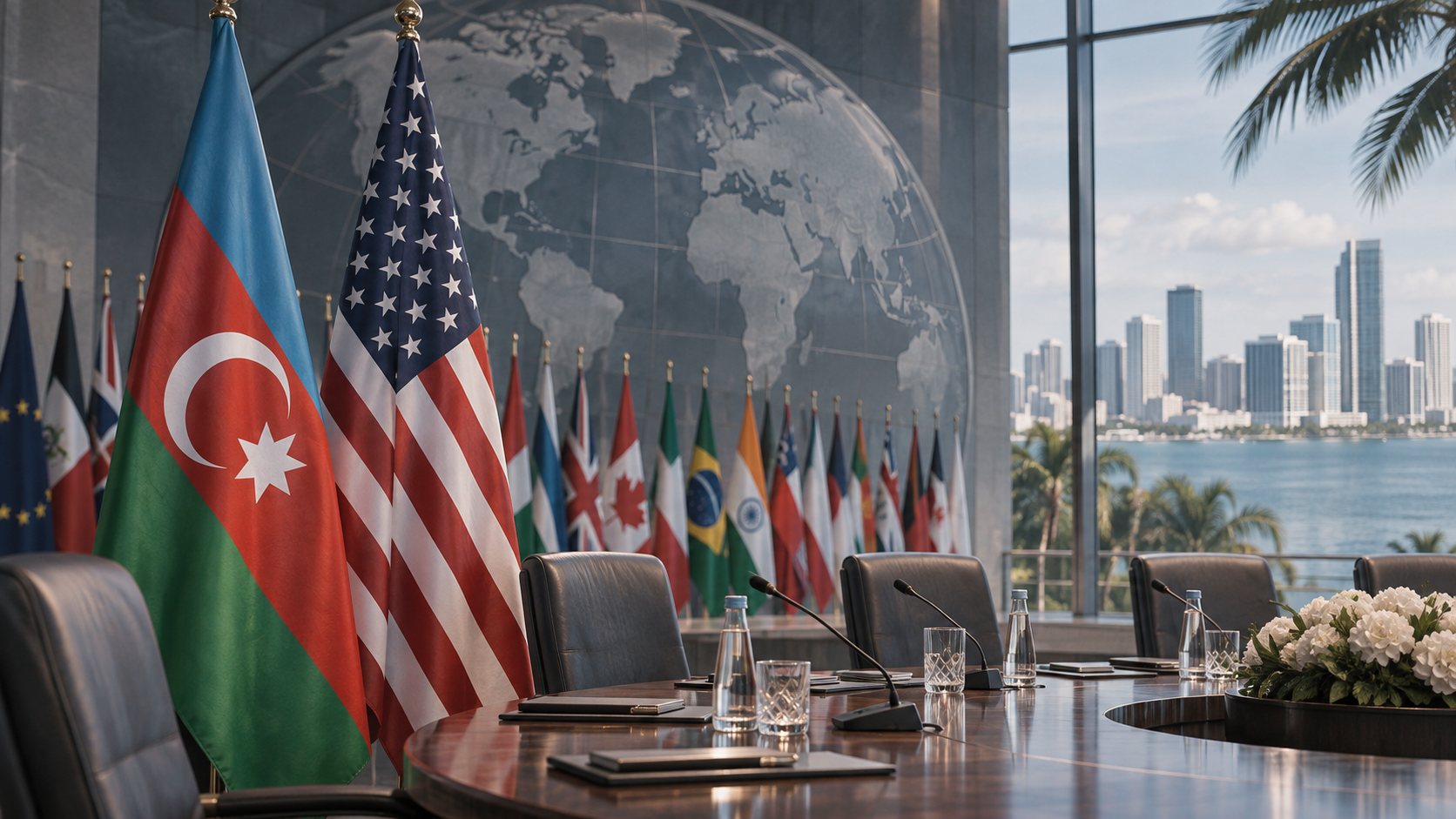
Read moreWhile Azerbaijan is certainly not one of the world's 20 largest economies, it is neither a permanent member of the G20 nor does it wield enough financial clout to be a regular attendee. Nevertheless, in December, President Ilham Aliyev was invited to attend the G20 summit in Miami. In the above, we see an aspect of contemporary diplomacy that is telling in itself; namely, that what matters to major nations is not necessarily their economic size but their strategic importance. America has offered to host this summit from the 14th to the 15th of December, where Azerbaijan is among the guest countries along with Kazakhstan, Uzbekistan, Qatar, Singapore, and some European countries. The invitation was announced in July and has been mentioned in the summit’s participant information. This is merely a matter of diplomacy, not the addition of the country to the G20.
The economies represented by the G20 account for 85% of global production, says the International Monetary Fund. The G20 gatherings introduce invited nations to those who affect commerce, money flows, energy policy and geopolitical risks. They do not guarantee agreement, investment or power. But they place the nation’s concerns before a very influential group.
Guest invitations are also a sign of who holds the key to the door. It is up to the host country to open up dialogue with countries it finds necessary without necessarily giving them membership in the club. This selective approach works two ways. It means that the visit by President Aliyev is significant, but Washington still holds the keys.
Washington’s map has expanded
While we are in the early stages of the 2020s, the idea of the US being number one has significantly diminished. Perhaps the world order aspires to transition into a multilateral system, which some might argue is inevitable. Realistically speaking, however, Uncle Sam still holds a stronger hand in international relations - like it or not. With that being said, what makes the guest list intriguing is the company Azerbaijan keeps. Kazakhstan and Uzbekistan have joined the dialogue as well. This indicates that America is beginning to view the Caspian and Central Asia not just as the far-off places that lie between Russia and China but also as an area that has options of its own. A better way to showcase the value of these countries is to put them under the bright lights on a grand stage like this.
Azerbaijan sits on the western pivot of this geography. Trade from Central Asia via the Caspian that moves on to Europe does so using ports and rail lines in Azerbaijan in conjunction with those in Georgia and Türkiye. According to estimates in 2023 by the World Bank, the Middle Corridor has the potential to triple volumes of cargo and halve transit times by 2030, provided there is significant development of infrastructure and processes. The energy equation becomes much more immediate. According to the European Commission, Azerbaijan and its state energy corporation delivered 12.5 billion cubic meters of gas to the member countries of the European Union in 2025 – a 53.8 percent increase from 2021. This is not sufficient for Azerbaijan to be the solution to Europe's energy woes. It is sufficient, however, for the country's energy network to become a part of the Continent’s effort to diversify its sources of energy.
However, there is a more political reason for Trump’s involvement. In August 2025, he received President Aliyev and Armenian Prime Minister Nikol Pashinyan at the White House, where they signed a joint declaration and their foreign ministers initialled a peace accord. The difference is significant; an initialled document is not the same as a signed and implemented treaty. Still, the meeting put the South Caucasus on the US diplomatic agenda. In addition to having an interest in ensuring peace and prosperity in this part of the world by developing the Trump Route for International Peace and Prosperity, which would involve transit through Azerbaijan’s Nakhchivan exclave via Armenia, the proposed route creates another interest for the United States in the region’s stability.
In participating in the Miami event, Baku would be creating the opportunity for itself to have its priorities recognized in the countries which would have the financial and political capability to assist, or conversely, hinder, such a development. For the United States, Azerbaijan is the partner in the peace process and the important transit hub between two continents. However, there is a diplomatic disparity in this situation. While the US can use diplomacy to draw attention and investment to the table, it cannot change the geographical reality nor force the neighboring countries to trust each other. Whether this will be an example of a real peace dividend for both sides, or yet another dispute over borders, is completely up to Baku and Yerevan.
The autonomy calculation
Strategic independence is one of the themes of the Azerbaijani President's foreign policy, which has been a recurring theme over the past few months. Azerbaijan wants good relations with different centers of power, and not exclusive patronage from any of them. The same state that gives gas to Europe also has ties with China, Russia, Turkey, and the United States. This can be risky, because good relations with various centers of power bring chances for bargaining but also various demands.
The visit to Miami is a much less exaggerated measure of prestige than the claim about the indispensability of Azerbaijan. Washington may invite countries without accepting all the things they do. Equally, the presence of Baku does not mean solving any criticism from the outside world about its governance and freedoms. International presence and international acceptance are not the same things.
That is exactly why the offer merits consideration beyond ritualistic discourse. Involving Azerbaijan has clear interests at stake: the sustainability of peace with Armenia, the robustness of the Eurasian transit route, and the reliability of the energy corridor. These interests afford Baku a voice, but also a test of credibility.
Value of being in the room
The most recent G20 summit was held in Johannesburg in 2025. Miami will provide something new in terms of a host country, a different political focus, and a carefully selected set of guest nations. The inclusion of Azerbaijan in the summit reflects a broader trend where medium-sized powers can hold some sway through corridors of cooperation.
However, what really matters will emerge when all the limousines have departed from Florida. Are there now better guarantees for transportation? Is the peace process between Armenia and Azerbaijan moving forward? Have business ties moved past declarations and into binding agreements and actual facilities? These are tougher issues than whether anyone shows up at the summit itself.
The invitation presents the chance for Azerbaijan to put across the point that its regional significance has become global. The proof of such an assertion comes later on. Miami provides Baku a platform. It is what they make of it that matters.
Here we are to serve you with news right now. It does not cost much, but worth your attention.
Choose to support open, independent, quality journalism and subscribe on a monthly basis.
By subscribing to our online newspaper, you can have full digital access to all news, analysis, and much more.
You can also follow AzerNEWS on Twitter @AzerNewsAz or Facebook @AzerNewsNewspaper
Thank you!