
Europe’s leaders losing public trust as anger spills onto streets of France and Germany
Elnur Enveroglu
Read moreEurope’s political leaders have become increasingly accustomed to explaining why things cannot be done. There is always another crisis, another budget constraint, another geopolitical emergency or another promise that difficult decisions will eventually produce better results. But across France and Germany, a younger generation is beginning to ask a more uncomfortable question: when exactly will those results become visible?
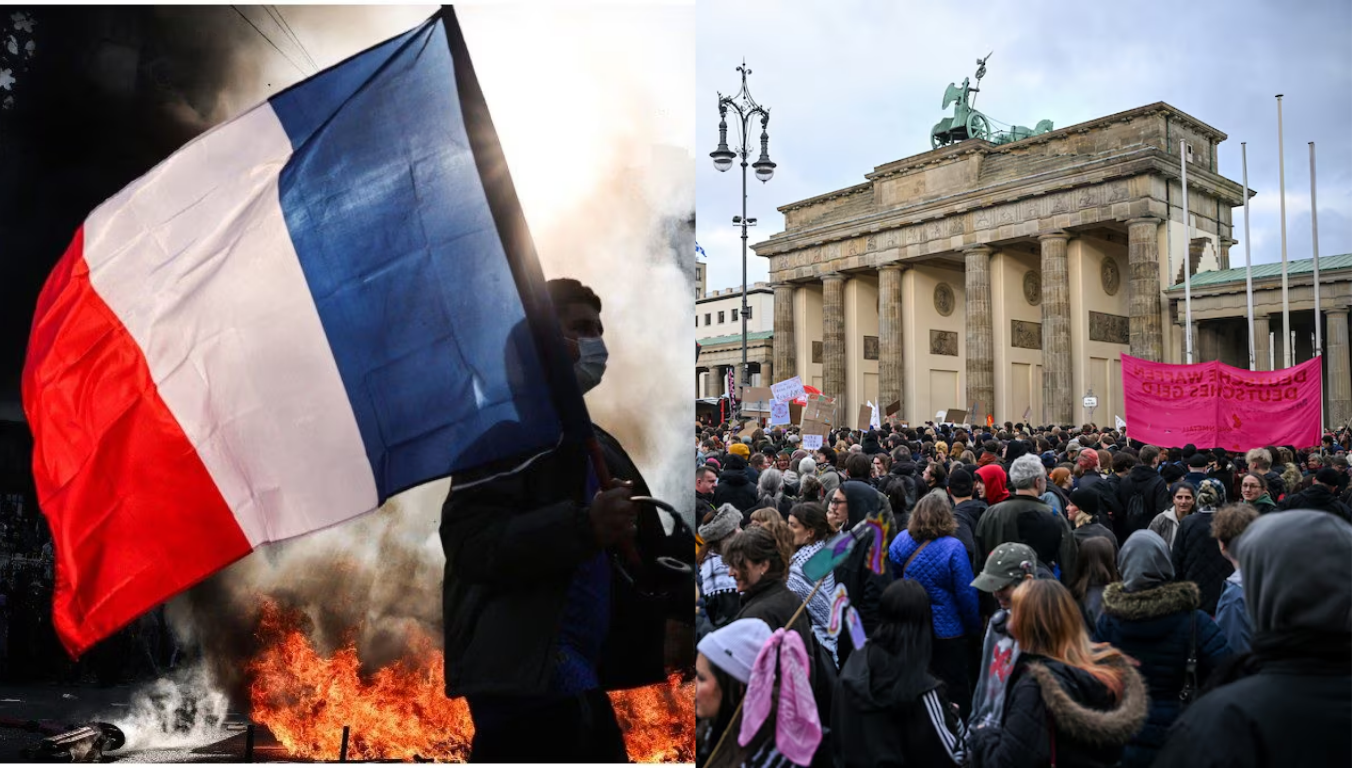
The streets of Europe offered a striking answer on Saturday, 31 October, as demonstrations spread across France and Germany for a third consecutive weekend in France and on a nationwide scale in Germany. What began as student anger over deteriorating schools, inadequate public services and the rising cost of living has evolved into something considerably broader. Trade unions, climate activists, public sector workers and supporters of the Yellow Vest movement have joined the demonstrations, turning local grievances into a wider challenge to political authority.
France remains the most visible expression of this discontent. According to the Interior Ministry, approximately 320,000 people took part in Saturday’s demonstrations, including 70,000 in Paris. Organisers put the national figure closer to half a million. Although participation has declined from the 550,000 recorded on 17 October and 410,000 on 24 October, the scale of mobilisation after three consecutive weekends suggests that the underlying anger is far from exhausted.
The most revealing aspect of the French demonstrations is their composition. Schoolchildren and university students are no longer protesting in isolation. Trade unionists, public sector employees, ordinary workers and Yellow Vest supporters have found common ground in their frustration with a system they believe is failing to provide basic opportunities and security. The original demands concerning poorly maintained school buildings, teacher shortages and an increasingly criticised university admissions system have expanded to encompass wages, living standards, social inequality and the future of public services.
For Emmanuel Macron, this represents another serious indictment of a presidency that promised to modernise France but has struggled to reconcile economic reform with the everyday expectations of ordinary citizens. Nearly a decade after entering the Élysée Palace, Macron faces a country in which political authority increasingly appears disconnected from social reality. His difficulties are not simply the result of an unpopular policy or an isolated economic downturn. They reflect a deeper failure to convince large sections of the population that the state understands their concerns, let alone has the capacity to address them.
The president's leadership has also been weakened by parliamentary fragmentation, mounting public debt and the limited room for manoeuvre available to his government. His decision to dissolve the National Assembly in 2024 contributed to a political environment in which stable parliamentary support has become increasingly difficult to secure. The government is consequently caught between two competing imperatives: responding to social demands and implementing budgetary restraint. It promises investment while simultaneously searching for savings, an approach that does little to reassure people who already feel that their needs have been postponed for too long.
The response to the demonstrations has exposed another weakness. The deployment of approximately 70,000 police officers and gendarmes across France, alongside restrictions on demonstrations and extensive security operations, demonstrates the government's determination to prevent further disorder. Clashes and the use of tear gas in several cities, including Lyon, have nevertheless reinforced the impression of a country struggling to manage its social tensions. More than 560 arrests were reported nationwide by Saturday night. While the overwhelming majority of demonstrators remained peaceful, violence by smaller groups has complicated the movement and provided the authorities with an opportunity to shift attention towards public order.
The government has also sought to attribute part of the escalation to radical political forces, including the left-wing La France Insoumise. There may be political groups attempting to exploit the unrest, just as there are individuals using demonstrations as an opportunity for violence. But reducing a movement involving hundreds of thousands of people to the activities of political extremists would be a convenient way of avoiding the more difficult question: why have so many ordinary citizens decided that taking to the streets is more effective than waiting for their elected representatives?
Germany's experience is different in its political circumstances but remarkably similar in its underlying frustrations. The Gen Z regelt movement organised demonstrations in 34 cities, attracting tens of thousands of participants. Organisers had reported more than 180,000 online registrations, although this should not be confused with actual attendance. The protests called for better-funded schools, affordable living, stronger social protection and climate action, while opposing the possible return of compulsory military service.
In Berlin, Hamburg, Frankfurt and other cities, young demonstrators questioned why governments could mobilise substantial resources for defence and security while educational institutions continued to struggle with inadequate facilities, staff shortages and insufficient investment. In Hamburg, clashes followed the largely peaceful demonstrations, with barricades set alight and police deploying water cannon and tear gas. Similar disturbances were reported in Cologne and Frankfurt.
The German protests are particularly significant because they challenge the assumption that economic strength automatically translates into public confidence. Germany remains one of Europe's largest economies, yet its younger population is increasingly concerned about housing affordability, economic uncertainty and the quality of public infrastructure. A country capable of financing major strategic ambitions is nevertheless struggling to persuade some of its young citizens that it can provide functioning schools and affordable prospects for the future.
There is a wider European dimension to this discontent. The energy shock that followed Russia's invasion of Ukraine may no longer dominate political headlines as it once did, but its economic consequences have not disappeared. Eurostat reported that household electricity prices across the EU declined by 2.2 per cent in the first half of 2026, yet remained considerably above pre-2022 levels. Housing, food, transport and energy continue to absorb a substantial share of household expenditure. For families already struggling with stagnant purchasing power, even modest increases in essential costs can become a source of political resentment.
Migration adds another layer to Europe's increasingly difficult political debate. Governments face legitimate questions about integration, pressure on housing and public services, border management and social cohesion. Yet migration is also repeatedly turned into a convenient political explanation for problems that have deeper structural origins. Blaming newcomers cannot compensate for a shortage of affordable homes, neglected schools or years of inadequate investment. Nor can political slogans resolve the tensions created when citizens believe that public resources are insufficiently distributed.
The growing appeal of populist movements across Europe is partly rooted in this sense of abandonment. When mainstream political parties offer explanations rather than solutions, voters become more receptive to forces promising simple answers to complicated problems. France's far right is already seeking to benefit from the turmoil ahead of the next presidential election. Similar pressures are visible elsewhere, where dissatisfaction with established political elites is increasingly shaping electoral choices.
The demonstrations also expose a generational contradiction. European governments speak about competitiveness, technological leadership, climate neutrality and strategic autonomy, yet young people are questioning whether they will inherit the economic and social foundations necessary to achieve those ambitions. They are being asked to accept higher defence spending, fiscal discipline and difficult reforms while confronting uncertainty over employment, housing, education and their future standard of living.
The decline in turnout in France on 31 October should therefore not be mistaken for a resolution of the crisis. The unions have already called for further mobilisation on 5 November, while the German demonstrations have demonstrated that youth discontent is no longer confined to one national political environment.
Europe does not necessarily face a continent-wide revolutionary moment. But it does face a widening crisis of confidence. Governments cannot indefinitely substitute announcements for action, security deployments for political dialogue or electoral slogans for credible economic policies. Macron's predicament is an especially visible example, but the questions being asked in Paris, Berlin and Hamburg extend far beyond France and Germany.
Ultimately, the protesters are demanding something more fundamental than a new package of government measures. They want evidence that political institutions still work for ordinary people. Until Europe's leaders can provide that evidence, the streets are unlikely to fall silent.
Here we are to serve you with news right now. It does not cost much, but worth your attention.
Choose to support open, independent, quality journalism and subscribe on a monthly basis.
By subscribing to our online newspaper, you can have full digital access to all news, analysis, and much more.
You can also follow AzerNEWS on Twitter @AzerNewsAz or Facebook @AzerNewsNewspaper
Thank you!