
Why Europeans are taking to the streets? [COMMENTARY]

Ulviyya Poladova
Read moreEurope is facing a growing wave of public discontent as demonstrations, strikes and clashes with law enforcement continue to spread across several countries. Rising living costs, pressure on household incomes, housing shortages, dissatisfaction with public services and disagreements over government policies have brought thousands of people onto the streets. From France and Italy to Belgium, Albania, Serbia and Germany, the protests have highlighted the mounting challenges facing the continent.
The current unrest cannot be explained by a single factor. Rather, it reflects the combined impact of economic, political, social and security problems that have accumulated over recent years. While the immediate reasons for demonstrations differ from one country to another, the underlying frustration is increasingly similar: many Europeans feel that their governments are struggling to address their everyday concerns.
The scale and diversity of the recent demonstrations illustrate how widespread public frustration has become. In France, protests that initially involved students and concerns over education have expanded into broader demonstrations over living costs, wages and public services. Italy has also experienced major protests and nationwide strikes, with workers, students and trade unions demanding higher wages, improved public services and measures to address rising prices. On October 30, demonstrations took place in more than 40 Italian cities, with clashes reported in several locations.
Belgium, Portugal, Spain, Albania and Serbia have also witnessed demonstrations driven by different combinations of economic, political and social demands. Germany, meanwhile, saw large-scale protests at the end of October, with demonstrators raising concerns about living costs, public spending, education and proposed military conscription measures.
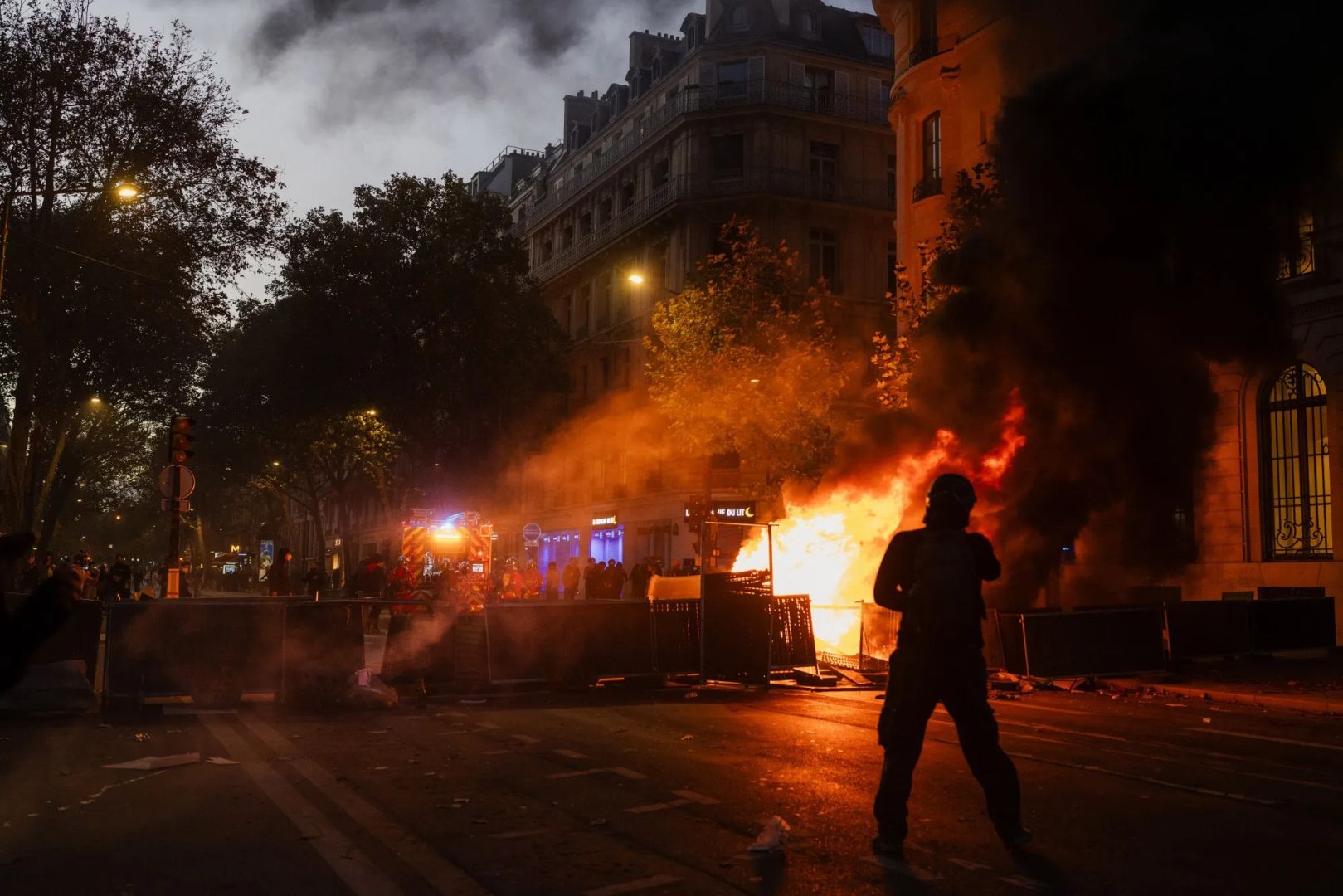
Although many demonstrations have been peaceful, some have been accompanied by clashes, vandalism, fires and looting. Such incidents have resulted in injuries among both protesters and law enforcement officers. However, it is important to distinguish between peaceful demonstrators expressing legitimate grievances and individuals or groups engaging in violence and criminal activity.
Analyst Frank Musmar, in a commentary to AzerNEWS, said that the protests spreading across Europe in September and October 2026 represent a geographically widespread but fragmented wave of public discontent.
According to Musmar, independent trackers had recorded 151 protest events in 85 cities across 20 countries since September 17, while Spanish newspaper El País counted at least 177 demonstrations in 12 countries between September 15 and October 23. He argued that the unrest should be understood through three interconnected factors: economic insecurity, declining public trust in institutions and the growing pressure of geopolitical commitments. Rather than representing a coordinated pan-European movement, the demonstrations reflect separate national crises that are increasingly connected through a shared information environment.
Musmar identified affordability as one of the main economic factors driving public dissatisfaction. While previous waves of populist discontent in Europe were often associated with unemployment and the consequences of the financial crisis, the current situation is increasingly shaped by the rising cost of everyday life.
Housing has become a particularly serious concern. Eurostat figures show that EU house prices increased by 55 percent and rents by 30 percent between 2010 and 2024. In Spain, the Bank of Spain estimates the housing shortage at 750,000 units, with the deficit potentially exceeding one million. Portugal has also experienced significant price increases, with residential property prices rising by 19 percent year-on-year in the fourth quarter of 2025.
The pressure is not limited to housing. Rising energy and consumer prices have further strained household budgets, while higher fuel and fertilizer costs have placed additional pressure on farmers and businesses. In Italy, agricultural producer prices fell by 5.8 percent year-on-year in the second quarter of 2026, contributing to protests and blockades by farmers and truckers in Calabria and Campania.
Public services have become another source of frustration. Musmar pointed to France, where demonstrations initially focused on teacher shortages and deteriorating school facilities, before expanding into wider social unrest. In Italy, high school students have also protested over poor building conditions and education cuts.
From a broader perspective, Musmar said the situation reflects a weakening social contract between governments and citizens. He referred to analysis by the Council on Foreign Relations, which highlights the growing difficulties facing France as public spending priorities, an ageing population and a shrinking younger workforce place additional pressure on the country's economic model.
The analyst also emphasized the generational dimension of the protests. He cited research suggesting that 52 percent of young people aged 16 to 26 across seven European countries expect to be worse off than their parents. In his view, this growing uncertainty about future opportunities has helped bring together students, trade unions and middle-class citizens around common concerns.
Economic stagnation and unequal access to opportunities have also contributed to declining confidence in political institutions. The expert noted that research by Brookings scholars links prolonged economic difficulties with greater political polarization and increased support for anti-establishment movements. Growing wealth inequality further reinforces perceptions that economic opportunities are becoming increasingly concentrated.
Political and fiscal pressures represent another important dimension of the crisis. European governments must balance domestic spending priorities with rising defence commitments, support for Ukraine and the costs of the energy transition. At the same time, high public debt and limited budgetary flexibility make it increasingly difficult to meet all these demands.
Musmar pointed out that NATO allies have committed to working towards defence spending of 5 percent of GDP by 2035, adding to the financial challenges facing European governments. The central dilemma, he added, is that citizens expect greater economic and social security at a time when governments are also being asked to finance expanding strategic commitments.
When citizens repeatedly take to the streets to demand changes, it suggests that existing political mechanisms are not always seen as sufficient to address their concerns. Governments are therefore under increasing pressure to demonstrate that they can deliver practical solutions rather than rely solely on political statements and temporary measures.
The consequences could extend beyond individual countries. Continued instability may affect investor confidence, industrial activity and the broader European economy. It could also reshape domestic political debates, especially as governments face increasing demands to review their economic priorities, social spending, and foreign policy commitments.
Image: Wayyan Barre / Bloomberg
Here we are to serve you with news right now. It does not cost much, but worth your attention.
Choose to support open, independent, quality journalism and subscribe on a monthly basis.
By subscribing to our online newspaper, you can have full digital access to all news, analysis, and much more.
You can also follow AzerNEWS on Twitter @AzerNewsAz or Facebook @AzerNewsNewspaper
Thank you!