
Azerbaijan’s multiculturalism model draws on centuries of coexistence

Ulviyya Poladova
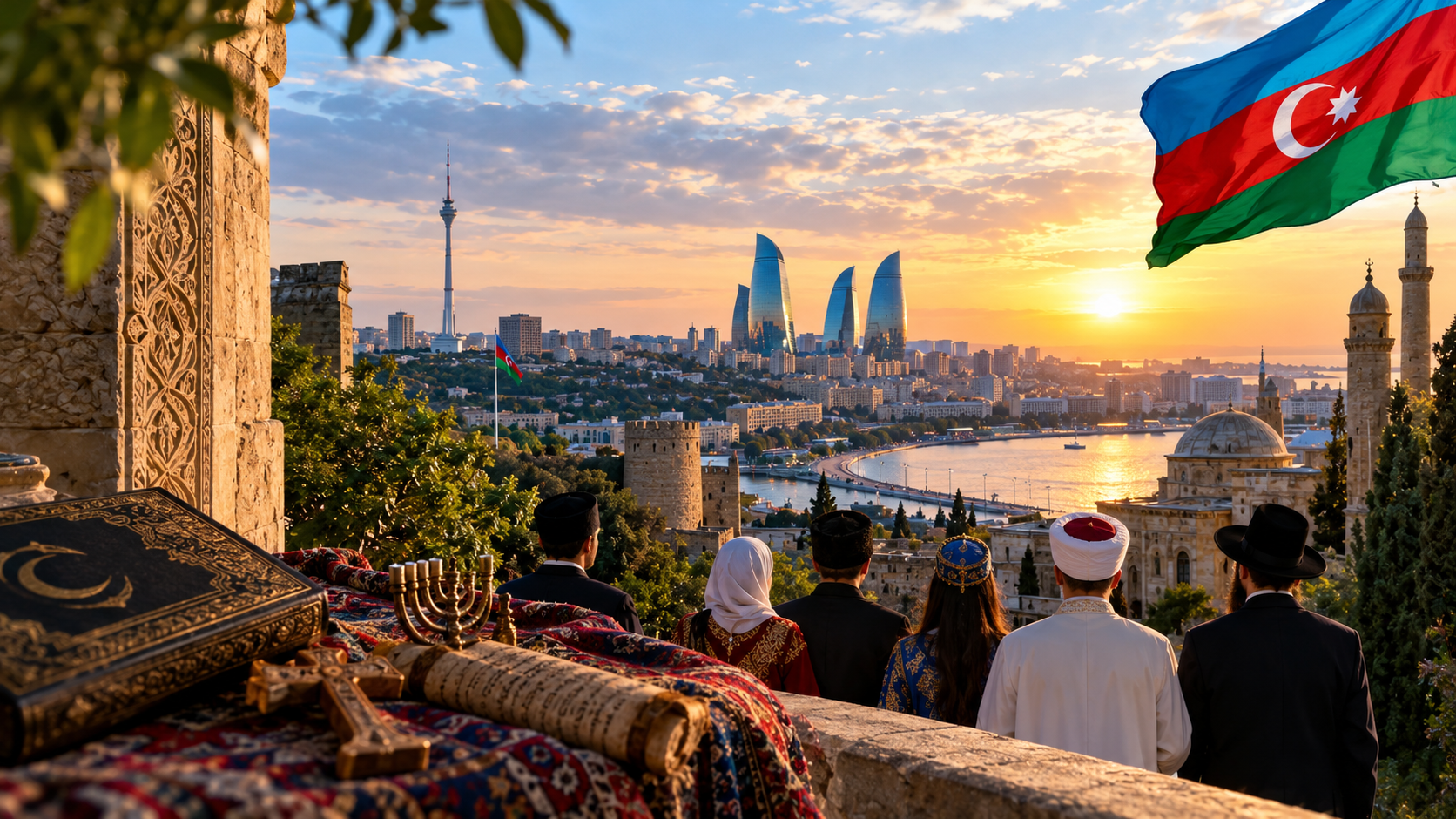
Read moreAzerbaijan’s long history of coexistence among different ethnic groups and religious communities was at the centre of discussions at the opening of the 7th World Forum on Intercultural Dialogue in Baku on October 27. Held under the theme "Dialogue for a Shared Future," the forum brought renewed attention to the country’s approach to cultural diversity and its efforts to promote dialogue between different societies.
Speaking at the opening ceremony, President Ilham Aliyev said Azerbaijan’s geographical position between Europe and Asia had made it a cultural bridge between the two continents for centuries. He also stressed that multiculturalism, religious tolerance and ethnic harmony were deeply rooted in the country’s history and remained important to its development today.
According to the president, social harmony has been one of the main reasons behind Azerbaijan’s stable development. He pointed to the country’s shared national identity, known as Azerbaijanism, which brings together the different peoples living in the country.
The head of state also recalled the period of Armenia’s military aggression and occupation, including the Second Garabagh War, saying that people of different ethnic and religious backgrounds had stood together in defence of Azerbaijan’s territorial integrity. Their unity, symbolised by the "Iron Fist," demonstrated the strength of the country’s social cohesion, he noted.
The development of intercultural and inter-civilizational dialogue is one of the main directions of Azerbaijan's foreign policy, and the country has several concrete achievements to show it. One of them is a term that has entered the political vocabulary - the "Baku Process." The initiative was first put forward by President Ilham Aliyev at the Conference of Ministers of Culture of European and neighboring countries, held in Baku on December 2-3, 2008, under the theme "Intercultural dialogue as the basis for sustainable development and peace in Europe and its neighboring regions."
The initiative continued to develop in the following years. In 2009, at a meeting of culture ministers from the Organisation of Islamic Cooperation, Azerbaijan invited representatives of the Council of Europe’s member states to participate. This reciprocal engagement helped establish the Baku Process as a platform connecting countries and institutions from different cultural and religious backgrounds. Speaking at the opening of the 3rd World Forum on Intercultural Dialogue in Baku in May 2015, President Aliyev recalled how the initiative had begun with the participation of Islamic countries in a meeting organised by the Council of Europe and subsequently expanded to include European countries in discussions within the Organisation of Islamic Cooperation.
Religious diversity through the centuries
The historical roots of Azerbaijani multiculturalism can be traced to the presence of different religious traditions long before the spread of Islam.
Zoroastrianism occupies an important place in the country’s pre-monotheistic history. One of its central teachings is the struggle between good and evil, in which human beings have a responsibility to help good prevail. Personal conduct and the way people live are considered essential to this struggle, alongside religious observances. Fire holds a central place in Zoroastrian rituals, while the Avesta serves as the religion’s sacred text. The text was associated with the priesthood of the Medes and later the Achaemenid Empire. During the Sasanian period, the Avesta was codified again, and Zoroastrianism became the state religion.
The arrival and spread of Christianity marked another important stage in the region’s religious history. In Caucasian Albania, the spread of Christianity was associated with the apostles Thaddeus and Bartholomew. In the early fourth century, the Albanian king Urnayr declared Christianity the state religion, allowing the Albanian Apostolic Church to expand its influence across the region.
Other religious traditions continued to exist alongside Christianity. Even as Sasanian influence weakened during the early seventh century, followers of Zoroastrianism, paganism and Manichaeism remained in the country. This religious diversity formed part of the early history of Azerbaijan’s multicultural traditions.
From the middle of the seventh century, Islam began to spread across Azerbaijani society during the period of the Arab Caliphate. Its expansion was gradual, with Islam gaining ground particularly in areas where Zoroastrianism and paganism had previously been practised.
Over time, these different religious traditions became part of the historical and cultural heritage of Azerbaijan. Zoroastrian, Christian and Islamic places of worship are preserved across the country, reflecting the different stages of its religious development.
This history is often cited as one of the foundations of the tolerance associated with Azerbaijani society. The coexistence of different beliefs over many centuries helped shape a cultural environment in which religious diversity became an established feature of life.
A diverse ethnic and linguistic landscape
Azerbaijan’s multicultural character is also reflected in its ethnic composition. Alongside ethnic Azerbaijanis, the country is home to communities including Udis, Ingiloys, Khinalug people, Kryz, Budukh, Tats, Talysh, Lezgins, Russians, Jews and others. These communities belong to different linguistic and cultural groups, including Caucasian-speaking, Iranian-speaking and Turkic-speaking peoples. Their traditions, languages and cultural practices form part of the country’s wider heritage.
According to the 2009 census cited in the source material, representatives of small ethnic groups accounted for 8.4 per cent of Azerbaijan’s population.
The preservation of this diversity is an important element of the country’s official multiculturalism policy. Rather than requiring minority communities to give up their identities, the stated approach seeks to protect their cultural values while encouraging their participation in national life.
Education is one of the areas in which this approach is reflected. Since the restoration of independence, schools in Azerbaijan have operated not only in Azerbaijani but also in Russian and Georgian. According to the information, 108 schools offering education in grades one to nine teach in Lezgian. In some areas where ethnic minorities live in concentrated communities, pupils also study their native languages, including Avar, Kurdish, Lezgian, Talysh, Tsakhur, Tat, Udi and Khinalug. Baku is also home to a private Jewish secondary school, opened in 2003, where students study Hebrew, Jewish history and culture. Russian-language sections operate at higher education institutions across the country. The state also provides support for publishing alphabets, educational programmes, textbooks and dictionaries in a range of minority languages, including Russian, Avar, Talysh, Kurdish, Lezgian, Tsakhur, Tat, Udi, Khinalug and Hebrew.
These measures form part of the official effort to maintain linguistic and cultural traditions while allowing minority communities to participate fully in the country’s social and educational life.
All for one, and one for all
The Azerbaijani model of multiculturalism rests on two closely connected elements: state policies designed to protect cultural diversity and traditions of coexistence that have developed over centuries. Supporters of the model argue that protecting different identities does not have to weaken a country’s national unity. On the contrary, cultural diversity can contribute to social stability when communities have equal rights, opportunities and a shared sense of belonging.
In Azerbaijan, this shared identity is often expressed through the concept of Azerbaijanism, which brings together the country’s different ethnic and religious communities under a common national identity. The idea is that belonging to the Azerbaijani nation is not limited to one ethnic or religious group but encompasses all citizens of the country.
This understanding of multiculturalism differs from approaches in some Western European countries, where the concept is often discussed in connection with the integration of immigrant communities. In Azerbaijan, multiculturalism is presented as a way of life shaped by the long-standing presence of different peoples within the same historical and geographical space. The country’s official position is that the protection of cultural identities should go hand in hand with social integration. Policies supporting cultural diversity are intended to prevent communities from becoming isolated while allowing them to preserve their distinctive traditions.
President Aliyev has repeatedly warned against xenophobia, discrimination, racism, Islamophobia and antisemitism, describing them as dangerous tendencies that can lead to serious human tragedies. From this perspective, multiculturalism is not simply a cultural policy but also a means of preventing divisions and maintaining social harmony.
Azerbaijani multiculturalism is not limited to its ethnic or religious forms. The country's social and economic development at the present stage is taking place against the background of a spiritual rise among the people. It would be wrong to tie Azerbaijan's success in the economic sphere solely to its rich natural resources. One of the main reasons for that success lies in the people's spiritual values. Growing stronger under the influence of economic development, these values do not merely accompany it. No economic leap happens in isolation from a spiritual rise, and it is pointless to look for spiritual fullness where there has been no economic leap.
Here we are to serve you with news right now. It does not cost much, but worth your attention.
Choose to support open, independent, quality journalism and subscribe on a monthly basis.
By subscribing to our online newspaper, you can have full digital access to all news, analysis, and much more.
You can also follow AzerNEWS on Twitter @AzerNewsAz or Facebook @AzerNewsNewspaper
Thank you!