
Iran, China keen on boosting trade and economic ties
By Aynur Karimova
China and Iran, two traditional trade partners, are keen on further boosting trade ties and increasing bilateral trade turnover in coming years.
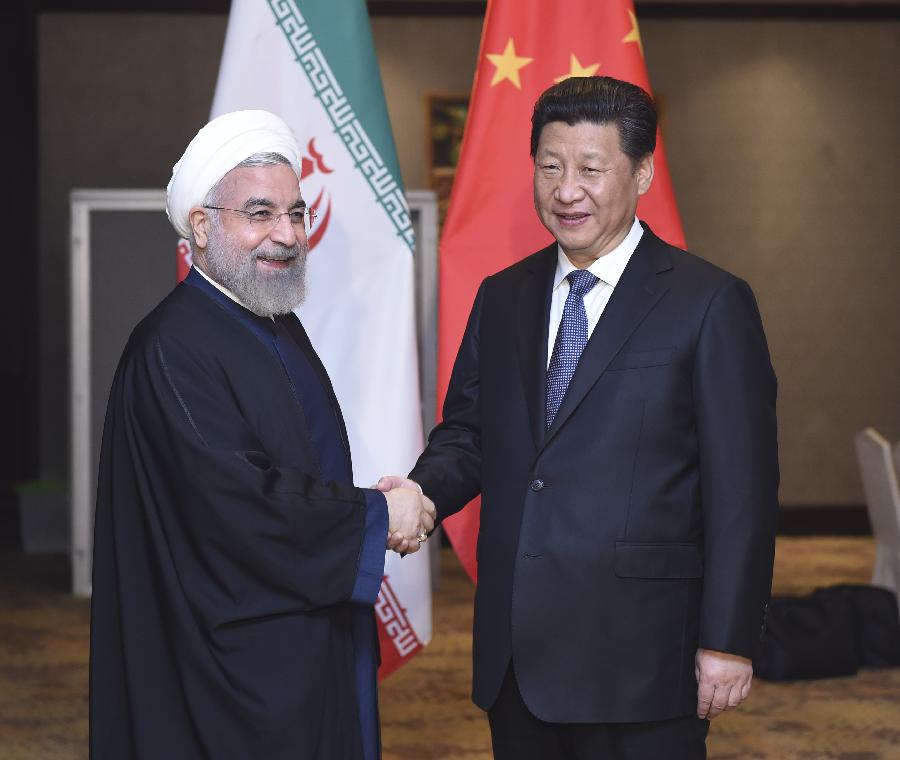
Chinese President Xi Jinping, the first head of state visiting Iran since sanctions were lifted on Tehran, was on a two-day visit to Tehran on January 22-23.
Iran was the last point of the Chinese president's three-nation tour to Middle East after Saudi Arabia and Egypt. This was the first visit of the Chinese leader to Iran since 2002, which proved China's intention to open a new chapter in strategic economic cooperation with Iran.
“In cooperation with the Iranian side and by benefiting from the current favorable conditions, China is ready to upgrade the level of bilateral relations and cooperation so that a new chapter will start in bilateral relations in the long term,” Xi Jinping said before visiting Iran.
The main achievement of Xi Jinping's visit to Iran was signing of 17 Memorandums of Understanding on cooperation in economic, industrial, cultural and judicial fields.
The two countries signed documents for cooperation in various sectors including nuclear, transportation, ICT, culture, science and education as well as economic, industrial and judicial field, investment promotion and environment protection.
One of the agreements allows Chinese banks to open branches in Iran, while others underline high-speed railroads, fiber-optic communication, etc. The two countries are also planning to develop cooperation in various nuclear fields.
As part of the visit, Iran and China discussed ways to bring their bilateral trade up to $600 billion within a ten-year period.
Iranian President Hassan Rouhani said at a press conference that the two countries have decided to develop a comprehensive 25-year cooperation document.
"Finance, banking and investment issues, as well as long-term agreements on energy and investment in the mining, industry and energy sectors were discussed during the meeting as well," Rouhani added. "In addition to economic issues the two parties also negotiated cooperation in various fields such as security and defense, tourism, technology and science."
Iran and China have also agreed on more cooperation to “combat regional terrorism.”
Rouhani noted that the two sides discussed cooperation for “creating stability and security in the Middle East and helping countries plagued by terrorism, including Afghanistan, Iraq, Syria and Yemen, and providing intellectual and intelligence assistance in the fight on terrorism."
The Chinese president, in turn, said he has traveled to Iran to prepare the ground for a new prospect in relations between the two countries. Jinping added that strong cooperation between Tehran and Beijing will not only benefit the two parties, but also would serve regional and global peace.
The Chinese president said that he seeks strategic ties with Iran, in particular in the energy market.
China was Iran's top consumer of crude oil. Even after
international sanctions targeted Tehran’s energy sector, China
continued its cooperation with Iran through purchasing oil and
developing energy projects.
Iran and China have enjoyed diplomatic ties and supported each
other since 1971. The Chinese president's current visit once again
showed that Tehran and Beijing will continue their ties to make
sure that the Joint Comprehensive Plan of Action will be fully
implemented without any failure.
Over the past six years Beijing has been Tehran’s major trade
partner.
According to Iranian Customs Administration, Iran exported 17.56
million tons of non-oil goods, worth $5.33 billion to China during
the first eight months of 2015. China was the main importer of
Iranian goods in the mentioned period. Beijing’s imports accounted
for 22.7 percent of Iran’s total non-oil exports in terms of value
and 33.3 percent in terms of volume.
Beyond its oil resources, Iran also plays an important role in
China’s regional economic ambitions.
Since 2013, China has pushed to expand its overland trade routes through the Silk Road Economic Belt, an initiative to build roads, railroads, and other transportation infrastructure throughout Central Asia. Iran is a critical part of this plan, due to its strategic location with access to key waterways.
China is for expansion of ties on transport sector and Iran and
China both are considered to be significant destinations that are
located along the Silk Road.
Earlier in 2015 Iranian media reported that Tehran plans to
participate in an ambitious Chinese plan to revive the Silk Road
which aims to connect Asia to Europe and Africa through a network
of roads, railways, ports and airports.
--
Aynur Karimova is AzerNews’ staff journalist, follow her on Twitter: @Aynur_Karimova
Follow us on Twitter @AzerNewsAz
Here we are to serve you with news right now. It does not cost much, but worth your attention.
Choose to support open, independent, quality journalism and subscribe on a monthly basis.
By subscribing to our online newspaper, you can have full digital access to all news, analysis, and much more.
You can also follow AzerNEWS on Twitter @AzerNewsAz or Facebook @AzerNewsNewspaper
Thank you!