
Turkey, Iran seen as key players in resolving Syria crisis
By Sara Rajabova
Turkey and Iran are seen as key players in brokering a solution of the Syrian crisis as both countries are striving to stop the bloodshed in the country and resolve the 19-month conflict.
However, their efforts aimed at finding a solution to the bloody conflict are still failing and the reason seems clear -- they take quite different positions. Iran is one of the allies of President Bashar al-Assad, while Turkey supports the Syrian opposition. Therefore, a long-waited decisive change in a resolution of the Syrian conflict seems too far off despite the continuing peace efforts.
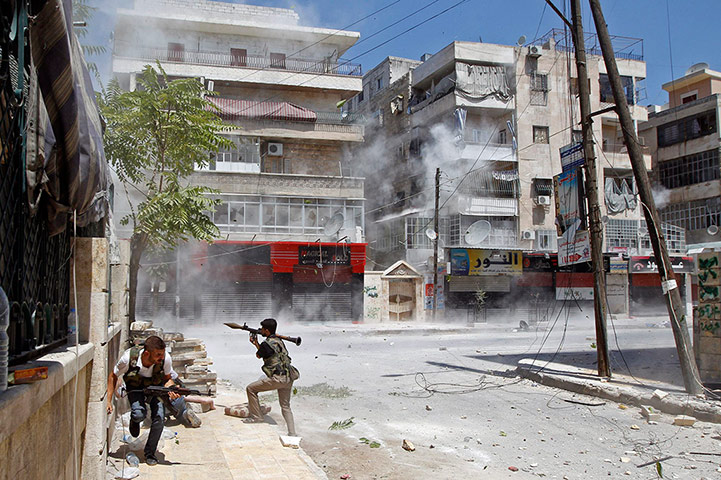
Meanwhile, the clashes between government troops and opposition groups continue to claim the lives of innocent people.
Frequent clashes between Syria and Turkey and the recent blast in Lebanon to assassinate the police intelligence chief, who was in charge of a top intelligence unit and the brain behind uncovering of a recent bomb plot that led to the arrest of a pro-Syrian Lebanese politician, are expected to exacerbate the conflict and to raise threats of a political crisis in the region.
Still, many countries and international organizations are continuing efforts to achieve a diplomatic solution of the conflict.
Iranian Foreign Minister Ali Akbar Salehi on Sunday announced a new round of intensive efforts by Tehran to enforce a ceasefire in Syria during the upcoming Islamic eve of Eid al-Adha, and said Tehran is in contact with the Syrian opposition to that end, semi-official Fars news agency reported.
Salehi noted that Tehran is ready to set the stage for dialogue between the Syrian government and the opposition.
Stressing Iran's readiness to provide the ground for such talks, he expressed hope that the Syrian opposition would come to the negotiating table with the authorities.
The joint UN-Arab League special envoy on Syria Lakhdar Brahimi during his recent visit to Iran called on Tehran to help to achieve a ceasefire in Syria during the four-day Eid al-Adha.
Then, Iran offered Brahimi a plan for a swift settlement of the crisis in Syria.
Later, Iranian Ambassador to Syria Mohammad Reza Raouf Sheibani said Iran's plan could be an appropriate ground for any political move aiming to settle the Syrian crisis.
The Iranian envoy said this plan needs to take into account all viewpoints on the Syrian political arena and abroad to turn into a comprehensive plan.
Sheibani said Iran believes a political solution with participation of different political and social groups in a national and all-inclusive dialogue is the best option to solve the crisis and Tehran has prepared and submitted a proposal to international and regional bodies and countries such as Egypt, Saudi Arabia and Turkey.
He said Iran's plan included stopping the violence, a ceasefire, and preventing foreign support for armed groups at the initial stage.
The proposal has been submitted to the UN special envoy to Syria and Syrian officials, he added.
Numerous plans on resolving the crisis offered before have turned out ineffective. One of the proposed solutions was the Yemeni model that outlined a way to end the bloodshed.
But Turkish Foreign Minister Ahmet Davutoglu said last Saturday that Yemen's power transfer deal, which allowed President Ali Abdullah Saleh to step down, is no longer a suitable model for a solution in Syria.
"The Yemen solution was suitable for Syria nine months ago," Davutoglu told a news conference in Sanaa with his Yemeni counterpart. "But now, because every country has its own special circumstances and due to the latest developments on the Syrian arena which saw the use of artillery and the air force in bombarding Syrian cities, this has narrowed the room for implementing such solutions."
Saleh handed over powers to his deputy last year under the power transfer deal but remained as ceremonial president until elections in February, when he stepped down.
Davutoglu said Turkey backed calls by U.N. and Arab League envoy Brahimi for a ceasefire during the Eid al-Adha Muslim holiday, which starts at the end of this week.
Brahimi over the weekend met top Syrian officials in Damascus to discuss the plan, which includes a truce during the upcoming Muslim eve of Eid al-Adha. Both President Bashar al-Assad and Foreign Minister Walid Mualem welcomed the proposal.
At the meeting with Brahimi Assad stressed that Syria supports the efforts of the UN envoy, and that it is open to any efforts to find a political solution to the crisis based on respecting Syria's sovereignty and rejecting foreign interference.
Assad made clear that any initiative or political process should be essentially based on ending terrorism, implying that certain foreign countries should drop their support for terrorists and their arms shipments and harboring of the terrorists.
Opposition leaders who met Brahimi in Damascus also welcomed the ceasefire proposal.
But Ahmed Ben Hilli, deputy secretary-general of the Arab League, said the Muslim holiday this week provides only a small window of hope for agreement on a ceasefire between Syria's rebels and the government of President Assad, Reuters reported.
According to the UN, more than 20,000 people, mostly civilians, have died in Syria since the uprising against the regime of President Assad began some 19 months ago. However, activists say more than 30,000 people have been killed in the uprising. A further 2.5 million Syrians urgently need humanitarian aid, according to UN estimates.
Here we are to serve you with news right now. It does not cost much, but worth your attention.
Choose to support open, independent, quality journalism and subscribe on a monthly basis.
By subscribing to our online newspaper, you can have full digital access to all news, analysis, and much more.
You can also follow AzerNEWS on Twitter @AzerNewsAz or Facebook @AzerNewsNewspaper
Thank you!