
Caspian states vow not to sideline Iran from talks
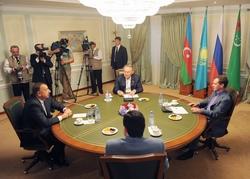
The leaders of four Caspian littoral states -
Azerbaijan, Russia, Kazakhstan and Turkmenistan - have pledged not
to discuss issues related to the sea without Iran`s involvement and
voiced hope for holding the next summit of the coastal nations in
Baku soon, the Russian RIA Novosti news agency reported.
Russian President Dmitry Medvedev told the four-member informal summit of the coastal nations in the Kazakh town of Aktau on Friday that all countries involved should take part in discussions on issues pertaining to the Caspian Sea to build on the ideas expressed during the latest Tehran summit and ensure holding the next summit in Baku.
Iran and the four ex-Soviet states have been, for years, engaged in fruitless talks about dividing the Caspian seabed, an issue that has major implications for offshore energy development.
Medvedev called the initiative to convene in Azerbaijan ``a productive idea``, adding that the five littoral states should ``agree on any given basic parameters.``
Kazakh President Nursultan Nazarbayev confirmed that the four leaders ``would not discuss problems related to the Caspian Sea today.``
``We last discussed this in Tehran and decided to meet again in Baku. I hope we all will convene soon, with the participation of the Iranian side, and discuss the issues that are important for all,`` Nazarbayev said.
The Azerbaijani and Turkmen presidents also concurred with their Russian and Kazakh counterparts.
``It would be good to consider Caspian issues in the five-sided format, i.e., with Iran`s participation,`` Turkmen President Kurbanguly Berdymukhamedov said.
Azerbaijani President Ilham Aliyev assured his counterparts that Baku was making extensive preparations for the Caspian summit.
``We would like to approach the summit in Baku with specific solutions, and for this summit to be a step forward, just like the one held in Tehran,`` Aliyev said.
He expressed confidence that ``the solutions of the Tehran summit and their enforcement would facilitate the successful resolution of the Caspian delimitation issues in the spirit of friendship and good neighborliness.``
Azerbaijan, Russia and Kazakhstan signed an agreement in 2001 on the delineation of the Caspian`s northern area into national sectors, with Azerbaijan and Russia possessing 19% each, while Kazakhstan holds 29%. The issue has yet to be agreed upon with Iran and Turkmenistan, which remains a major sticking point in resolving the long-standing status issue. Tehran supports equal division of the basin, saying each littoral state should receive 20 percent of the seabed.
The summit of the four countries along the Caspian has raised alarms in Iran. The country`s Foreign Minister, Manouchehr Mottaki, called the Azerbaijani, Russian, Kazakh and Turkmen ambassadors to the ministry and expressed Tehran`s objection to the four-state summit. Mottaki reiterated his earlier statement, saying addressing the Caspian issue without Iran`s participation was wrong.
The Iranian minister wrote in a letter to his counterparts of the other four littoral states, saying ``the involvement of all coastal countries is pivotal for determining the status of the Caspian.`` Mottaki indicated that the problem will not be solved if one or several of the countries involved are sidelined, warning that this could, in fact, lead to the emergence of complicated issues.
Iran`s grievances have been met with astonishment in Russia. Observers in the country`s diplomatic circles said the summit was a function of member states of the former Soviet bloc CIS, and numerous such meetings have already taken place in different formats.
Sergei Prikhodko, the aide to the Russian President, said prior to the meeting that the Caspian status was not the only issue on the agenda of the Aktau summit. He said the presidents would chiefly focus on regional security and energy cooperation, as well as the CIS summit scheduled for Chisinau in October and a G20 meeting in Pittsburg.
Here we are to serve you with news right now. It does not cost much, but worth your attention.
Choose to support open, independent, quality journalism and subscribe on a monthly basis.
By subscribing to our online newspaper, you can have full digital access to all news, analysis, and much more.
Subscribe
You can also follow AzerNEWS on Twitter @AzerNewsAz or Facebook @AzerNewsNewspaper
Thank you!