
Moscow says ceasefire violation in Karabakh should be stopped immediately
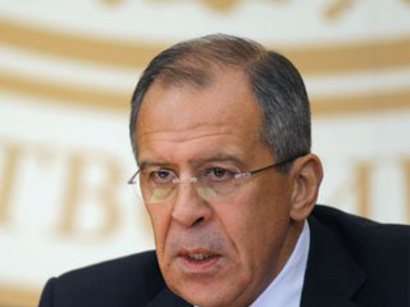
It is necessary to stop the ceasefire violation in the Nagorno-Karabakh conflict, Russian Foreign Minister Sergey Lavrov said during the joint press conference with Moldova’s foreign minister.
No difficulties should be created in renewing the efforts for the peaceful settlement of the conflict, he added.
Lavrov said that he and Russia’s Defense Minister Sergei Shoigu
contacted their Azerbaijani counterparts and expressed concern over
the situation and urged for the immediate ceasefire.
“In contact with Baku and Yerevan, we continue to ensure that
signals are heard from the US, Russia and France, which are
co-chairs of the OSCE Minsk Group,” said the minister.
Lavrov said that the OSCE Minsk Group has made a statement similar
to that of Russia.
“OSCE Minsk Group is a sufficiently great mechanism and it has set
the principles which should be the basis for the final settlement
of the conflict,” Russia’s foreign minister said. “A more compact
mechanism is needed for practical work and OSCE Minsk Group
co-chairs are such a mechanism which works through its official
representatives together with the OSCE special
representatives.”
“OSCE Minsk Group co-chairs are in permanent contact with the
conflicting sides, they come to Baku and Yerevan, visit the contact
line,” he said. “OSCE Minsk Group is the most important mechanism
for resolving the Nagorno-Karabakh conflict and this mechanism
should be fully supported.”
The progress achieved by the OSCE Minsk Group in contacts with the
conflicting sides is of great importance, according to Lavrov.
The documents, as well as those signed by heads of the OSCE Minsk
Group countries, envisage the peaceful political settlement of the
Nagorno-Karabakh conflict based on the principles of the Helsinki
Final Act in all their totality, he added.
On the night of Apr. 2, all the frontier positions of Azerbaijan
were subjected to heavy fire from Armenians, who were using
large-caliber weapons, mortars, grenade launchers and guns.
Azerbaijani settlements near the frontline densely populated by
civilians were shelled as well.
A counter-attack was carried out following the provocations of the
Armenian armed forces on the night of Apr. 2.
Six Armenian tanks, 15 gun mounts and reinforced engineering
structures were destroyed and more than 100 servicemen of the
Armenian armed forces were wounded and killed during the
shootouts.
Twelve servicemen of the Azerbaijani armed forces heroically died,
one Mi-24 helicopter was shot down and one tank was damaged on a
mine.
Three more soldiers of Azerbaijan were killed during the past day
and night as a result of the ceasefire violation.
On Apr. 4, Azerbaijani armed forces destroyed three tanks and
eliminated around 30 servicemen of the Armenian armed forces.
The conflict between the two South Caucasus countries began in 1988
when Armenia made territorial claims against Azerbaijan. As a
result of the ensuing war, in 1992 Armenian armed forces occupied
20 percent of Azerbaijan, including the Nagorno-Karabakh region and
seven surrounding districts.
The two countries signed a ceasefire agreement in 1994. The
co-chairs of the OSCE Minsk Group, Russia, France and the US are
currently holding peace negotiations.
Armenia has not yet implemented the UN Security Council's four
resolutions on withdrawal of its armed forces from the
Nagorno-Karabakh and the surrounding districts.
--
Follow us on Twitter @AzerNewsAz
Here we are to serve you with news right now. It does not cost much, but worth your attention.
Choose to support open, independent, quality journalism and subscribe on a monthly basis.
By subscribing to our online newspaper, you can have full digital access to all news, analysis, and much more.
You can also follow AzerNEWS on Twitter @AzerNewsAz or Facebook @AzerNewsNewspaper
Thank you!