
Aliyev: Azerbaijan, Armenia only parties to conflict
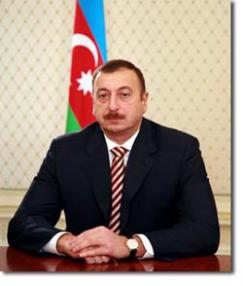
Azerbaijani President Ilham Aliyev described as a
positive step the signing of a declaration on the Upper (Nagorno)
Garabagh conflict with the Armenian and Russian leaders in Moscow
on November 2.
Aliyev emphasized that the document accurately sets out the steps
needed to reach a settlement to the dispute.
"These are the norms and principles of international law, and the
resolutions and decisions adopted in this framework. This
declaration, itself, is an important political document that
determines ways of settlement referring to the very decisions of
international organizations," Aliyev said while hosting
participants of the international roundtable entitled "Azerbaijan
in the 21st century - the strategy of success," held in Baku last
week.
He noted that the declaration cites guarantees that are to be
provided during the various stages in resolving the conflict. This
envisions a stage-by-stage settlement process, which Azerbaijan has
always insisted upon.
"Certainly, it is also an important factor that Armenia and
Azerbaijan, which signed the declaration, are parties to the
conflict. There are no other parties to this conflict. This has
always been obvious and now this has been confirmed by the Armenian
leader`s signature."
The self-proclaimed Upper Garabagh republic is seeking
participation in peace talks as a party, a claim repeatedly
dismissed by Baku as a blatant contradiction to international law.
Azerbaijani officials have, on many occasions, made it clear that
preserving the country`s territorial integrity is mandatory in
reaching a solution to the Garabagh problem.
The declaration, signed following the Russia-brokered November
meeting, urges further OSCE-mediated dialog between the Azerbaijani
and Armenian governments. The sides were also urged to continue in
joint efforts to bolster stability in the South Caucasus through a
political settlement of the conflict based upon the principles of
international law and earlier documents. It is the first time in
nearly 15 years that such a document has been signed.
Nonetheless, the Azerbaijani leader said adopting the declaration
was not, in itself, enough to reach a solution to the long-standing
Garabagh dispute.
"In order to reach the correct decisions, such as to withdraw from
the territories that never belonged, do not and will never belong
to Armenia, to end the occupation, and to pursue a policy
consistent with international norms, and, simply, with
international rules of conduct, first of all, political will of the
Armenian side is necessary. Then it would be possible to achieve
peace in the Caucasus much sooner."
Azerbaijan and Armenia have been locked in conflict for over a
decade. Peace talks began in 1994 after a lengthy war that ended
with the signing of a cease-fire but have brought few tangible
results. Armenia continues to occupy Upper Garabagh and seven other
Azerbaijani districts in defiance of international law.
Vasiliy Istratov, the Russian Ambassador in Baku, did not rule out
the self-styled republic`s joining peace talks in the future. He
said that although the Moscow declaration contains no relevant
clauses, "it does not say that this will never happen, either."
Commenting on Armenian President Serzh Sarkisian`s recent statement
to that end, Istratov told reporters that the regime`s
participation "was an affair of the future."
The ambassador noted that the Moscow declaration touched on
all-important issues regarding ending the conflict.
"It outlines ways of settling the conflict. Azerbaijan and Armenia
are cited in the document as parties in negotiations, and the sides
co-signed this. As for Sarkisian`s statement, it should be merely
treated as such as it has no legal force."
Garabagh status
Matthew Bryza, the US co-chair of the OSCE Minsk Group (MG)
brokering the peace process, has said holding a referendum to
determine the status of Upper Garabagh was on the negotiating
table.
"Holding a referendum in the future, as well as developing a
mechanism for this process and its participants, is a subject of
talks," Bryza told Radio Liberty`s Russian bureau.
According to Bryza, the fact that Russia was the only MG
co-chairing state that co-signed the November 2 declaration
demonstrates that Russian President Dmitry Medvedev had sought to
bolster his country`s influence in the settlement of conflicts in
the turbulent South Caucasus region.
Asked whether the Armenian president was facing US pressure
regarding the Garabagh settlement, Bryza said that "Armenians,
themselves, should answer that question."
Here we are to serve you with news right now. It does not cost much, but worth your attention.
Choose to support open, independent, quality journalism and subscribe on a monthly basis.
By subscribing to our online newspaper, you can have full digital access to all news, analysis, and much more.
You can also follow AzerNEWS on Twitter @AzerNewsAz or Facebook @AzerNewsNewspaper
Thank you!