
Japanese community informed about Nagorno-Karabakh conflict
By Sara Rajabova
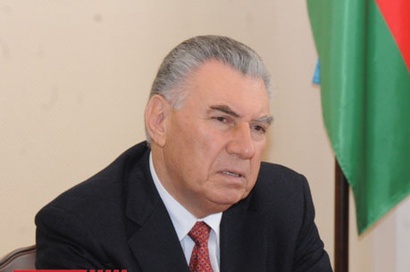
Azerbaijan's Deputy Prime Minister Ali Hasanov informed the Japanese community about the Nagorno-Karabakh conflict, its history and the plight of refugees and IDPs.
Hasanov, who is also the Chairman of the State Committee on Refugee and IDP Affairs, noted in an interview with Japan`s TV Tokyo channel that Azerbaijanis have been facing deportations and ethnic cleansing during the last 200 years.
"Armenia was created at the expense of the original Azerbaijani lands. The ancient Azerbaijani city of Irevan is now the capital of Armenia," Hasanov said.
He pointed out that the Armenian aggression resulted in the occupation of 20 percent of Azerbaijani lands, displacement of over one million people and destruction of different infrastructures.
Hasanov underlined that the UN Security Council adopted four resolutions calling for the withdrawal of Armenian troops and return of IDPs to their homes but they have not been enforced to this day.
He said Armenia's aggressive policy was condemned by the Organization for Security and Cooperation in Europe (OSCE), Parliamentary Assembly of the Council of Europe, Organization of Islamic Cooperation and other international organizations. Hasanov added however, these decisions and resolutions have not yet been implemented. He also noted that the OSCE-mediated peace talks have not produced any positive results over the past 20 years.
He also spoke about the Khojaly genocide committed by the Armenian armed forces in early 1990s.
On February 25-26 in 1992, the town of Khojaly, the second largest town in the Nagorno-Karabakh region of Azerbaijan, came under intense fire from the towns of Khankendi and Askeran already occupied by the Armenian armed forces. 613 civilians mostly women and children were killed in the massacre, and a total of 1,000 people were disabled. Eight families were exterminated, 25 children lost both parents, and 130 children lost one parent.
Moreover, 1,275 innocent people were taken hostage, and the fate of 150 of them remains unknown. Civilians were shot at close range, scalped, and burned alive. Some had their eyes gouged out and others were beheaded.
A number of countries have already recognized this brutal act as genocide.
Hasanov further said Armenian armed forces are seeking to exacerbate the situation on the frontline and its reconnaissance groups raiding some Azerbaijani positions.
The reconnaissance and sabotage groups of Armenia attacked the positions of Azerbaijani armed forces late July and in early August.
Over the last several days, Azerbaijani positions have come under attack constantly. At least 13 servicemen have been killed and several others wounded. Despite what is said by Armenian sources, they suffered more losses.
Touching upon the Japan-Azerbaijan relations, Hasanov said there are good ties between the countries and reciprocal visits play an important role in expanding these relations.
He said a number of Japanese humanitarian organizations, in particular Fuji Optical, have successfully implemented their projects in Azerbaijan.
Several months ago, Fuji Optical completed its optometric services to IDPs, refugees, and vulnerable people in Azerbaijan for 2014.
The mission provides free eye-screening services and conducts eye glasses distribution to persons of concern to UNHCR, e.g. refugees, internally displaced persons and other vulnerable people.
Here we are to serve you with news right now. It does not cost much, but worth your attention.
Choose to support open, independent, quality journalism and subscribe on a monthly basis.
By subscribing to our online newspaper, you can have full digital access to all news, analysis, and much more.
You can also follow AzerNEWS on Twitter @AzerNewsAz or Facebook @AzerNewsNewspaper
Thank you!