
OSCE envoy: Airport opening in Nagorno-Karabakh to harm peace talks
By Sara Rajabova
The news about the opening of international airports in the self-proclaimed Nagorno-Karabakh republic run by ethnic Armenians in the occupied Azerbaijani territories have provoked a diplomatic furore, posing a threat to the already fragile ceasefire that has been in place between Armenia and Azerbaijan since 1994.
The Organization for Security and Cooperation in Europe (OSCE), whose Minsk Group is brokering the process of settling the long-standing Nagorno-Karabakh conflict, warned that flights to and from the territory, internationally recognized as part of Azerbaijan, may harm the ongoing peace talks.
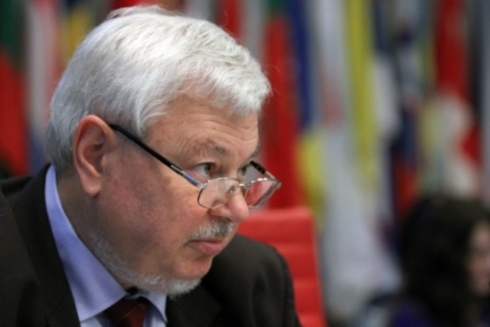
Recent commissioning of the airport in Khankandi, the center of the self-proclaimed republic, without mutual agreement of the conflict parties will harm the negotiations between Azerbaijan and Armenia, personal representative of the OSCE Chairman-in-Office, Andrzej Kasprzyk, said last Wednesday.
"The land that the Khankandi airport is located on is Azerbaijan's sovereign territory," Kasprzyk told media. "Therefore, in this respect, much depends on Azerbaijan's position."
Head of the self-proclaimed republic's civil aviation body, Valeri Adbashyan, announced launching the airport in Khankandi in the Armenian press on October 1.
The OSCE Minsk Group, established in 1992 and co-chaired by France, Russia and the United States, has been working to negotiate a peaceful resolution to the Karabakh conflict, which erupted in 1988. But the talks have largely stalled in recent years, calling into question the group's effectiveness.
The airport in Khankandi, which was built in 1974, has been inoperational since the early 1990s since war broke out between Armenia and Azerbaijan over Nagorno-Karabakh. Both Armenia's capital Yerevan, which has not recognized the "Nagorno-Karabakh Republic", and the self-proclaimed entity itself had repeatedly raised the issue of reopening the airport in recent years.
Armenian armed forces have occupied 20 percent of Azerbaijan's territory since the brutal war, including Nagorno-Karabakh and seven surrounding regions. Armenia has not yet implemented the U.N. Security Council's four resolutions on its withdrawal from the occupied Azerbaijani territories.
Azerbaijan has repeatedly condemned Armenia's illegitimate step to commission the Khankandi airport.
Azerbaijani Deputy Foreign Minister Araz Azimov said recently that the commissioning of the airport would be an open violation of the Convention on International Civil Aviation -- which was signed in Chicago in 1944. Therefore, Baku will "intensify work in the legal realm" to enforce the convention, Azimov told Trend news agency.
The head of Civil Aviation Administration, Arif Mammadov, said earlier that Azerbaijan had banned the use of airspace of the occupied Nagorno-Karabakh territory, as the security of flights over this territory cannot be guaranteed.
The International Civil Aviation Organization (ICAO) and the European Civil Aviation Conference (ICAC) support Baku's stance on the issue.
Besides, Armenia intends to commission an airport in Khojaly, a town in Nagorno-Karabakh, now under the control of the armed forces of the self-proclaimed republic, where Armenian armed forces committed genocide against civilians in 1992 during the war with Azerbaijan.
The Azerbaijani government strongly condemned the move as well. Foreign Ministry spokesman Elman Abdullayev earlier said the move is dangerous, violates international law and harms peaceful settlement of the Karabakh conflict. Abdullayev said all international companies operating in the Khojaly airport must immediately stop their illegal activities in the occupied territories of Azerbaijan, otherwise, Baku would take appropriate steps.
Some media reports said several international companies cooperating with the Armenian side are installing their equipment at the Khojaly airport, Abdullayev noted. He added that one of the companies is French-German joint venture Thales.
Thomas de Waal, an expert on the South Caucasus region at the Carnegie Endowment think-tank, in his earlier comments to Armenian media said the opening of the airport in Khankandi could heighten tension on the contact line of Azerbaijani and Armenian troops -- where deadly clashes frequently occur.
However, some experts say that the airport dispute is only part of the political brinksmanship both Baku and Yerevan have exhibited in recent months - and is not explicitly intended to rekindle the war, which left more than 30,000 dead in the early 1990s.
"Any decision to reopen the airport would be political, and obviously a calculated risk," said Lawrence Scott Sheets, South Caucasus project director for the International Crisis Group. "But neither side at this point wants to risk an all-out confrontation."
Here we are to serve you with news right now. It does not cost much, but worth your attention.
Choose to support open, independent, quality journalism and subscribe on a monthly basis.
By subscribing to our online newspaper, you can have full digital access to all news, analysis, and much more.
You can also follow AzerNEWS on Twitter @AzerNewsAz or Facebook @AzerNewsNewspaper
Thank you!