
Mud volcano eruptions, quake in Azerbaijan; experts see no link to Japan disaster
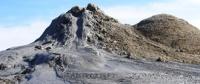
BAKU – A mud volcano near a village of the Gobustan district, 50 km away from the Azerbaijani capital, Baku, erupted on Sunday, the environment ministry said.
The eruption caused masses of lava to spill over, with the column of lava rising up to 3 meters. An explosion triggered 40-50 cm cracks in the soil, the ministry said.
The blaze caused by the eruption rose to 60-70 meters above ground, and the heat wave was felt as far as 3 km away.
The eruption has now stopped, but roaring gas excretions are being seen across the area and the blaze is up to 2 meters high, a source at the Ministry of Ecology and Natural Resources said.
Since the volcano is just 600-700 meters away from residential houses, the government agencies in charge are monitoring the area.
The mud volcano, called Shikhzayirli, which erupts once in six to seven years, last erupted in 2005, but this time its activity was accompanied by a more powerful explosion.
Eruptions are also being observed at two other mud volcanoes, located in the Alat settlement, 80 km south of Baku, the environment ministry said.
There are over 1,000 mud volcanoes in 36 countries of the world, with more than 300 of them located in Azerbaijan.
On Monday, four minor earthquakes occurred in Azerbaijan. The tremors, reported close to the town of Shirvan, 150 km away from Baku, had a magnitude of up to 3.5 points. No casualties are reported.
Gurban Yetirmishli, head of Azerbaijan’s seismology center, did not rule out that the quakes could be linked to Sunday’s volcano eruptions.
"There is a distance of 35-40 km between those territories. In principle, there is a link between mud volcanoes and earthquakes. Following the quakes that hit Japan, scores of volcanoes erupted in the Pacific Ocean. Volcanoes may erupt before and after quakes."
Yetirmishli said four quakes occuring in Shirvan was not that scary. "Such small tremors taking place is actually good, as it prevents more powerful ones."
Tahir Mammadli, the seismology center’s senior researcher, said that the tremors registered in Azerbaijan are not linked to the devastating quake that has jolted Japan or the subsequent shift of the axis around which the Earth rotates.
According to Italy's National Institute of Geophysics and Volcanology, the 9.0 magnitude quake that struck Japan last Friday was so powerful that it shifted the Earth’s axis by 25cm.
According to Mammadli, since Azerbaijan and Japan are located in different seismic zones, the quake that occured in the Far East country has no bearing on the tremors reported in the South Caucasus republic.
Mammadli added that 800 to 900 such slight tremors occur in Azerbaijan’s territory every year.
Here we are to serve you with news right now. It does not cost much, but worth your attention.
Choose to support open, independent, quality journalism and subscribe on a monthly basis.
By subscribing to our online newspaper, you can have full digital access to all news, analysis, and much more.
You can also follow AzerNEWS on Twitter @AzerNewsAz or Facebook @AzerNewsNewspaper
Thank you!